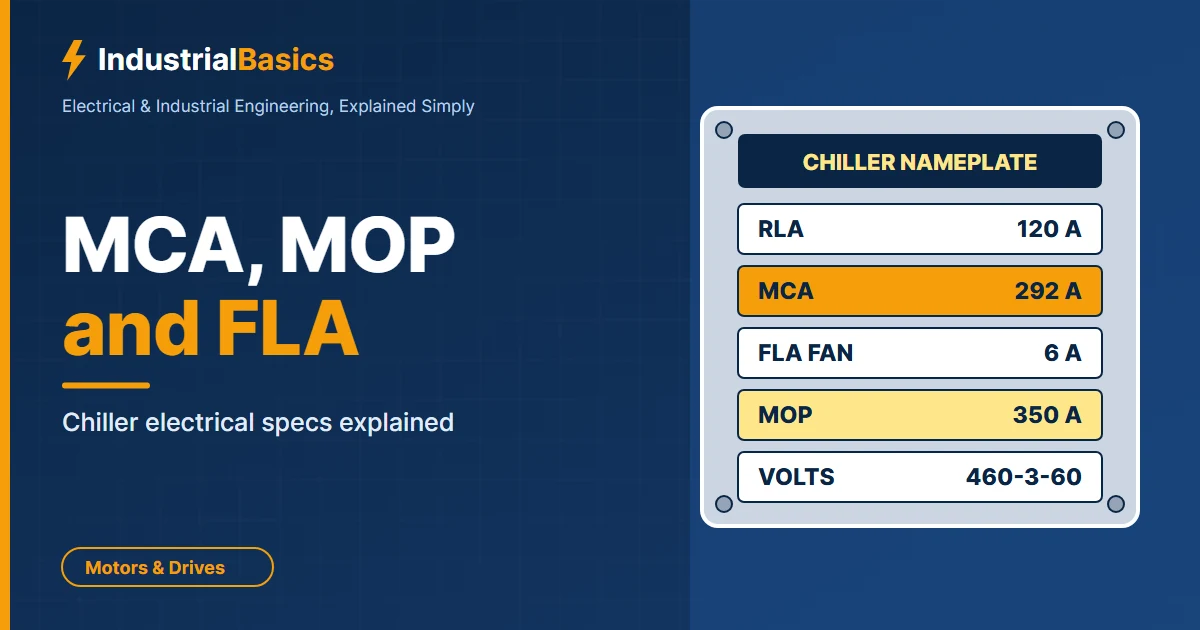
In electrical work, MCA means Minimum Circuit Ampacity: the lowest ampacity the supply conductors must have. On a chiller or HVAC nameplate, use MCA to choose the wire and MOP (Maximum Overcurrent Protection) to limit the breaker or fuse. FLA is a motor’s full-load current, and RLA is a compressor’s rated-load current. If the nameplate prints MCA and MOP, those values govern.
| Term | Meaning | Used for |
|---|---|---|
| MCA | Minimum Circuit Ampacity | Minimum wire ampacity |
| MOP / MOCP | Maximum Overcurrent Protection | Largest breaker or fuse |
| RLA | Rated Load Amps | Compressor current |
| FLA | Full Load Amps | Fans and other motors |
| LRA | Locked Rotor Amps | Starting current with the rotor stationary |
MCA and MOP Check Calculator
Use this to check a value or understand a label. It does not replace the equipment nameplate.
How to Read a Chiller Nameplate
A chiller has several motors, so its supply cannot be sized from one number. The manufacturer combines those loads and prints the circuit requirements. The two values an installer usually needs are MCA and MOP.
- Choose a conductor with ampacity at or above MCA.
- Choose a breaker or fuse that does not exceed MOP.
- Follow any device marking, such as Max Fuse or HACR Breaker.
- Confirm the voltage, phase and frequency.
For more on motor current, read our guide to full load, running and starting amps. Wire capacity is covered in our AWG ampacity chart.
MCA vs FLA vs RLA
RLA and FLA describe the current of individual motors. MCA describes the whole circuit. A common mistake is adding every motor’s current and treating that total as the wire size. That leaves out the extra margin on the largest compressor.
How MCA Is Calculated
This follows the NEC Article 440 approach described by the sources below. For a unit with a 20 A compressor and a 2 A fan:
How MOP Is Calculated
The protective device must let the compressor start but still clear a short circuit or ground fault. The sources describe a base of 175%, with a ceiling of 225% only where a device at 175% will not carry the starting current.
MOP ceiling = 2.25 × largest RLA + other loads
Worked Examples
| Equipment | Largest RLA | Other loads | MCA | MOP base (175%) | MOP ceiling (225%) |
|---|---|---|---|---|---|
| Small condensing unit | 24 A | 0 A | 30 A | 42 A | 54 A |
| Packaged unit | 20 A | 2 A | 27 A | 37 A | 47 A |
| Illustrative two-compressor chiller | 120 A | 142 A | 292 A | 352 A | 412 A |
In the chiller example, “other loads” are the second 120 A compressor, three 6 A fans and 4 A of controls: 120 + 18 + 4 = 142 A. Only the single largest compressor gets the 125%, 175% or 225% multiplier.
Common Mistakes
| Mistake | Why it matters | Correct approach |
|---|---|---|
| Sizing wire from RLA | Ignores the required margin | Use MCA |
| Sizing breaker from MCA | May nuisance-trip on start | Follow MOP and the marking |
| Exceeding MOP | Equipment may not be protected | Never exceed the nameplate |
| Using a breaker on a Max Fuse label | Breaks the listing | Use the marked device type |
| Recalculating over the nameplate | Tested values govern | Use the printed MCA and MOP |
Protective devices are compared in our guides to fuses vs circuit breakers and types of circuit breakers. Motor overload protection is covered in our thermal overload relay guide.
Frequently Asked Questions
What does MCA mean in electrical?
MCA means Minimum Circuit Ampacity. It is the lowest ampacity the supply conductors must have for the equipment.
What is the difference between MCA and FLA?
FLA is the full-load current of a motor, such as a fan. MCA is a calculated circuit value that includes a margin on the largest compressor and adds the other loads.
What does MOP mean on a nameplate?
MOP means Maximum Overcurrent Protection. It is the largest breaker or fuse allowed. It is also written as MOCP or Max Fuse.
Do I size the wire from MCA or MOP?
Size the wire from MCA. Size the breaker or fuse so it does not exceed MOP.
Why can the breaker be larger than the wire ampacity?
Motor and compressor circuits draw high starting current. Article 440 allows the short-circuit and ground-fault device to be larger because overload protection is provided separately.
How is MCA calculated?
MCA is 125% of the largest compressor RLA plus 100% of the other loads. If the nameplate prints MCA, use the nameplate value.
Can I use a breaker on a Max Fuse nameplate?
If the label says Max Fuse, use fuses of the required rating. A breaker is only suitable if the nameplate allows it, such as a Max Fuse or HACR Breaker marking.
What is RLA?
RLA is the compressor’s rated-load current. It is taken from the equipment nameplate and is used in the MCA and MOP calculations.
Sources and Further Reading
- Electrical Toolbox: MCA and MOCP Calculator: Article 440 percentages and nameplate priority.
- BuildCalc: MCA and MOCP Sizing Guide: MCA, MOCP base and ceiling.
- VoltageLab: HVAC and Heat Pump Circuit Calculator: formulas and device markings.