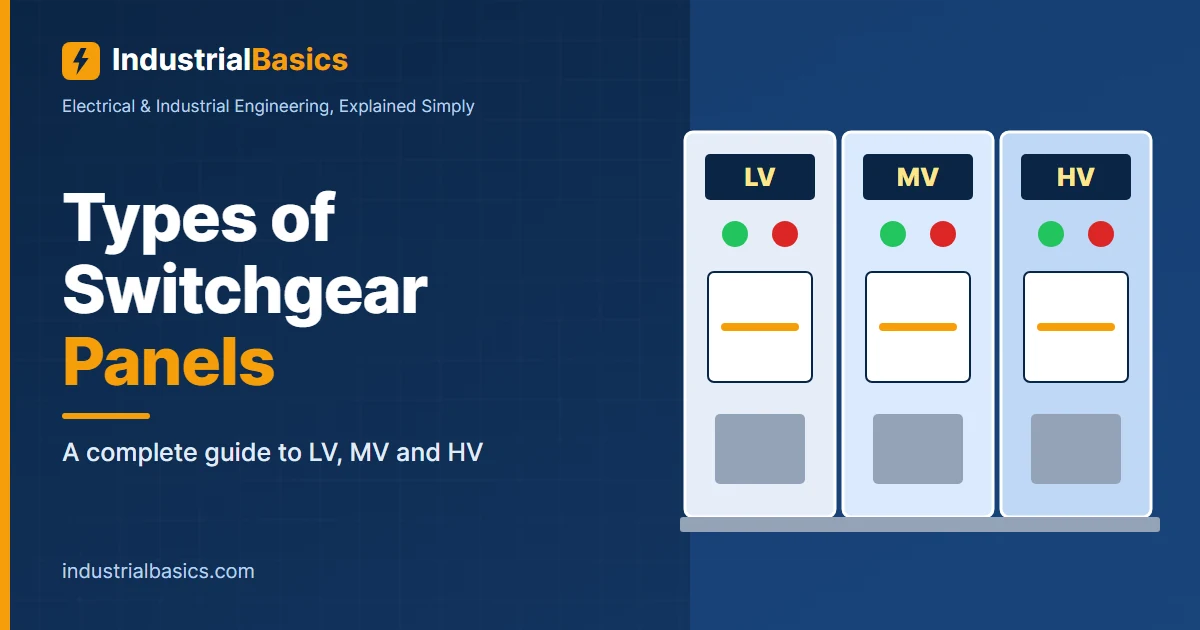
Switchgear panels are classified in five main ways: by voltage (low, medium and high), by insulation (air, gas, solid or SF6-free), by construction (metal-enclosed, metal-clad, fixed or withdrawable), by installation (indoor, outdoor or pad-mounted) and by function (PCC, MCC, APFC, ATS and more). Voltage is the best place to start, because it decides the safety rules, the size and the design of the panel.
Quick answer: the main types of switchgear panels
- By voltage: LV (up to 1 kV), MV (above 1 kV to 52 kV), HV (above 52 kV)
- By insulation: AIS, GIS, solid-insulated, hybrid, SF6-free
- By construction: metal-enclosed, metal-clad, fixed, withdrawable (plus Forms 1 to 4 in LV)
- By installation: indoor, outdoor, pad-mounted, pole-mounted, kiosk
- By function: PCC, MCC, PMCC, MDB, SDB, FDB, APFC, ATS, AMF, DG synchronising, VFD, soft starter, protection and RTU/SCADA panels
If you are new to the topic, our guide on what is switchgear covers the basics. This guide goes further and shows how each type differs, where it is used and how to tell them apart. It uses IEC terms as the base, with short notes for the UK, India and the US.
What Is a Switchgear Panel?
A switchgear panel is a metal enclosure that holds the equipment used to switch, protect, control and isolate an electrical circuit. It sits between the power source and the loads, and it does three jobs:
- Switching: connecting and disconnecting circuits in normal service.
- Protection: detecting overloads and short circuits and tripping the faulty circuit.
- Isolation: making a circuit safe to work on by separating it from the supply.
Without a panel, a single fault could damage a transformer, a motor or the whole plant, and it could injure people nearby. The panel limits the fault to one circuit and keeps the rest running.
How Does a Switchgear Panel Work?
- Normal running: current flows from the incomer through the busbars and breakers to the loads.
- Overload: current rises above the safe level. The protection device trips after a time delay.
- Short circuit: current rises very sharply. The relay sends a trip signal and the breaker opens within a fraction of a second.
- Isolation: the faulty circuit is separated, earthed if needed, and made safe to work on.
- Restoration: after the fault is cleared and checked, the breaker is closed and supply returns.
Main Components of a Switchgear Panel
| Component | What it does |
|---|---|
| Circuit breaker | Opens automatically on a fault and can be operated manually. See types of circuit breakers. |
| Busbars | Copper or aluminium bars that carry current between incomers and feeders. See what a busbar is. |
| Isolator / disconnector | Gives a visible or proven open gap for safe working. It is not meant to break load current. |
| Contactor | Switches motors and other loads often, using a control signal. |
| Protection relay | Senses faults and sends the trip signal. See types of protection relays. |
| CT and VT | Scale down current and voltage so relays and meters can read them safely. |
| Fuse | A one-time protective link. Our fuse vs circuit breaker guide explains when each is used. |
| Meters and indicators | Show voltage, current, power and energy, and the open or closed state. |
| Earthing switch | Connects a dead circuit to earth so that stored or induced charge cannot harm anyone. |
Switchgear vs Switchboard vs Control Gear vs Distribution Board
These words overlap, and they are used differently in different countries. The table gives the practical meaning of each.
| Term | Main purpose | Notes |
|---|---|---|
| Switchgear | Switching, protection and isolation | Used for LV, MV and HV. Often the term for heavy-duty, high fault level assemblies. |
| Switchboard | Power distribution and circuit control | Mostly an LV assembly. In the US it is a separate product class (UL 891). |
| Control gear | Control of motors and equipment | Contactors, starters and relays. IEC titles use the joint term “switchgear and controlgear”. |
| Distribution board | Splits a supply into smaller circuits | Usually wall-mounted or floor-standing. Common UK and Indian term. |
| Panelboard | Distribution of branch circuits | The US name for a distribution board. |
Regional note: in the UK and India, “switchgear panel” and “switchboard” are often used loosely for the same LV panel, and IEC 61439 covers both. In the US, the National Electrical Code and UL treat switchgear, switchboards and panelboards as separate products.
Metal-Clad vs Metal-Enclosed Switchgear
| Feature | Metal-enclosed | Metal-clad |
|---|---|---|
| Meaning | Live parts inside a metal housing | Metal-enclosed with earthed metal barriers between main compartments |
| Compartments | May be shared or separated | Breaker, busbar and cable compartments are separated |
| Breaker type | Fixed or withdrawable | Normally withdrawable, with shutters |
| Standards | IEC 62271-200, IEEE C37.20.3 | IEEE C37.20.2 (the term is mainly North American; IEC describes the same idea with LSC and partition classes) |
How Are Switchgear Panels Classified?
Each classification looks at a different feature of the same panel. A single panel can therefore be described in several ways, for example “an 11 kV, air-insulated, metal-clad, withdrawable, indoor VCB panel”.
| Classification | Main types |
|---|---|
| By voltage | LV, MV, HV |
| By insulation | AIS, GIS, solid-insulated, hybrid, SF6-free |
| By interrupting medium | Air, oil, SF6, vacuum |
| By construction | Metal-enclosed, metal-clad, fixed, withdrawable |
| By installation | Indoor, outdoor, pad-mounted, pole-mounted, kiosk |
| By function | PCC, MCC, PMCC, APFC, ATS, AMF, MDB, SDB, FDB and others |
| By operation | Manual, motorised, remote, smart |
Types of Switchgear Panels by Voltage Level
Voltage is the main classification, because it sets the insulation distances, the breaker technology and the safety rules.
1. Low Voltage (LV) Switchgear Panels
Low voltage switchgear works at up to 1 kV AC (1.5 kV DC) under IEC. Most plants and buildings use 415 V three-phase in India (400 V in the UK). LV panels hold ACBs, MCCBs, MCBs, contactors and busbars. For help choosing between breakers, see MCB vs MCCB vs ACB.
They are used in factories, commercial buildings, hospitals and data centres. Their strengths are low cost and easy maintenance. Their limit is that they cannot handle large power over long distances.
2. Medium Voltage (MV) Switchgear Panels
Medium voltage switchgear covers above 1 kV up to and including 52 kV in IEC 62271-200. Common network voltages are 11 kV, 22 kV and 33 kV in India and 11 kV and 33 kV in the UK. MV panels normally use vacuum circuit breakers, and they appear as AIS, GIS, solid-insulated or ring main unit designs.
They feed large motors, transformers and substations in industrial plants, renewable energy sites and utility distribution networks.
3. High Voltage (HV) Switchgear Panels
High voltage switchgear is used above 52 kV in the IEC equipment standards. It includes circuit breakers, disconnectors and earthing switches in transmission and sub-transmission substations (66 kV, 132 kV, 220 kV and 400 kV are typical in India; 132 kV, 275 kV and 400 kV in the UK). Outdoor AIS and compact GIS are both common. HV gear is a utility topic, so this guide does not go into its design.
Boundaries differ by region
IEC calls everything above 1 kV “high voltage” in some standard titles, and many manufacturers use different MV and HV limits. The IEEE C37.20.2 standard covers metal-clad switchgear from 4.76 kV to 48.3 kV. Indian rules may also use their own voltage bands, so always state the actual voltage and the standard, and check current CEA and BIS requirements for your project.
LV vs MV vs HV Switchgear: Key Differences
| Parameter | LV | MV | HV |
|---|---|---|---|
| Voltage (IEC) | Up to 1 kV AC | Above 1 kV to 52 kV | Above 52 kV |
| Typical systems | 415 V (India), 400 V (UK) | 11, 22, 33 kV | 66 kV to 400 kV and above |
| Main devices | ACB, MCCB, MCB, contactors | Vacuum, SF6 or SF6-free breakers, CT/VT, relays | Breakers, disconnectors, earthing switches |
| Insulation | Air | Air, gas, solid | Air or gas |
| Typical use | Buildings, factories, MCCs | Plant intake, RMUs, substations | Transmission substations |
| Main standards | IEC 61439; UL 891 and IEEE C37.20.1 (US) | IEC 62271-200; IEEE C37.20.2 | IEC 62271-203 and related parts |
Types of Switchgear Panels by Insulation Medium
Insulation medium is what keeps live parts apart from each other and from earth. It is not the same as the interrupting medium, which is covered in the next section.
1. Air-Insulated Switchgear (AIS)
AIS uses air at normal pressure. It is the most common type, it is easy to inspect and repair, and it costs less. It needs more floor space and is more affected by dust, humidity and pollution.
2. Gas-Insulated Switchgear (GIS)
GIS seals the live parts in gas-filled metal compartments, traditionally with SF6. This makes it very compact and well protected from the weather, which suits cities, offshore sites and polluted areas. Capital cost is higher, and it needs gas handling skills.
3. Solid-Insulated Switchgear (SIS)
Solid-insulated switchgear covers live parts with an epoxy or similar solid material, often with an earthed shield. It is compact, needs little maintenance and avoids SF6, so it is popular for MV distribution and renewable plants.
4. Hybrid Switchgear
Hybrid switchgear mixes AIS and GIS features, for example gas-insulated breakers with air-insulated busbars. It saves space compared with AIS at a lower cost than full GIS. There is no single IEC definition, so check what each manufacturer means.
5. SF6-Free Switchgear
SF6-free switchgear avoids SF6 by using clean air, vacuum interrupters with solid or clean-air insulation, or other gas mixtures. It is growing fast because of F-gas rules, which are covered later in this guide. It is not one technology, so ratings and performance vary.
AIS vs GIS vs Solid-Insulated vs SF6-Free Switchgear
| Feature | AIS | GIS | Solid-insulated | SF6-free |
|---|---|---|---|---|
| Insulation | Air | Gas (usually SF6) | Solid material | Clean air, vacuum or other gases |
| Size | Largest | Smallest | Compact | Compact to moderate |
| Space needed | High | Low | Low | Low to moderate |
| Maintenance | More access, more cleaning | Sealed, specialist service | Low | Low to moderate |
| Environmental impact | No insulation gas | High if SF6 leaks | No SF6 | Designed to avoid high-GWP gas |
| Initial cost | Lower | Higher | Moderate | Moderate to higher |
| Typical use | Industrial plants, substations | Cities, indoor and polluted sites | Distribution, renewables | New projects facing F-gas limits |
Types of Switchgear by Interrupting Medium
The interrupting medium is where the arc is put out when the breaker opens. A panel can be air-insulated and still use a vacuum breaker.
| Medium | How it works | Advantages | Limits | Typical use |
|---|---|---|---|---|
| Air | Arc is lengthened and cooled in chutes | Simple and familiar | Bulky at higher ratings | LV ACBs, some MV |
| Oil | Arc is cooled by oil | Proven in the past | Fire risk, upkeep, largely legacy | Old installations |
| SF6 | Gas absorbs electrons and quenches the arc | Compact and strong | Very high GWP, regulated | GIS, some MV and HV |
| Vacuum | Arc dies at current zero in a sealed bottle | Compact, long life, low upkeep | Rating and application limits | Most modern MV breakers, RMUs |
Types of Switchgear Panels by Construction and Design
1. Metal-Enclosed Switchgear
All live parts sit inside an earthed metal enclosure. It covers a wide range of designs, from simple cubicles to fully compartmented units.
2. Metal-Clad Switchgear
Metal-clad is a stricter form. Earthed metal barriers separate the breaker, busbars and cables, and the breaker is withdrawable with shutters. A fault in one compartment is less likely to spread.
3. Fixed-Type Switchgear
The breaker or switch is bolted in place. It is simpler and cheaper, but the circuit must be isolated before work, and replacement takes longer.
4. Withdrawable (Drawout) Switchgear
The breaker is mounted on a truck that rolls out of the panel. A spare can be fitted quickly, which cuts downtime.
Fixed vs Withdrawable Switchgear: Key Differences
| Factor | Fixed | Withdrawable |
|---|---|---|
| Maintenance | Needs the circuit to be isolated and the device worked on in place | Breaker is racked out, inspected or swapped |
| Service continuity | Lower | Higher |
| Safety | Depends on isolation procedures | Racking, shutters and interlocks help |
| Space | Smaller | Larger |
| Cost | Lower first cost | Higher first cost, less downtime |
| Best for | Simple, low-priority feeders | Critical feeders and plants that cannot stop for long |
What Are LSC Classes in Medium Voltage Switchgear?
Loss of Service Continuity (LSC) describes how much of the switchboard must be switched off when you open one compartment, as defined in IEC 62271-200.
- LSC1: other units, and usually the busbars, must be isolated when a compartment is opened.
- LSC2: other units and the busbars can stay live.
- LSC2A and LSC2B: LSC2B is the most demanding level, where the cable compartment is also kept separate.
What Are PM and PI Partition Classes?
Partitions and shutters between compartments are either PM (partition metallic, earthed metal) or PI (partition insulating, at least one non-metallic). PM gives a stronger barrier and matches the idea of metal-clad gear.
Forms of Separation in Low Voltage Switchgear Panels
IEC 61439 defines Forms 1 to 4 to show how far parts inside an LV panel are separated. More separation allows safer work on one section while others stay live, but it also adds size and cost.
| Form | What is separated | Maintenance value | Typical use |
|---|---|---|---|
| Form 1 | Nothing inside the enclosure | Whole panel is usually shut down | Small boards, low-cost distribution |
| Form 2 (2a, 2b) | Busbars from functional units | Units can be worked on with busbars screened | General distribution |
| Form 3 (3a, 3b) | Busbars from units, and units from each other | One unit can be isolated while others run | Industrial PCC and MCC |
| Form 4 (4a, 4b) | As Form 3, plus outgoing terminals | Highest level of safe access | Critical plants, data centres, process plants |
The letters refer to the terminals. In 2a and 3a, terminals are not separated from the busbars; in 2b and 3b they are. In Form 4a the terminals sit in the same compartment as their functional unit; in Form 4b they are in a separate space. The IEC document gives the exact rules, and the cost increases with each step, so choose by maintenance need rather than assuming Form 4 is always required.
Types of Switchgear Panels by Function and Application
This is how panels are most often named on site, especially in India. Each type does a specific job in the power system.
1. Power Control Centre (PCC) Panel
The PCC panel is the main LV panel after the transformer. It holds the incoming ACB, busbars, bus coupler, large feeder breakers, meters and protection relays. It serves factories, commercial complexes and utilities.
2. Motor Control Centre (MCC) Panel
An MCC panel groups motor starters in one line-up. Each unit has a breaker or fuse, a contactor, an overload relay and control wiring, and many are withdrawable. It suits pump houses, process plants and manufacturing floors.
3. Power and Motor Control Centre (PMCC) Panel
A PMCC combines PCC and MCC sections. It saves space and cabling when the same room has to supply feeders and motors.
4. Automatic Power Factor Correction (APFC) Panel
An APFC panel measures the power factor and switches capacitor stages in and out to hold it near the target. It cuts reactive power charges and losses, and it is usually next to the PCC. Reactors or filters are added where harmonics are present.
5. Main Distribution Board (MDB)
The MDB takes the main supply into a building or plant and divides it into major outgoing circuits.
6. Sub Distribution Board (SDB)
An SDB takes a feeder from the MDB and supplies a floor, a zone or a plant area.
7. Final Distribution Board (FDB)
An FDB supplies the final circuits, such as lighting and sockets, through MCBs and RCDs.
8. Automatic Transfer Switch (ATS) Panel
An ATS panel moves the load between two sources, such as the utility and a generator, using interlocked breakers or contactors. It is common in hospitals, data centres and critical buildings.
9. Automatic Mains Failure (AMF) Panel
An AMF panel watches the mains, starts the generator on failure, and then commands the changeover. It stops the generator after the mains return and a cooling period.
10. DG Synchronising Panel
This panel matches voltage, frequency and phase so that two or more generators, or a generator and the grid, can run in parallel and share load.
11. Variable Frequency Drive (VFD) Panel
A VFD panel varies the motor speed, which saves energy on pumps and fans. It contains the drive, input protection, filters and cooling.
12. Soft Starter Panel
A soft starter raises the motor voltage gradually to reduce starting current and mechanical shock. A bypass contactor is often added after starting.
13. Capacitor Bank Panel
A capacitor bank panel supplies reactive power through capacitors, contactors and fuses. It can be fixed or automatic, and it is the core of an APFC system.
14. Protection and Relay Panel
This panel holds the relays, CT and VT connections, test blocks and trip circuits that protect MV feeders, transformers and motors. It uses devices named by ANSI device numbers, and its settings need protection coordination and regular relay testing.
15. RTU and SCADA Panel
An RTU panel collects status and measurements from the field and sends them to a SCADA control room. It also receives remote commands. It is used in substations, utilities and automated plants.
16. Ring Main Unit (RMU)
An RMU is a compact MV unit, normally 11 kV or 33 kV, with two ring switches and a transformer protection switch (fuse or breaker). It lets a network be fed from either side of a ring. It is used in urban and campus distribution.
Comparison of Functional Switchgear Panels
| Panel | Main function | Voltage level | Typical application |
|---|---|---|---|
| PCC | Main power distribution | LV | Industrial plants, large buildings |
| MCC | Motor control | LV (some MV) | Manufacturing, pump houses |
| PMCC | Power and motor control | LV | Industrial facilities |
| APFC | Power factor correction | LV | Factories, commercial buildings |
| MDB / SDB / FDB | Main, sub and final distribution | LV | Buildings, floors, plant areas |
| ATS / AMF | Source transfer and generator start | LV (some MV) | Critical sites, generator systems |
| DG synchronising | Parallel generators | LV or MV | Captive power plants |
| VFD / Soft starter | Motor speed or soft start | LV or MV | Pumps, fans, compressors |
| Protection and relay | Protection and tripping | MV, HV | Substations, switchrooms |
| RTU / SCADA | Remote monitoring and control | Control level | Utilities, substations |
| RMU | Ring network distribution | MV | Urban and campus networks |
Types of Switchgear Panels by Installation Location
- Indoor: installed in a switchroom with controlled conditions. It is the standard choice for LV and most MV gear.
- Outdoor: weatherproof enclosure with higher protection against rain, dust and sun. Used at substations and remote sites.
- Pad-mounted: a tamper-resistant steel cabinet on a concrete pad, common in North American and UK underground networks.
- Pole-mounted: switches or reclosers on overhead lines, used on rural and overhead feeders in India.
- Kiosk or compact substation: a factory-built enclosure holding MV switchgear, a transformer and LV panel, used in cities and on industrial sites.
Types of Switchgear Panels by Operating Method
- Manual: operated by hand at the panel.
- Motorised: spring or motor mechanisms allow electrical closing and opening.
- Remote-controlled: operated from a control room using SCADA or an RTU, which keeps people away from the panel.
- Smart or digital: adds temperature, partial discharge and current sensors with communication, so maintenance can be planned from condition data instead of fixed intervals.
Important Ratings and Specifications of Switchgear Panels
| Rating | What it means | Why it matters |
|---|---|---|
| Rated voltage | Highest system voltage the panel is designed for | Sets insulation and clearances |
| Rated current | Continuous current the busbars and breakers can carry | Prevents overheating |
| Short-circuit breaking capacity | Highest fault current the breaker can interrupt | Must be above the site fault level |
| Short-time withstand current | Fault current the panel can carry for a set time, such as 1 s or 3 s | Lets upstream protection clear the fault |
| Frequency | Supply frequency, 50 Hz in India and the UK, 60 Hz in the US | Must match the system |
| IP rating | Protection against solids and water (IEC 60529) | Not a measure of arc protection |
| Internal arc classification (IAC) | Tested protection of people during an internal arc, for example IAC AFLR with a stated kA and duration | Defines how safe the panel front, sides and rear are |
Electrical Safety Features in Switchgear Panels
- Internal arc protection: reinforced enclosure and tested doors that keep the arc energy contained.
- Pressure relief: flaps or ducts that vent hot gases up or away from people.
- Earthing: a continuous earth bar and earthing switches so dead parts can be made safe.
- Interlocking: mechanical and electrical locks that stop unsafe operations, for example opening a door while the breaker is closed.
- Overcurrent protection: relays and breakers that clear faults quickly, which also limits arc energy.
- Arc detection and remote operation: light sensors trip the breaker in milliseconds, and remote racking keeps staff outside the arc zone.
IP rating is not arc protection
An IP rating only shows protection against dust, solids and water. A panel is arc-resistant only if it has a tested internal arc classification (IEC 62271-200 for MV; IEC 61641 and IEEE C37.20.7 are used for LV and North American arc-resistant testing).
SF6 Gas Phase-Out and the Future of Switchgear Panels
SF6 (sulphur hexafluoride) is a very good insulator and arc-quenching gas, so it made GIS and compact MV equipment possible. Its weakness is its climate impact. Under IPCC AR6 its 100-year global warming potential is 24,300, which means one kilogram traps as much heat as about 24 tonnes of CO2 over that period. Older assessments use 23,500 (AR5), so always state which edition you use.
EU SF6 Switchgear Regulation and Important Dates
Regulation (EU) 2024/573 limits F-gases in new switchgear in steps. These are EU rules. They do not automatically apply in India, the UK or the US, although manufacturers selling in several markets are following them. Read the full text on EUR-Lex for exact scope and exceptions.
| Date | Milestone |
|---|---|
| 1 January 2026 | Restrictions on specified MV switchgear up to 24 kV |
| 1 January 2028 | Restrictions on specified HV switchgear above 52 kV up to 145 kV (up to 50 kA) |
| 1 January 2030 | Restrictions on specified MV switchgear above 24 kV up to 52 kV |
| 1 January 2032 | Restrictions on specified HV switchgear above 145 kV or above 50 kA |
| 1 January 2035 | Limits on using SF6 for servicing, unless reclaimed or recycled, subject to exceptions |
What Are the Alternatives to SF6?
- Clean air: a nitrogen and oxygen mix with vacuum interrupters.
- Fluoroketone or fluoronitrile mixtures: blended with CO2 and oxygen, with far lower warming potential than SF6.
- Vacuum with solid insulation: no gas needed for insulation.
The industry is moving this way for MV first, with HV following. Ratings, size and cost vary between alternatives, so compare type-test reports rather than assuming equal performance.
How to Choose the Right Type of Switchgear Panel
Start with the voltage and the job, then narrow by space, safety and maintenance. These are learning factors, not a design instruction.
| Factor | What to check |
|---|---|
| 1. Voltage | System voltage and the LV, MV or HV class |
| 2. Load current | Continuous current and expected growth |
| 3. Fault level | Prospective short-circuit current and short-time withstand |
| 4. Application | Distribution, motors, generation, power quality or standby |
| 5. Location | Indoor or outdoor, altitude, temperature, pollution |
| 6. Space | Room size and access, which can favour GIS or solid insulation |
| 7. Safety | Arc classification, interlocks, earthing and form of separation |
| 8. Maintenance | Fixed or withdrawable, LSC class, and how often shutdowns are allowed. Good protection coordination limits the size of any outage. |
| 9. Environment | SF6 policy, local regulation and customer rules |
| 10. Standards and budget | IEC, IS, IEEE or UL requirements, and lifecycle cost |
Example of an Industrial Switchgear Distribution System
The diagram shows how the panels work together in a plant fed from a 33 kV supply. The MV switchgear receives and protects the incoming supply, the transformer steps it down to 415 V, the PCC distributes it, the MCC runs the motors, and the SDBs and FDBs serve the final loads.
Important International Standards for Switchgear Panels
| Standard | Main coverage | Edition noted |
|---|---|---|
| IEC 61439 series | LV switchgear and controlgear assemblies, including forms of separation | Parts 1 and 2: 2020 |
| IEC 62271-200 | AC metal-enclosed switchgear above 1 kV up to 52 kV | Edition 3.0 (2021) with Amendment 1 (2024) |
| IEC 62271-203 | Gas-insulated metal-enclosed switchgear above 52 kV | 2022 |
| IEC 61641 | Arc fault testing of LV assemblies | Check current edition |
| IEEE C37.20.1 | LV metal-enclosed power circuit breaker switchgear | 2015 |
| IEEE C37.20.2 | Metal-clad switchgear, 4.76 kV to 48.3 kV | 2025 |
| IEEE C37.20.3 | Metal-enclosed interrupter switchgear | 2023 |
| UL 891 / UL 1558 | US LV switchboards and metal-enclosed LV switchgear | Check current edition |
IEC vs IEEE: IEC standards are used in India, the UK and most of the world, and they describe panels through LSC classes, partition classes and forms of separation. IEEE and UL standards apply mainly in North America and use terms such as metal-clad and switchboard. Do not mix their definitions. For Indian projects, check the matching BIS (IS or IS/IEC) documents and the CEA regulations, as editions change. You can browse the IEC 62271-200 page and the IEEE C37.20.2 page for scope details.
Common Mistakes and Misconceptions About Switchgear Panels
- “Switchgear and switchboards are always the same.” They overlap in everyday use, but standards in some regions treat them as different products.
- “GIS never needs maintenance.” The gas compartments are sealed, but gas density, mechanisms and seals still need checks.
- “A high IP rating means arc protection.” IP covers dust and water. Arc safety needs a tested internal arc classification.
- “PCC and MCC do the same job.” A PCC distributes power; an MCC controls motors.
- “SF6-free is one technology.” It covers clean air, vacuum with solid insulation and alternative gases.
- “Fixed and withdrawable are interchangeable.” They differ in maintenance, safety, space and cost.
- Ignoring fault level. A panel must be rated above the site’s prospective short-circuit current.
Documenting a panel build? Our guide to electrical CAD software compares free and professional tools for schematics, terminal plans and bills of materials.
Frequently Asked Questions About Types of Switchgear Panels
1. What are the main types of switchgear panels?
Switchgear panels are grouped by voltage (low, medium and high), insulation (air, gas, solid or SF6-free), construction (metal-enclosed, metal-clad, fixed or withdrawable), installation (indoor or outdoor) and function (PCC, MCC, APFC, ATS and others).
2. How many types of switchgear are there?
There is no single fixed number, because the answer depends on the classification used. The three voltage classes are low voltage, medium voltage and high voltage. Within each class there are further types by insulation, construction and function.
3. What is the difference between LV, MV and HV switchgear?
Under IEC standards, LV is up to 1 kV AC, MV is above 1 kV up to 52 kV, and HV is above 52 kV. Higher voltage means larger clearances, stronger insulation and more demanding safety design.
4. What is the difference between PCC and MCC panels?
A PCC panel receives power from the transformer and distributes it to large feeders. An MCC panel groups the starters, protection and control gear for motors.
5. What is a PMCC panel?
A PMCC panel combines power distribution and motor control sections in one line-up. It suits plants where both functions are needed in the same room.
6. What is the difference between AIS and GIS switchgear?
AIS uses air as the main insulation and needs more space. GIS seals live parts in gas-filled compartments, so it is far more compact but costs more and needs specialist handling.
7. What is metal-clad switchgear?
Metal-clad switchgear has earthed metal barriers between its main compartments, usually with a withdrawable circuit breaker. This limits the spread of a fault and allows safer maintenance.
8. What is the difference between metal-clad and metal-enclosed switchgear?
Metal-enclosed is the wider term for gear inside a metal housing. Metal-clad is a more strictly compartmentalised type of metal-enclosed gear.
9. What is a withdrawable switchgear panel?
It is a panel in which the circuit breaker or switching unit sits on a truck or drawer and can be racked out of the circuit for maintenance or replacement.
10. What are Forms 1, 2, 3 and 4 in switchgear?
They are IEC 61439 levels of internal separation in LV panels. Form 1 has no separation. Form 2 separates busbars, Form 3 also separates functional units, and Form 4 also separates the outgoing terminals.
11. What is an APFC panel?
An APFC panel automatically switches capacitor stages in and out to keep the power factor close to the target value, which reduces reactive power charges and losses.
12. What is the purpose of an ATS panel?
An ATS panel automatically transfers the load from the normal supply to a standby source, such as a generator, when the normal supply fails, and back again when it returns.
13. What is an RMU in electrical distribution?
A ring main unit is a compact MV unit with load-break switches and fuse or breaker protection. It is used to connect transformers to a ring distribution network.
14. Why is SF6 gas used in switchgear?
SF6 is an excellent insulator and arc-quenching gas, so it allows very compact equipment. Its drawback is a very high global warming potential.
15. What is SF6-free switchgear?
It is switchgear that does not use SF6. It relies on alternatives such as clean air, vacuum with solid insulation, or other gas mixtures.
16. What is internal arc classification?
Internal arc classification (IAC) describes how well a panel protects people near it during an internal arc fault, as proven by a type test.
17. Which switchgear panel is used in industries?
Industries mainly use PCC, MCC and PMCC panels at low voltage, APFC and ATS or AMF panels for supporting functions, and metal-clad MV switchgear at medium voltage.
18. Which standard is used for LV and MV switchgear?
IEC 61439 covers LV switchgear and controlgear assemblies. IEC 62271-200 covers AC metal-enclosed switchgear above 1 kV and up to 52 kV. In India, check the matching IS or IS/IEC documents.
Conclusion
The main types of switchgear panels are LV, MV and HV by voltage, and each can be further described by insulation, construction, installation and function. Voltage comes first, and the other classifications refine the choice. In practice, an LV plant mostly uses PCC, MCC, APFC and distribution boards, while MV sites use metal-clad or compact switchgear with a growing shift to SF6-free designs.
Always confirm voltage, fault level, form of separation, arc classification and the applicable local standard before specifying a panel.
Disclaimer: This article is for general learning only. The selection, design, installation, operation and maintenance of switchgear must be carried out by qualified engineers following local codes, regulations and the manufacturer’s instructions. Examples are illustrative and contain no design ratings.