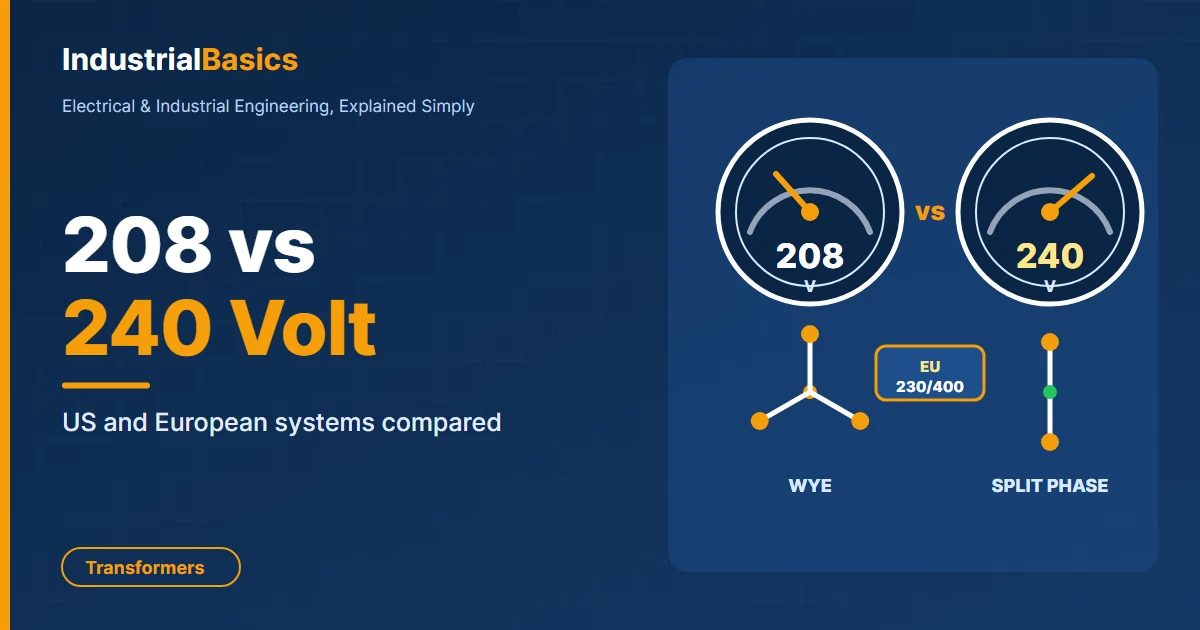
208 V and 240 V are not interchangeable. 208 V is the phase-to-phase voltage of a 120/208 V three-phase wye system, common in US commercial buildings. 240 V comes from 120/240 V single-phase service or a 240 V delta. 208 V is about 13% lower, so a 240 V heater loses about 25% of its output and a 230 V motor can end up below its tolerance. Europe uses 230/400 V at 50 Hz, a third design case.
| System | Phase to phase | Phase to neutral | Frequency | Where |
|---|---|---|---|---|
| 120/208 V wye | 208 V | 120 V | 60 Hz | US commercial and multi-family buildings |
| 120/240 V split phase | 240 V | 120 V | 60 Hz | US homes and small shops |
| 240/120 V four-wire delta | 240 V | 120 V on two legs | 60 Hz | Older US commercial and rural services |
| 277/480 V wye | 480 V | 277 V | 60 Hz | US industrial and large commercial |
| 230/400 V | 400 V | 230 V | 50 Hz | Europe and many other countries |
Where 208 V and 240 V Come From
Both systems give 120 V from any hot leg to neutral. The difference is the angle between the legs. In a wye system the three phases are 120 degrees apart, so the voltage between two of them is 120 × √3 = 207.8 V. In a split-phase system, the two halves of the transformer winding are 180 degrees apart, so they add to a full 240 V. Our guides to 208 V single phase and 3 phase calculations go deeper into the maths.
ANSI Voltage Ranges: 208 V vs 240 V
ANSI C84.1 sets two zones. Range A is the favourable zone where most voltages should sit. Range B is tolerable but should be corrected. The service voltage is measured at the utility connection, and the lower utilization voltage at the equipment allows for wiring voltage drop.
| Nominal system | Range A service | Range A utilization | Range B utilization |
|---|---|---|---|
| 208Y/120 V | 197 to 218 V | 187 to 218 V | 180 to 220 V |
| 120/240 V single phase | 228 to 252 V | 216 to 252 V | 208 to 254 V |
| 480Y/277 V | 456 to 504 V | 432 to 504 V | 416 to 508 V |
The two Range A utilization bands overlap only between 216 V and 218 V. That is the core design problem. A product marked “230 V” and tested at ±10% covers 207 to 253 V, which handles a 240 V system but misses the bottom of a 208 V system.
Designing a Product for Both
The DOE motor tip sheet lists the standard motor utilization voltages as 200 V for a 208 V service and 230 V for a 240 V service, about 4% below service voltage. It also describes tri-voltage motors rated 208-230/460 V, which are designed to produce rated torque at each voltage but will slip more and run hotter at 208 V. Some 230/460 V motors are marked “Usable on 208 Volts”.
- Use a wide-range rating such as 208-230 V or 200-240 V, and test at the bottom of the 208 V range as well as the top of the 240 V range.
- Resistive heaters: offer separate 208 V and 240 V elements, or rate the product’s output at both voltages on the nameplate.
- Motors: specify a 208-230 V or 200 V motor for 208 V buildings. The DOE notes torque falls with the square of the voltage ratio.
- Control transformers: choose one with a 208 V primary tap, or a multi-tap primary. A building fed from a delta-wye transformer will almost always be 120/208 V.
- Electronics and drives: check the input range covers 187 to 252 V, or offer two input options.
208 V vs 240 V Calculator
The default shows a 4,500 W, 240 V heater on 208 V. Output falls to about 3,380 W, and current also falls because resistance is fixed. Motors behave differently: they try to deliver the same power, so current rises at low voltage, which is why undervoltage overheats them. Size motor circuits from the nameplate, as explained in our guide to full load amps.
Worked Example: Heater Panel for Both Markets
A manufacturer builds a 6 kW three-phase heater panel for US buildings that may have either 208 V or 240 V.
| Case | Calculation | Result |
|---|---|---|
| 240 V elements on 240 V | Rated | 6.0 kW, 14.4 A per line |
| 240 V elements on 208 V | 6.0 × (208/240)² | 4.5 kW, 12.5 A per line |
| 240 V elements on 187 V (Range A low) | 6.0 × (187/240)² | 3.6 kW, 11.2 A per line |
| 208 V elements on 208 V | Rated | 6.0 kW, 16.7 A per line |
The 240 V design loses 25% of its heat on a 208 V building and 40% at the bottom of Range A. The fix is a separate 208 V element set, with conductors and protection sized for the higher 16.7 A current.
European 230/400 V Systems
The Electrical Installation Guide’s IEC 60038 table lists 230/400 V three-phase four-wire systems at 50 Hz and 60 Hz, and says 230/400 V evolved from older 220/380 V and 240/415 V systems, which still exist. Under normal conditions the supply should not differ from nominal by more than ±10%.
| Design point | US 208/240 V | Europe 230/400 V |
|---|---|---|
| Single-phase load voltage | 120 V, 208 V or 240 V | 230 V phase to neutral |
| Three-phase line voltage | 208 V, 240 V or 480 V | 400 V |
| Frequency | 60 Hz | 50 Hz |
| Motor synchronous speed, 4 pole | 1,800 RPM | 1,500 RPM |
The frequency change matters as much as the voltage. A 4-pole motor runs at about 1,500 RPM instead of 1,800 RPM on 50 Hz, so fans and pumps deliver less. See Hz and RPM for the speed relationship.
Frequently Asked Questions
What is the difference between 208 V and 240 V?
208 V is measured between two phases of a 120/208 V three-phase wye system. 240 V comes from a 120/240 V single-phase system or a 240 V delta. Both give 120 V to neutral, but 208 V is about 13% lower between hot legs.
Why is it 208 V and not 240 V in commercial buildings?
Because the phases of a wye system are 120 degrees apart, the voltage between two 120 V phases is 120 × √3, which is about 208 V.
Can I run a 240 V appliance on 208 V?
Only if the nameplate allows it, for example a 208-230 V or 208/240 V rating. A resistive heater will work but gives about 75% of its rated output.
How much less heat does a 240 V heater make on 208 V?
About 25% less. Output follows the square of voltage, so (208 ÷ 240)² is about 0.75.
Will a 230 V motor run on 208 V?
The DOE says motors are designed for ±10% of nameplate voltage, which for 230 V is 207 V. On a weak 208 V supply the voltage at the motor can fall below that. Look for a 208-230/460 V or “usable on 208 V” rating.
What is the ANSI range for a 208 V system?
For a 208Y/120 V system, Range A service voltage is 197 to 218 V, and Range A utilization voltage is 187 to 218 V, per the ANSI C84.1 tables reproduced by PacifiCorp.
What voltage is used in Europe?
230/400 V, three-phase four-wire, at 50 Hz. The Electrical Installation Guide says the supply should not differ from nominal by more than ±10% under normal conditions.
Why are motors rated 200 V and 230 V instead of 208 V and 240 V?
The DOE explains that motor utilization voltages are about 4% below the service voltages to allow for voltage drop between the transformer and the motor.
Sources and Further Reading
- PacifiCorp Engineering Handbook 1C.2.1: Voltage Level and Range (2024): ANSI C84.1 service and utilization ranges.
- U.S. DOE Motor Systems Tip Sheet #9: Improve Motor Operation at Off-Design Voltages: motor voltages, tolerance, torque.
- Schneider Electric Electrical Installation Guide: Definition of Voltage Ranges: IEC 60038 voltages and tolerance.