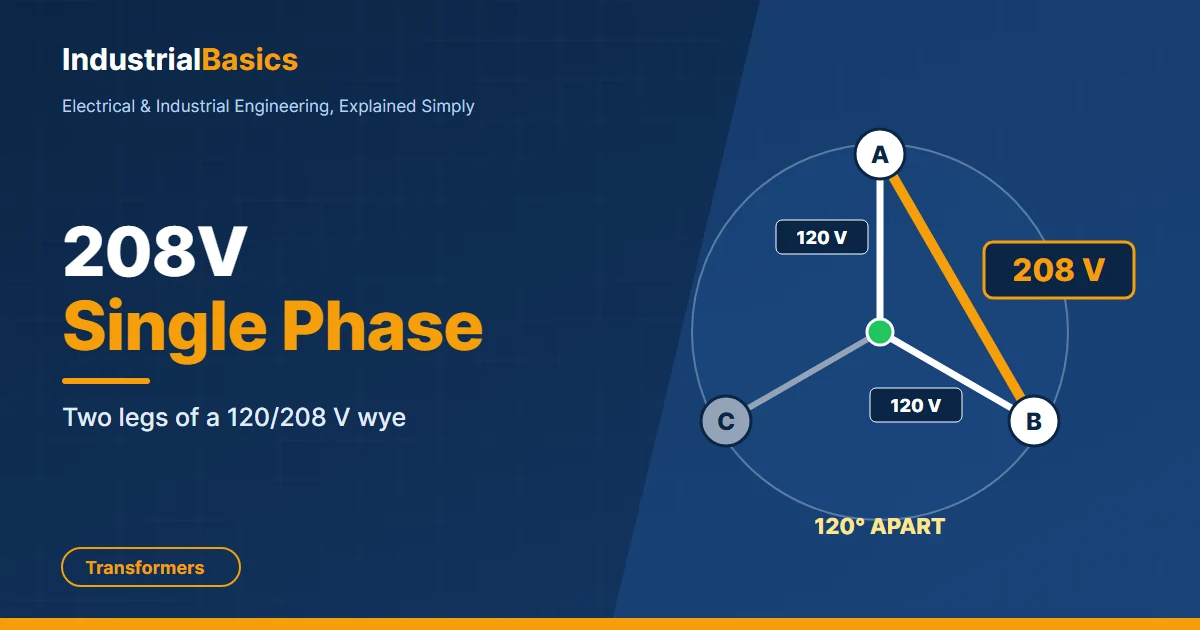
208V single phase comes from connecting a load across two legs of a three-phase 120/208 V wye system. Each leg is 120 V to neutral, but the legs are 120° apart, so the voltage between them is 120 × √3 ≈ 208 V. A straight 208 V load normally uses a two-pole breaker, two hot conductors and an equipment grounding conductor. It needs a neutral only if it also has 120 V circuits.
| Measurement on 120/208 V wye | Nominal voltage |
|---|---|
| A to neutral | 120 V |
| B to neutral | 120 V |
| C to neutral | 120 V |
| A to B | 208 V |
| B to C | 208 V |
| C to A | 208 V |
Why Two Legs Make 208 V
In a wye (star) connection, the three phase windings meet at a neutral point. Their voltages are 120° apart, so the voltage between any two legs is the phase voltage multiplied by √3.
A residential split-phase service is different. Its two 120 V legs come from a center-tapped winding and are 180° apart, so they add directly to 240 V. A 208 V supply cannot be turned into 240 V by changing the conductors. The source is usually the secondary of a delta-wye transformer.
How to Wire 208V Single Phase
| Part | Straight 208 V load | 208 V load with 120 V controls |
|---|---|---|
| Breaker | 2-pole | 2-pole |
| Hot conductors | 2 | 2 |
| Neutral | Not needed | Required |
| Equipment ground | Required | Required |
Size the conductors and protection for the load using the applicable code. Our guides to AWG wire ampacity, ground wire size and circuit breakers can help. Do not use white or gray conductors as the hot legs.
Calculating 208V Single-Phase Current
A load connected across two legs is still a single-phase load, so do not use the √3 factor.
| Load | Calculation | Current |
|---|---|---|
| 5 kW resistive | 5,000 ÷ 208 | 24.0 A |
| 3 kW resistive | 3,000 ÷ 208 | 14.4 A |
| 2 kW at 0.85 PF | 2,000 ÷ (208 × 0.85) | 11.3 A |
For loads connected across all three phases, use our electrical 3 phase calculations guide instead.
208 V vs 240 V Equipment
Always start with the nameplate. Equipment marked 208-230 V or 208/240 V is designed for the lower voltage. Equipment rated only for 240 V may underperform or fail to run correctly on 208 V.
| Nameplate voltage | 208 V as a share of nameplate | What it means |
|---|---|---|
| 200 V | 104.0% | Motor rating intended for 208 V systems |
| 208 V | 100% | Matched |
| 230 V | 90.4% | Close to a −10% limit, so little margin for voltage drop |
| 240 V | 86.7% | Below a −10% limit |
Worked example: 240 V heater on 208 V
A resistive heater has a fixed resistance, so power falls with the square of voltage. A 5,000 W, 240 V element has a resistance of 240² ÷ 5,000 = 11.52 Ω.
That is about 75% of rated output, at about 18.1 A. A water heater or oven with this element would still work, but it would heat more slowly. Check that the manufacturer allows operation at 208 V.
Balancing Single-Phase Loads
If every 208 V load is connected across A and B, those phases carry more current than C. Rotate circuits across A-B, B-C and C-A to spread the load. When three equal loads are connected this way, they form a balanced delta. Three 10 A loads draw 10 × 1.732 = 17.3 A in each line conductor.
If you are choosing equipment for either supply, see our comparison of 208 vs 240 volt systems, including ANSI ranges and heater output.
Frequently Asked Questions
Is 208V single phase or three phase?
A 208Y/120 V supply is three-phase. A load connected across only two of its legs is a single-phase 208 V load.
How do you get 208V single phase?
Connect the load between two phase conductors of a 120/208 V wye system, using a two-pole breaker.
Does 208V single phase need a neutral?
Not for a load that uses only 208 V. It needs two ungrounded conductors and an equipment grounding conductor. Add a neutral if the equipment has 120 V circuits.
Why is it 208 V and not 240 V?
The two 120 V legs are 120° apart, so the voltage between them is 120 × √3, or about 208 V. On a split-phase system they are 180° apart and add to 240 V.
Can I run 240 V equipment on 208 V?
Only if the nameplate or manufacturer allows it. Dual-rated 208-230 V equipment is designed for this. Equipment rated only for 240 V should be checked or re-specified.
How much power does a 240 V heater lose on 208 V?
A resistive heater produces about 75% of its rated power, because power varies with the square of voltage. A 5,000 W heater gives about 3,756 W.
What breaker is used for 208V single phase?
A two-pole breaker across the two legs. Size it for the load and conductors using the applicable code.
How do I balance 208V single-phase loads?
Spread them across the A-B, B-C and C-A leg pairs so each phase carries a similar current.
Sources and Further Reading
- ElectricalFlux: 208V Single Phase Wiring Explained: wiring and the 5 kW heater example.
- VoltageLab: 208 V vs 240 V: conductors, equipment and motor ratings.
- DEI Power: How to Wire a 120/208V 3-Phase Panel: breaker poles and phase balancing.