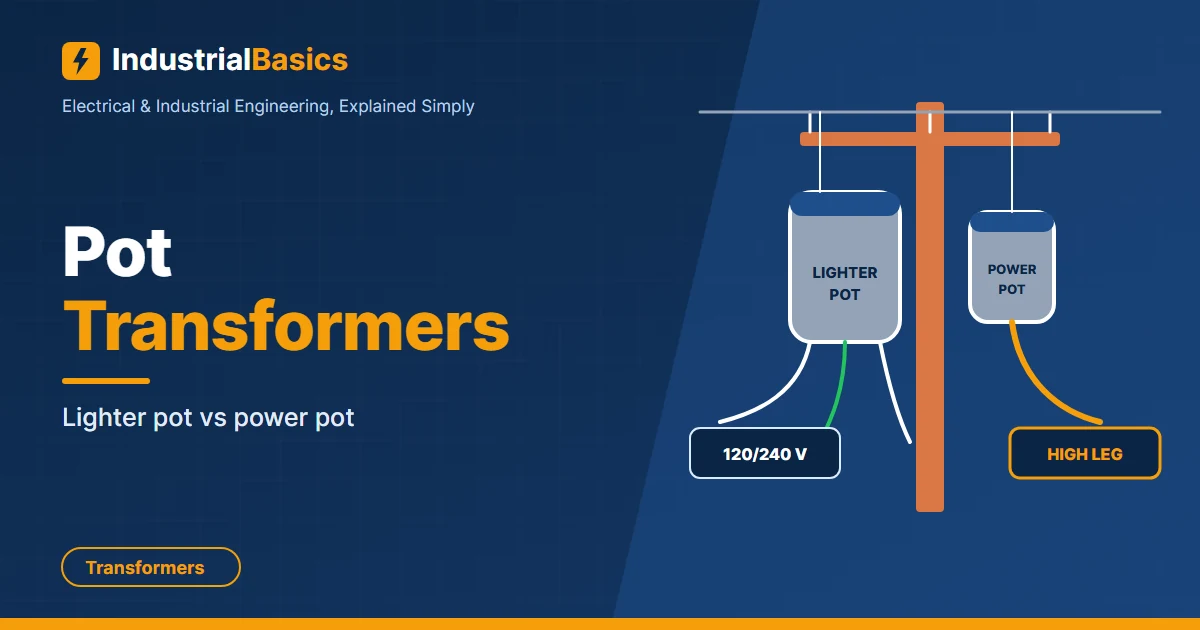
A “pot” is field slang for a pole-mounted distribution transformer. In a 240/120 V three-phase delta bank, the lighter pot is the larger, centre-tapped transformer that supplies 120/240 V lighting and receptacle loads plus part of the three-phase load. The smaller power pot (or pots) completes the third phase for motors. With two pots the bank is an open delta, which delivers only about 86.6% of the two units’ combined rating. The third phase, the high leg, is about 208 V to neutral and must never feed 120 V loads.
| Bank | Pots | Lighter pot role | Typical use |
|---|---|---|---|
| Closed 4-wire delta | 3: one lighter, two power | Centre-tapped, largest unit | Larger single and three-phase loads |
| Open 4-wire delta | 2: one lighter, one power | Centre-tapped, larger unit | Small three-phase load, or only two primary phases available |
| Single-phase service | 1 | The only unit | Homes and small shops, 120/240 V |
Lighter Pot vs Power Pot
A 240/120 V, 4-wire delta gives three things from one bank: 120 V and 240 V single phase, plus 240 V three phase. MSU’s tech note explains that this is done by connecting the transformers in delta “with a center-tap to one of the transformers”. That centre-tapped unit is the lighter pot.
Wikipedia’s high-leg delta article describes the open-delta version: one transformer is connected to one primary phase “to provide the lighting side of the circuit (this will be the larger of the two transformers)”, and the second is connected to another phase, with its free end brought out as the high leg. It also notes that where the single-phase load is much greater than the three-phase load, the bank shows two units sized significantly smaller than the third, centre-tapped one.
The High Leg
Because the neutral is taken from the middle of the lighter pot’s winding, the far end of the power pot sits at about 208 V to neutral. MSU calls it the phase with the higher voltage to ground, and warns: “Do not install any single-pole circuit breakers in the panel connected to the high leg.” A 120 V load on it would see about 208 V.
The NEC requires the high leg to be marked orange. MSU references Section 110.15 and says it is normally the B phase. CTL Systems notes that the 2008 NEC allows the high leg to be the C phase where metering is part of the switchboard or panelboard, with permanent field marking. CTL also gives the phase angles to neutral as 0°, 90° and 180°, rather than the 0°, 120° and 240° of a wye system.
Open Delta vs Closed Delta
MSU explains that any delta bank can run with one transformer removed, which lets a utility supply three-phase power “even when one of the phase conductors of the primary distribution system is not available”. Wikipedia notes that open delta is used where the three-phase load is small relative to the total load, at reduced cost, but with “reduced capacity relative to a full delta”.
The reduction follows from the geometry. In open delta, each unit carries the full line current but at a 30° displacement, so the two units deliver √3 × V × I of three-phase power from a combined rating of 2 × V × I. That is √3 ÷ 2 = 86.6% of their combined rating, or √3 ÷ 3 = 57.7% of what three identical units would deliver in closed delta.
Sizing the Pots
In an open-delta bank carrying a balanced three-phase load T (kVA), each unit carries a line current of T ÷ (√3 × 240 V), so each needs T ÷ √3 = 0.577 T of capacity. The lighter pot also carries the single-phase load S. Adding them directly gives a conservative estimate:
In a closed delta with equal-impedance units, each unit carries T ÷ 3 of the three-phase load, and a single-phase load across the lighter pot divides about two-thirds through it and one-third through the other two in series.
Worked Example
| Item | Open delta | Closed delta |
|---|---|---|
| Three-phase load T | 45 kVA | 45 kVA |
| Single-phase load S | 20 kVA | 20 kVA |
| Lighter pot | 0.577 × 45 + 20 = 46.0 kVA | 15 + 13.3 = 28.3 kVA |
| Power pot(s) | 0.577 × 45 = 26.0 kVA | 15 + 6.7 = 21.7 kVA each |
The open-delta lighter pot ends up much larger than its partner, which is exactly the pattern Wikipedia describes. If the three-phase load grows, adding a third pot to close the delta is a common upgrade path.
What This Means Inside the Building
- Panel layout: the high leg lands on B (or C where permitted) and is marked orange. No single-pole breakers on it.
- Motors: three-phase motors run at 240 V. Our 3 phase calculations guide covers current.
- Metering: CTL notes that meters on this system will read about 208 V on the high leg to neutral, which is normal.
- Single-phase transformers inside: for more 120 V capacity, a separate dry-type transformer fed from 240 V avoids overloading the lighter pot.
For the bigger picture, see power vs distribution transformers, types of transformers and corner grounded delta, another older delta arrangement.
Frequently Asked Questions
What is a pot transformer?
“Pot” is field slang for a pole-mounted distribution transformer, named after its can shape. In a three-phase bank, the lighter pot feeds lighting and 120 V loads, and the power pot or pots supply the extra phase for motors.
What is a lighter pot?
It is the centre-tapped transformer in a 240/120 V delta bank. Wikipedia’s high-leg delta article describes it as the transformer that provides the lighting side of the circuit, and the larger of the two in an open delta.
Why is the lighter pot bigger than the power pot?
It carries all of the 120/240 V single-phase load plus its share of the three-phase load. The power pot carries only three-phase load.
What is the high leg voltage?
About 208 V to neutral on a 240/120 V delta, while the other two phases are 120 V to neutral. MSU warns never to connect single-pole breakers to it.
What colour is the high leg?
Orange. MSU notes the NEC requires the high leg to be marked orange wherever it is visible, referencing Section 110.15, and it is usually the B phase. CTL notes the 2008 NEC allows the C phase where metering is part of the switchboard or panelboard.
How much power can an open-delta bank supply?
For balanced three-phase load, about 86.6% of the two units’ combined rating, or 57.7% of an equivalent three-unit bank.
Why do utilities use open delta?
MSU explains it lets the utility supply three-phase power when only two primary phase conductors are available, using two transformers instead of three.
Is a pot transformer the same as a potential transformer?
No. A potential transformer (PT) is an instrument transformer that steps voltage down for meters and relays. A “pot” in this sense is a distribution transformer that powers loads.
Sources and Further Reading
- Michigan State University: Electrical Tech Note 220, Three-Phase Electrical Systems: 4-wire delta, high leg, open delta.
- Continental Control Systems: Four-Wire Delta Service: high-leg names, 2008 NEC C-phase change, phase angles.
- Wikipedia: High-leg delta: lighting transformer role and open-delta use.
- Wikipedia: Distribution transformer: pole-mounted transformers.