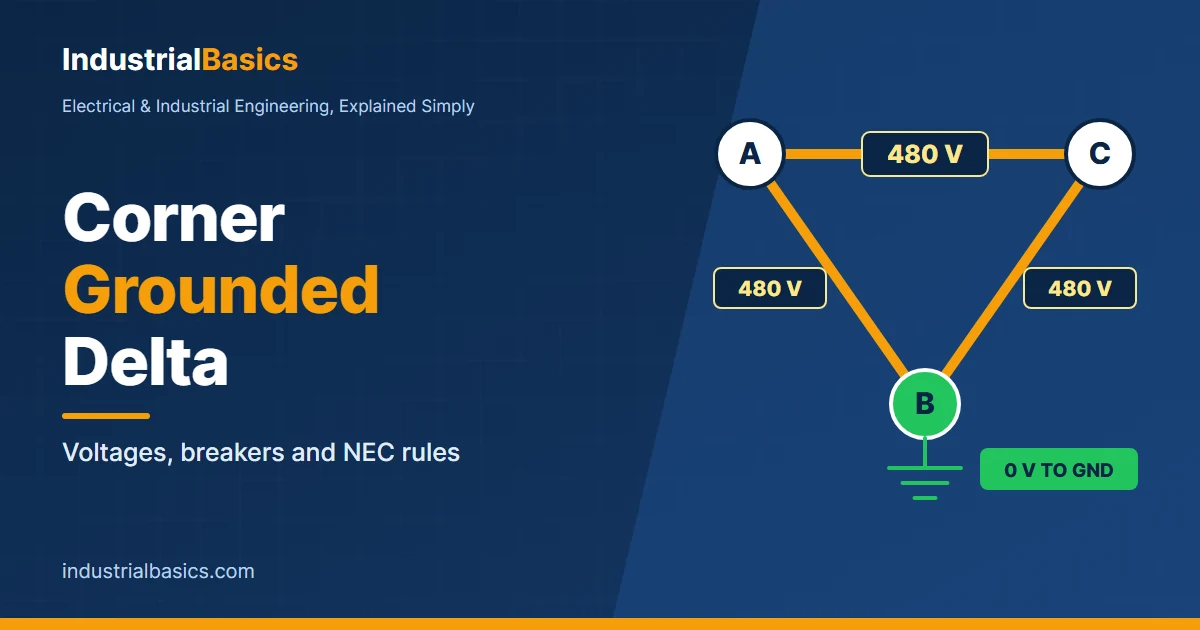
A corner grounded delta is a three-phase, three-wire system in which one corner of a delta transformer secondary is solidly grounded. On a 480 V system, the grounded phase (usually B) reads 0 V to ground, while the other two phases read the full 480 V to ground. Schneider Electric says these systems are not recommended for new installations, but many older services remain in use and they need correctly rated equipment.
| Measurement | 240 V system | 480 V system | 600 V system |
|---|---|---|---|
| Phase to phase (all pairs) | 240 V | 480 V | 600 V |
| Ungrounded phase to ground (A, C) | 240 V | 480 V | 600 V |
| Grounded phase to ground (B) | 0 V | 0 V | 0 V |
How a Corner Grounded Delta Works
In a delta connection, the three windings form a closed loop with no neutral point. To create a grounded system from a delta, one corner is solidly connected to ground. That conductor is still a phase conductor, but it is now also the system’s grounded conductor.
The system is also known as a grounded B phase, grounded phase service or end-grounded delta. For the wider picture, see our guide to types of earthing systems.
Why it was used
Older low-voltage systems were commonly supplied from delta-connected transformers, which offered no neutral to ground. Grounding one phase was a low-cost way to obtain a grounded system. As delta-wye transformers became common, the arrangement became rare. Our delta-wye transformer guide explains the connection that largely replaced it.
How to Identify One With a Meter
A qualified person can identify the system from six readings: the three phase-to-phase voltages and the three phase-to-ground voltages.
| System at 480 V | A to ground | B to ground | C to ground |
|---|---|---|---|
| Solidly grounded wye | 277 V | 277 V | 277 V |
| Corner grounded delta | 480 V | 0 V | 480 V |
Advantages and Disadvantages
| Advantages | Disadvantages |
|---|---|
| Stabilizes the ungrounded phases to ground | Cannot supply dual-voltage lighting and power loads |
| Reduces transient overvoltages | Grounded phase must be positively identified throughout |
| Allows ground faults to be detected and cleared | Higher line-to-ground voltage on two phases |
| Could be created from an existing delta bank | Most distribution equipment is not rated for it |
| Low-cost grounded system when it was installed | Fault clearing is more severe, and ratings may be greatly reduced |
A first ground fault can draw high current and must be cleared immediately. Schneider Electric recommends providing some type of equipment ground fault protection on equipment used with these systems.
Breaker Ratings: Straight vs Slash
This is where corner grounded systems most often go wrong. NEC 240.85, as quoted by Schneider Electric, sets two tests:
- Straight rating (such as 480 V): the voltage between any two conductors must not exceed the rating.
- Slash rating (such as 480Y/277 V): voltage to ground must not exceed the lower value, and voltage between conductors must not exceed the higher value.
| System | Breaker rating | Test | Voltage rule met? |
|---|---|---|---|
| 480 V corner grounded | 480 V straight | 480 V ≤ 480 V | Yes |
| 480 V corner grounded | 600 V straight | 480 V ≤ 600 V | Yes |
| 480 V corner grounded | 480Y/277 V slash | 480 V to ground > 277 V | No |
| 480 V corner grounded | 600Y/347 V slash | 480 V to ground > 347 V | No |
| 240 V corner grounded | 120/240 V slash | 240 V to ground > 120 V | No |
| 240 V corner grounded | 480Y/277 V slash | 240 V ≤ 277 V and 240 V ≤ 480 V | Yes |
A 2-pole breaker must not protect a three-phase corner grounded circuit unless it is marked 1Ø–3Ø. NEMA and UL standards carry the same marking requirement. For background on device types, see types of circuit breakers and MCB vs MCCB vs ACB.
Fuses and the Grounded B Phase
NEC 240.22 generally prohibits an overcurrent device in series with an intentionally grounded conductor. The device is allowed only if it opens all circuit conductors with no pole operating independently, or where 430.36 or 430.37 requires it for motor overload protection.
| Location | Grounded B phase | Reason |
|---|---|---|
| Service or distribution fused switch | Solid copper link, no fuse | A blown fuse must not open the grounded conductor alone |
| Circuit breaker opening all poles together | May include the grounded conductor | All conductors open simultaneously |
| Motor controller with fused overload protection | Fuse required | NEC 430.36 requires it on a 3-wire, 3-phase system with one conductor grounded |
For motor circuits, overload protection is covered in our guide to the thermal overload relay.
Drives and Other Equipment
Always check that equipment is rated for a corner grounded supply. Electronic equipment needs special care because internal components may be connected from phase to ground. Voltage Disturbance notes that VFD EMC filters are often rated for phase-to-ground voltage and can misoperate or be damaged on a corner grounded system unless they are reconfigured as the drive maker instructs. See our VFD vs soft starter guide for more on drives.
The grounded phase also connects to the electrode system through a grounding electrode conductor, sized using NEC Table 250.66.
Checklist Before Connecting Equipment
- Confirm the system with six voltage readings.
- Identify the grounded phase at the source and at the equipment.
- Check that the equipment is rated for corner grounded delta use.
- Do not use slash-rated devices unless both voltage tests pass.
- Check individual pole-interrupting capability.
- Use only 1Ø–3Ø marked breakers for 2-pole three-phase protection.
- Keep fuses out of the grounded phase, except at a motor controller using fused overload protection.
- Check drive and filter configuration in the manufacturer’s manual.
Frequently Asked Questions
What is a corner grounded delta system?
It is a three-phase, three-wire system with a delta-connected transformer secondary and one corner solidly grounded. It is also called a grounded B phase or end-grounded delta system.
What is the voltage to ground on a 480 V corner grounded delta?
The two ungrounded phases, generally A and C, measure 480 V to ground. The grounded phase, generally B, measures 0 V to ground.
How do I identify a corner grounded delta with a meter?
A qualified person measures each phase to phase and each phase to ground. If two phases read full line voltage to ground and the third reads zero, the system is corner grounded.
Can I use a 480Y/277 V breaker on a corner grounded delta?
Not on a 480 V corner grounded delta. The voltage to ground is 480 V, which exceeds the breaker’s lower 277 V rating. Use suitably rated equipment with a straight voltage rating.
Can a fuse be installed in the grounded B phase?
Not on service or distribution disconnects. The exception is motor overload protection using fuses, where a fuse is required in the grounded conductor at the motor controller.
What does 1Ø–3Ø mean on a 2-pole breaker?
It shows the breaker is suitable for protecting a three-phase corner grounded delta circuit. A 2-pole breaker without that marking must not be used for this purpose.
Why are corner grounded delta systems not recommended?
They cannot provide dual-voltage service, need positive identification of the grounded phase, have higher voltage to ground, and place more severe duty on clearing devices. Much equipment is not rated for them.
Can a VFD run on a corner grounded delta?
Sometimes, but check the drive manual first. EMC filters are often rated for phase-to-ground voltage, so the drive may need its filter configuration changed for this system.
Sources and Further Reading
- Schneider Electric: Corner-Grounded Delta (Grounded B Phase) Systems, Data Bulletin 2700DB0202R03/12: definitions, NEC, NEMA and UL rules, advantages and limits.
- IAEI: Installations and Inspections of Corner-Grounded Systems: inspection and breaker application.
- Voltage Disturbance: Corner Grounded Delta Transformer Connection: measurement and VFD filter considerations.