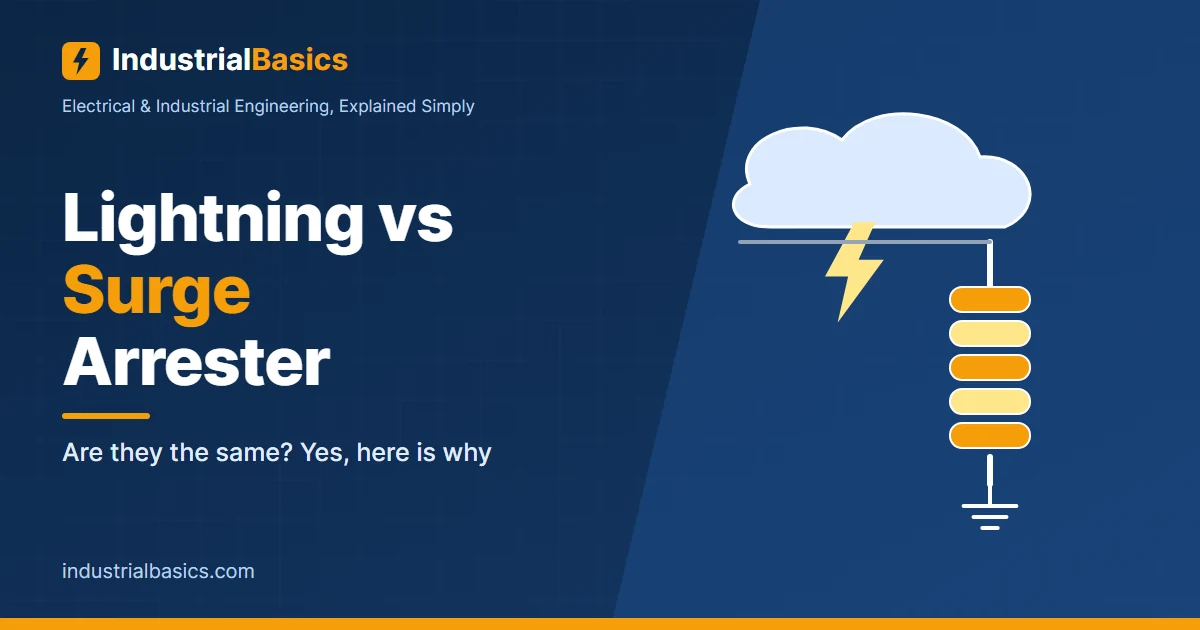
Yes, a lightning arrester and a surge arrester are the same device. Both connect between a live conductor and earth, limit dangerous transient overvoltages, divert the surge current to earth and then reset. “Surge arrester” is the modern IEC and IEEE term. “Lightning arrester” is the older name, still common in India and the UK.
The belief that one is “outdoor, lightning only” and the other is “indoor, switching only” comes mostly from commercial blogs. It is not a distinction made by the standards. Modern metal-oxide arresters handle lightning and switching surges alike. The real differences people need to know about are between an arrester, a low-voltage surge protective device (SPD) and a lightning rod. This guide covers all three.
Lightning Arrester vs Surge Arrester at a Glance
| Factor | Lightning arrester | Surge arrester |
|---|---|---|
| What it is | Traditional name | Modern standards name |
| Main job | Limits transient overvoltage and diverts surge current to earth | Same |
| Surges handled | Lightning and switching surges | Lightning and switching surges |
| Voltage range | Above 1 kV in power systems | Above 1 kV in power systems |
| Modern technology | Gapless zinc oxide (metal oxide) | Gapless zinc oxide (metal oxide) |
| Where the name is used | India, UK, older textbooks | IEC 60099 and IEEE C62.11 |
Why Do the Two Names Exist?
Early arresters were simple air gaps fitted to overhead lines to deal with lightning, so “lightning arrester” stuck. Later designs also had to cope with switching surges caused by breaker operations. Standards bodies chose the wider term surge arrester because the device does not care where the surge came from.
IEC 60099-4 and IEEE C62.11 both use “surge arrester” in their titles. Indian utilities and specifications still say “lightning arrester” in everyday use. Both names point to the same equipment, so check the rating and standard on the nameplate rather than the label in a brochure.
What Is a Surge Arrester?
A surge arrester is a protective device connected between a phase conductor and earth. In normal service it behaves like an insulator and passes only a tiny leakage current. When a surge arrives, it becomes conductive, sends the surge current to earth and holds the voltage across the protected equipment to a safe level. Once the surge has passed, it returns to its insulating state.
It does not attract lightning, stop a strike or absorb all of the energy. Its job is to limit the voltage that reaches transformers, cables and switchgear. If you are new to the equipment it protects, our guide on what switchgear is gives useful background.
How a Surge Arrester Works
- Normal voltage: the zinc oxide blocks have very high resistance. Only microamps of leakage current flow.
- Surge arrives: voltage rises above the arrester’s reference level, resistance collapses and the surge current flows to earth.
- Voltage is clamped: the voltage across the equipment stays near the arrester’s protective level.
- Surge ends: the blocks return to high resistance and normal operation continues.
Why the V-I Curve Matters
Zinc oxide (ZnO) blocks are non-linear. A normal resistor lets current rise in step with voltage. A ZnO block lets almost no current through until the voltage passes a knee point, then current rises very steeply while the voltage barely increases. That steep section is what clamps the surge.
What Causes the Surges an Arrester Handles?
- Lightning: direct strikes to a line, or induced surges from nearby strikes, send high-voltage pulses along conductors.
- Switching surges: breaker operations, capacitor and transformer switching and fault clearing create transient overvoltages inside the network.
- Temporary overvoltages (TOV): longer power-frequency rises, for example on healthy phases during an earth fault. These last far longer than a surge, and an arrester must be chosen so it can withstand them.
Lightning is a real and seasonal hazard. In the United States, NOAA reports roughly 25 million lightning flashes a year, about 300 people struck and about 30 deaths on average. Around 70% of those deaths happen between June and August. In India, a news report citing the WMO put lightning deaths at about 1,300 in 2024, though you should check the primary WMO report before quoting that figure.
Types of Lightning and Surge Arresters
Many articles list every type as if all were still in use. They are not. Only gapless metal-oxide arresters are the standard choice for new power-system work.
| Type | How it works | Main limitation | Status |
|---|---|---|---|
| Rod gap | Air gap flashes over during a surge | Crude protection and no way to stop follow current | Legacy |
| Horn gap | Arc rises and stretches along horns until it goes out | Coarse protection, affected by weather | Legacy |
| Expulsion (protector tube) | Tube vents gas to extinguish the arc | Limited operations and maintenance needs | Largely superseded |
| Valve type (silicon carbide) | Silicon carbide blocks in series with spark gaps | Gaps add complexity and ageing problems | Largely superseded |
| Metal oxide (MOSA) | Gapless stack of zinc oxide blocks | Must be rated correctly for continuous voltage and TOV | Current standard |
| Externally gapped line arrester (EGLA) | Metal-oxide unit with an external series gap | Specific to line applications | Used on selected lines |
Housings also differ. Porcelain is heavy and can fracture at end of life. Polymer (silicone) is lighter, and may vent or operate a disconnector when it fails, according to Eaton’s technical guidance.
Arrester Classes and Voltage Ranges
IEEE-style practice groups arresters into four classes. The higher the class, the greater the energy duty and the better the protective level. Eaton gives these typical rating ranges:
IEC 60099-4 classifies arresters differently, by nominal discharge current (commonly 5 kA, 10 kA or 20 kA) and by line-discharge class. The two systems do not map one-to-one, so do not treat an IEEE class as an IEC class.
Key Surge Arrester Ratings Explained
| Rating | Plain meaning | Standard term |
|---|---|---|
| Uc / MCOV | The highest power-frequency voltage the arrester can carry continuously | Uc (IEC), MCOV (IEEE) |
| Ur | Rated voltage, the reference for the arrester’s operating-duty test | Ur (IEC); duty-cycle rating (IEEE) |
| In | Standard 8/20 µs current pulse used to classify the arrester | Nominal discharge current |
| Residual voltage (Up) | Voltage across the arrester while it carries the discharge current | Protective level |
| TOV capability | How much temporary overvoltage, for how long, it can withstand | TOV curve |
| Energy handling | How much surge energy it can take without damage | Line-discharge class (IEC) |
| Pressure relief | Ability to fail safely without violent housing failure | Short-circuit rating |
Uc and MCOV serve the same purpose but are defined under different standards, so never assume the numbers are interchangeable. A higher kA rating is also not automatically better. Protective level, TOV withstand and correct coordination matter just as much.
Insulation Coordination and Protective Margin
Insulation coordination means making sure the voltage reaching equipment stays below what its insulation can withstand. Equipment withstand is usually given as the Basic Impulse Insulation Level (BIL). The protective margin compares BIL with the arrester’s residual voltage:
Protective margin (%) = (BIL − Residual voltage) ÷ Residual voltage × 100
Illustrative example (not design data): a transformer has a BIL of 250 kV and the arrester has a residual voltage of 175 kV. Margin = (250 − 175) ÷ 175 × 100 = 42.9%.
Real studies also include lead-length voltage, system arrangement and the arrester’s characteristic at the actual surge current. This links closely with protection coordination, which looks at how protective devices work together across a network.
Where Arresters Are Installed and Why Lead Length Matters
Arresters are fitted at transformer terminals, substation line entrances, riser poles (where overhead lines go underground), cable terminations and on some overhead lines. Eaton also notes use at pole-mounted and pad-mounted transformers. They are placed as close as practical to the equipment they protect.
The reason is that surge current has to flow through the connecting leads, and leads have inductance. A long lead adds extra voltage during a fast surge, so the equipment sees more than the arrester’s own protective level. Keep leads short and straight, and make sure the earth connection is low impedance. Good earthing is essential, and our articles on types of earthing systems and earthing vs grounding explain the basics. Arresters are commonly installed around switchgear panels and transformer incomers, near the busbar entry points.
Surge Arrester vs SPD vs Lightning Rod
This is where most of the real confusion lies. Many web pages describe a “lightning arrester” as a rooftop spike, or a “surge arrester” as a socket-strip protector. Those are different products.
| Feature | Surge (lightning) arrester | Low-voltage SPD | Lightning rod (air terminal) |
|---|---|---|---|
| Main job | Limits overvoltage and diverts surge current | Limits surge voltage in low-voltage circuits | Intercepts a direct strike and guides it to earth |
| Voltage range | Above 1 kV | Up to 1,000 V AC | Not an electrical-circuit device |
| Typical location | Lines, transformers, substations | Distribution boards and panels | Roofs, towers, high points |
| Protects | Equipment insulation | Low-voltage equipment | The structure |
| Main standards | IEC 60099, IEEE C62.11 | IEC 61643-11, UL 1449 | IEC 62305, NFPA 780 |
A lightning rod does not replace an arrester. It can carry a strike safely to earth, but surges can still travel along incoming cables. That is why a building often needs a rod, SPDs and good earthing working together. Switching and breaking equipment are separate subjects, covered in our guides to types of circuit breakers and types of protection relays.
Standards to Check
| Standard | What it covers |
|---|---|
| IEC 60099-4 (2014) | Gapless metal-oxide surge arresters for AC systems above 1 kV |
| IEC 60099-5 (2018) | Selection and application recommendations |
| IEEE C62.11 | Metal-oxide surge arresters for AC circuits above 1,000 V |
| IEEE C62.22 | Guide for applying metal-oxide arresters above 1,000 V |
| IEC 61643-11 (2025) | Low-voltage SPDs on AC systems up to 1,000 V |
| UL 1449 | Surge protective devices (US) |
| IEC 62305 | Protection against lightning (external systems) |
| IEC 60071 | Insulation coordination |
In India, specifications often refer to IS 3070 for metal-oxide lightning arresters without gaps. Check the current BIS edition and any CEA or utility requirements before citing it in a specification.
Testing, Monitoring and Failure
Arresters age. Common checks are visual inspection of the housing, leakage-current measurement, surge counters and thermal imaging. A rise in leakage current or an unusually warm unit suggests deterioration.
Eaton lists these typical causes of failure: long or excessive temporary overvoltage, an undersized arrester, surge duty beyond the rating, housing deterioration, disk ageing and wildlife contact. Poor earthing and wrong installation make things worse. Visible cracks, a discoloured housing or an operated disconnector are warning signs, and the unit should be assessed by a qualified person.
Frequently Asked Questions
Is a lightning arrester the same as a surge arrester?
Yes. They are two names for the same overvoltage-limiting device. “Surge arrester” is the standards term; “lightning arrester” is the traditional one.
What is the working principle of a lightning arrester?
It is connected in parallel with the equipment. It has high resistance at normal voltage, conducts surge current to earth when voltage rises sharply, then returns to high resistance.
What is the difference between a surge arrester and an SPD?
Both limit surge voltage. Surge arresters are for systems above 1 kV (IEC 60099, IEEE C62.11). SPDs are for low-voltage systems up to 1,000 V AC (IEC 61643-11, UL 1449).
What is the difference between a lightning arrester and a lightning rod?
A lightning rod intercepts a strike on a structure and carries it to earth. An arrester limits overvoltage on electrical equipment. They do different jobs.
What does MCOV mean on a surge arrester?
MCOV is Maximum Continuous Operating Voltage, the highest voltage the arrester can carry continuously. IEC uses Uc for the same purpose.
Can a surge arrester protect against switching surges?
Yes. Metal-oxide arresters limit both lightning and switching surges.
Do surge arresters protect against direct lightning strikes?
They do not stop or intercept a strike. They limit the voltage the strike creates on the electrical system. Direct-strike protection on structures comes from an external lightning protection system.
Which type of surge arrester is used today?
Gapless metal-oxide (zinc oxide) arresters are the dominant modern type, in porcelain or polymer housings.
Conclusion
Lightning arrester and surge arrester are one device with two names. Judge an arrester by its standard, rated voltage (Uc or MCOV), discharge current, protective level, TOV capability and installation, not by whether the label says “lightning” or “surge”. Keep it separate in your mind from LV SPDs and lightning rods.
Disclaimer: this article is for education only. The worked example uses illustrative numbers. Arrester selection, insulation coordination and installation must be carried out by qualified engineers following local regulations, utility practice and manufacturer instructions.
Sources: IEEE C62.11; IEEE C62.22; IEC 60099-4; IEC 60099-5; IEC 61643-11; Eaton, fundamentals of surge arresters; NOAA lightning statistics; US National Weather Service; Rediff report citing WMO.