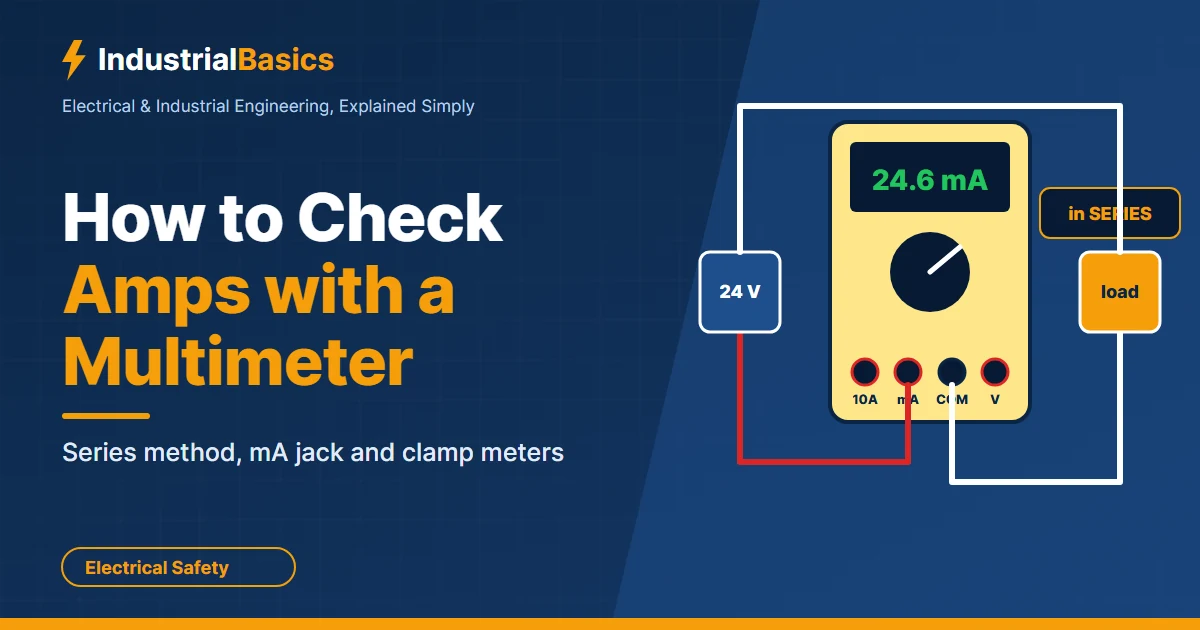
To check amps with a multimeter, you must connect it in series with the load. Turn off the power, open the circuit, move the red lead to the A (10 A) or mA jack, set the dial to AC or DC amps, connect the meter so all the current flows through it, then turn the power back on and read the display. Use the mA jack for small currents and the 10 A jack for larger ones, and use a clamp meter for anything above the meter’s rating. Never place the leads across a voltage source while they are in an amps jack: the current input is a near short.
Step by Step: Measuring DC or AC Current
- Estimate the current first (I = P ÷ V or V ÷ R) so you pick the right jack; the calculator below does this.
- Turn off and lock out the circuit where required.
- Open the circuit at a convenient point, such as a terminal, fuse holder or connector.
- Move the red lead from the V/Ω jack to the mA or 10 A jack; the black lead stays in COM.
- Select the function: DC A/mA for DC circuits, AC A/mA for AC. Start on the highest range if the meter is not autoranging.
- Connect in series: red lead to the supply side, black lead toward the load.
- Restore power and read the display. A negative DC reading just means the leads are reversed.
- Return the red lead to the V jack when you finish, so the next voltage measurement does not short the circuit.
SparkFun calls current “one of the trickiest” readings because the meter has to go in-line, and recommends starting on the 200 mA range for small electronics. It also warns that the most common mistake is probing from supply to ground in current mode, which instantly blows the meter’s fuse. Reversing the leads is harmless: the reading simply turns negative.
Which Jack and Range to Use
| Expected current | Jack | Function | Notes |
|---|---|---|---|
| Microamps to a few mA (sensors, LEDs) | µA/mA | mA DC / µA | Lowest range for best resolution |
| Up to the mA jack rating (often 200–400 mA) | mA | mA DC or AC | SparkFun’s meter: mA jack up to 200 mA |
| Above the mA rating, up to about 10 A | 10 A (or A) | A DC or AC | Many meters limit high currents to short periods |
| Above 10 A, or motors and feeders | Clamp meter or clamp accessory | A AC (or AC/DC clamp) | No need to open the circuit |
Expected Current Calculator
Why the Fuse Blows (and Why the Right Fuse Matters)
Fluke explains that voltage inputs have high impedance, so they rarely see overcurrent, but current inputs “usually employ a simple shunt through which the measured current flows.” The shunt is about 0.01 Ω and the test leads about 0.04 Ω, so the meter in current mode is a short of less than 0.1 Ω. That is fine in series with a load, but if you forget the leads are in the amps jacks and touch them across a supply, the meter shorts that supply.
Measuring Amps with a Clamp Meter
Fluke notes that clamps extend a multimeter’s range to thousands of amps without opening the circuit. Current-transformer clamps such as its i200 and i400 output 1 mA AC per amp AC (a 1,000:1 ratio), plug into the meter’s mA jack, and do not measure DC; AC/DC clamps with a millivolt output handle DC. In every case, clamp around one conductor only: around a line cord, the line and neutral currents cancel.
In motor work, a clamp on each phase lets you compare running current to the nameplate full-load amps. Our full load amps guide explains what FLA means, and locked rotor amps covers the much higher starting current you may see on the display.
Measuring 4-20 mA Loop Current
Process transmitters send their signal as current, so a meter in series on the mA DC range reads the signal directly: 4 mA is 0% and 20 mA is 100% of the transmitter range, so 12 mA is 50%. Open the loop at a terminal or use the transmitter’s test terminals. For how the loop is wired and scaled, see our 4-20 mA guide.
What About LoZ (Low Impedance) Mode?
LoZ is a voltage function, not a current function, but it often comes up alongside amps checks. Fluke explains that most modern meters have input impedance above 1 MΩ, which can show “ghost voltages” on de-energized wires running near live ones in the same conduit, through capacitive coupling. Fluke’s Auto-V/LoZ presents a low impedance input that collapses these induced readings. Fluke recommends the normal high-impedance volts positions for most troubleshooting, especially on sensitive electronic loads.
Common Mistakes
- Measuring current across a supply. Current is measured in series, never in parallel.
- Leaving the leads in the amps jacks. The next voltage check becomes a short.
- Using the mA jack for motor or heater current. It will blow the fuse; use the 10 A jack or a clamp.
- Clamping both conductors. The reading cancels to near zero.
- AC clamp on DC. CT clamps read nothing on DC; use a Hall-effect AC/DC clamp.
A practical place to use these meter skills is a vehicle charging system; see the motorcycle regulator rectifier guide for the voltage tests.
Frequently Asked Questions
How do you check amps with a multimeter?
Turn the circuit off, open it at one point, move the red lead to the A or mA jack, select AC or DC amps, connect the meter in series so all the current flows through it, then turn the power back on and read the display.
Do you measure current in series or parallel?
In series. SparkFun explains that voltage is measured in parallel, but to measure current “you have to physically interrupt the flow of current and put the meter in-line”.
Which jack do I use for amps?
Use the mA (or µA/mA) jack for small currents and the 10 A jack for larger ones. On SparkFun’s example meter, the mA jack is for up to 200 mA and the 10 A jack for anything larger. Check your own meter’s labels.
Why did my multimeter fuse blow?
Usually because the leads were left in the amps jacks and placed across a voltage source. Fluke notes the current input is a shunt of about 0.01 Ω; with the test leads it is under 0.1 Ω, so across a supply it acts as a short circuit.
How do I read milliamps on a multimeter?
Plug the red lead into the mA jack, set the dial to the mA DC (or AC) range, and connect in series. A reading of 50 mA shows as 50.0 on a mA range, or 0.050 on an A range.
What does 50 milliamps look like on a multimeter?
On the mA range it reads about 50.0 (or 50.00). On a 10 A range it shows 0.05 or 0.050. Watch the unit indicator (mA or A) on the display.
Can I measure amps without breaking the circuit?
Yes, with a clamp meter or a clamp accessory around one conductor. AC-only CT clamps measure AC; DC needs a Hall-effect (AC/DC) clamp.
Why does my clamp meter read zero on a cord?
Because the jaws are around both the line and neutral. Fluke explains that clamping both conductors at once cancels the reading; separate the conductors and clamp only one.
What is LoZ on a multimeter?
Low impedance mode. It loads the circuit so that ghost voltages from capacitive coupling collapse, helping you tell a truly energized conductor from an induced reading. Fluke says to use the normal high-impedance volts positions for most work, especially on sensitive electronics.
How do I measure 4-20 mA with a multimeter?
Open the loop at a terminal and insert the meter in series on the mA DC range, or use a meter with a loop-current clamp. Many transmitters have test terminals for exactly this.
Sources and Further Reading
- SparkFun: How to use a multimeter: measuring current in series, jacks and fuse replacement.
- Fluke: Choosing the correct fuse for your tester: current shunt resistance and high-energy fuses.
- Fluke: Using accessory current clamps with digital multimeters: clamp ratios and one-conductor rule.
- Fluke: Dual impedance digital multimeters: ghost voltage and LoZ.