
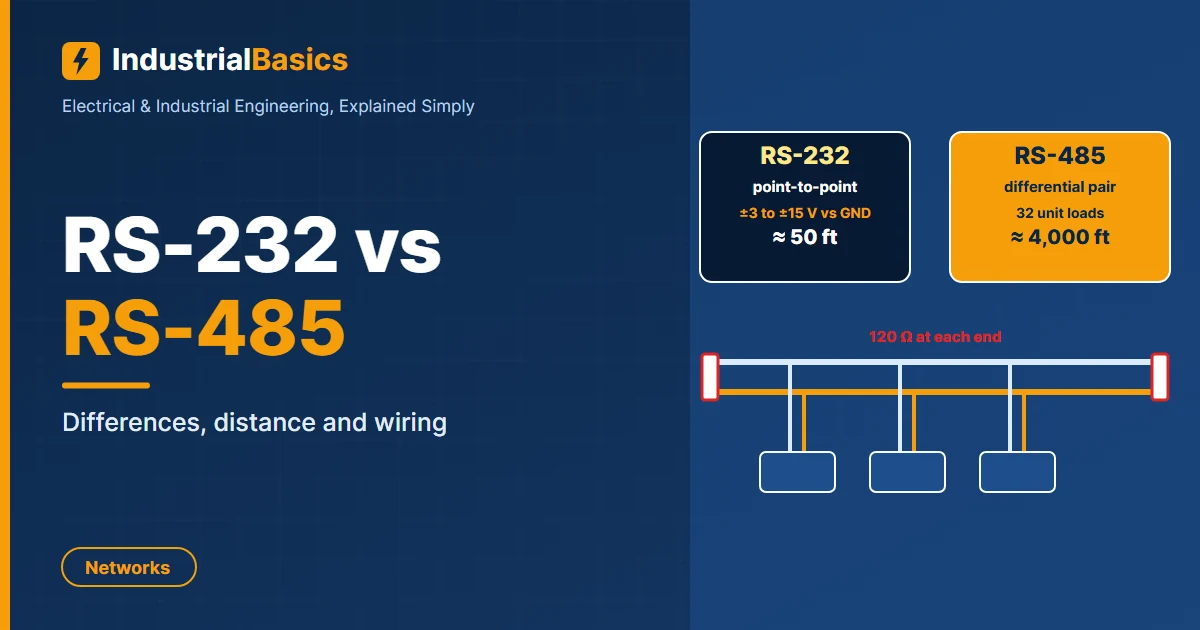
RS-232 is a single-ended, point-to-point serial interface: one transmitter and one receiver, with signals referenced to ground, and cables of about 15 m (50 ft). RS-485 is a differential, multipoint interface: a twisted pair carries each signal as the difference between two wires, so it rejects noise, connects at least 32 devices on one bus and reaches about 1,200 m (4,000 ft). RS-422 sits between them: differential like RS-485, but with one driver and up to ten receivers. For industrial networks such as Modbus RTU, RS-485 is the usual choice; RS-232 suits short links between two devices.
RS-232 vs RS-422 vs RS-485 Comparison
| Parameter | RS-232 | RS-422 | RS-485 |
|---|---|---|---|
| Signaling | Single-ended (vs ground) | Differential pair | Differential pair |
| Topology | Point-to-point | Simplex multidrop | Multipoint bus |
| Devices | 1 driver, 1 receiver | 1 driver, 10 receivers | 32 unit loads |
| Maximum cable length | About 15 m (50 ft) rule of thumb | 1,200 m | 1,200 m |
| Maximum data rate | Limited by length and capacitance | 10 Mbps | Over 10 Mbps (TI devices to 50) |
| Signal levels | ±3 to ±15 V | Driver 2–10 V differential | Driver 1.5–5 V differential |
| Common-mode range | — | ±7 V | −7 to +12 V |
| Receiver sensitivity | ±3 V | ±200 mV | ±200 mV |
| Typical industrial use | Laptop to one device, barcode scanner, legacy port | Long point-to-point or one-to-many links | Modbus RTU, drives, meters, BACnet MS/TP |
RS-232 Explained
Wikipedia describes RS-232 signals as valid in the range +3 to +15 V or −3 to −15 V with respect to the common ground pin; on data lines, logic one (mark) is negative and logic zero (space) is positive. Because every signal is measured against ground, ground-potential differences between two machines on separate power systems reduce the noise margin and can even create a hazardous ground loop, as Wikipedia notes. A widely used rule of thumb puts the limit around 15 m (50 ft) of cable, because of cable capacitance, unless low-capacitance cable is used.
RS-232 is one transmitter talking to one receiver, so it suits short point-to-point connections: a laptop to a single drive, a scanner to a terminal, or an older instrument’s configuration port. For connector pin assignments, see our DB9 pinout guide.
RS-485 Explained
RS-485 (TIA/EIA-485) defines balanced, multipoint drivers and receivers. TI’s overview notes that it allows only one driver to send at a time and up to 32 unit loads on the bus, with a −7 V to +12 V common-mode range. Because the receiver only looks at the voltage difference between A and B, noise that couples equally into both wires cancels. Wikipedia notes RS-485 can run up to 10 Mbit/s or, at lower speeds, up to 1,200 m (4,000 ft), and gives a rule of thumb that bit rate times length in meters should not exceed 108.
RS-485 wiring rules
- Daisy-chain the devices in a single line. Wikipedia notes star and ring topologies are not recommended.
- Terminate both ends with a resistor equal to the cable’s characteristic impedance, typically 120 Ω for twisted pair (TI). Do not add a terminator at every device.
- Keep stubs short. TI’s design guide gives the maximum stub length as about one tenth of the driver rise time in cable length; for a 500 ns driver on 78%-velocity cable, about 38 ft.
- Use twisted-pair cable rated around 120 Ω (TI uses 22–24 AWG UTP in its example).
- Provide failsafe biasing where noise is high. TI explains that receivers need a defined output when the bus is idle, open or shorted; built-in failsafe has only about 10 mV of noise margin, so noisy plants may need external bias resistors.
- Run a common or signal-ground conductor between devices so the common-mode voltage stays within −7 to +12 V.
RS-485 Length and Stub Calculator
RS-422 vs RS-485
TI explains that RS-422 is a simplex multidrop standard: one driver and up to ten receivers on a line. RS-485 allows several drivers on a shared line (multipoint), with only one enabled at a time, and a wider common-mode range. RS-422’s driver can deliver a larger differential output (2 to 10 V versus 1.5 to 5 V) into a 100 Ω load. TI’s conclusion: RS-485 devices can be used in RS-422 systems, but not the other way round. In practice, “4-wire RS-485” wiring (separate transmit and receive pairs) looks like RS-422.
2-Wire vs 4-Wire RS-485
| 2-wire (half duplex) | 4-wire (full duplex) | |
|---|---|---|
| Pairs | One pair (A, B) plus common | Two pairs (TX+/TX−, RX+/RX−) plus common |
| Communication | Devices take turns on the same pair | Send and receive at the same time |
| Typical use | Modbus RTU, BACnet MS/TP, most drives and meters | Point-to-point or master/slave with separate return |
| Converter requirement | Must switch its driver on only while sending | Driver can stay enabled |
Connecting RS-232 to RS-485
The two cannot be wired together directly: RS-232 swings ±3 to ±15 V against ground, while RS-485 uses a differential pair. Use an RS-232/RS-485 converter (or a USB-to-RS-485 adapter). On a 2-wire RS-485 bus, the converter must enable its transmitter only while sending, either automatically or from the RS-232 RTS line, so it does not hold the bus while other devices answer.
For PLC and HMI communication setup, see HMI communication drivers; for selecting the controller itself, how to select a PLC.
Troubleshooting Serial Links
- No response on 2-wire RS-485: swap A and B (naming varies by maker), then check baud rate, parity and node address.
- Works on the bench, fails in the field: missing or extra termination, a star-wired branch, or long stubs.
- Intermittent errors on an idle bus: no failsafe bias, so noise looks like data.
- RS-232 garbage characters: mismatched baud rate or a cable longer than 15 m (50 ft).
- Damaged ports: large ground-potential differences between buildings; use isolated converters.
Moving from serial to Ethernet? Our T568A vs T568B guide gives the RJ45 color codes and explains straight-through vs crossover cables.
The most common protocol on RS-485 is Modbus; see Modbus RTU vs Modbus TCP for frames, CRC and gateways.
Frequently Asked Questions
What is the main difference between RS-232 and RS-485?
RS-232 is single-ended (each signal is a voltage relative to ground) and point-to-point between two devices over short cables. RS-485 is differential over a twisted pair, supports at least 32 devices on one bus and runs up to about 1,200 m (4,000 ft).
Which is better, RS-232 or RS-485?
For industrial networks, RS-485: it rejects noise, tolerates ground differences, reaches much longer distances and connects many devices. RS-232 remains fine for short, point-to-point links such as a laptop to one instrument.
What is the difference between RS-422 and RS-485?
RS-422 allows one driver and up to ten receivers (simplex multidrop). RS-485 allows multiple drivers and up to 32 unit loads (multipoint), with a wider −7 V to +12 V common-mode range. TI notes RS-485 devices work in RS-422 systems, but not the reverse.
How far can RS-232 go?
Wikipedia cites a rule of thumb of about 15 m (50 ft), limited by cable capacitance, unless special low-capacitance cable is used.
How far can RS-485 go?
Up to about 1,200 m (4,000 ft) at lower speeds. A rule of thumb from Wikipedia: bit rate × length in meters should not exceed 10⁸, so 100 kbit/s works to about 1,000 m.
Can RS-232 connect directly to RS-485?
No. The voltage levels and signaling are different. You need an RS-232 to RS-485 converter; for 2-wire RS-485 it must also switch the driver on and off (automatic send-data control or RTS control).
Do I need a termination resistor on RS-485?
Yes on longer or faster networks: one resistor equal to the cable impedance, typically 120 Ω, at each end of the trunk, not at every device. TI notes that without proper termination, reflections can corrupt data.
What is 2-wire vs 4-wire RS-485?
2-wire is half duplex: one pair (A/B) shared by all devices, taking turns. 4-wire is full duplex: separate transmit and receive pairs, similar to RS-422 wiring.
What are A and B on RS-485?
The two lines of the differential pair. Naming is not consistent between manufacturers, so if a 2-wire link does not work, swapping A and B is a common first fix.
What are RTS and CTS?
RS-232 hardware flow control lines: Request to Send and Clear to Send. Converters sometimes use RTS to turn an RS-485 driver on when sending.
Sources and Further Reading
- Texas Instruments SLLA070D: RS-422 and RS-485 standards overview (PDF): specification comparison and system configurations.
- Texas Instruments SLLA272: RS-485 design guide (PDF): cable, termination, stub length and failsafe.
- Wikipedia: RS-485: topology, distance rule of thumb and termination.
- Wikipedia: RS-232: voltage levels, ground issues and cable length.
- Wikipedia: RS-422: background on the RS-422 standard.



