
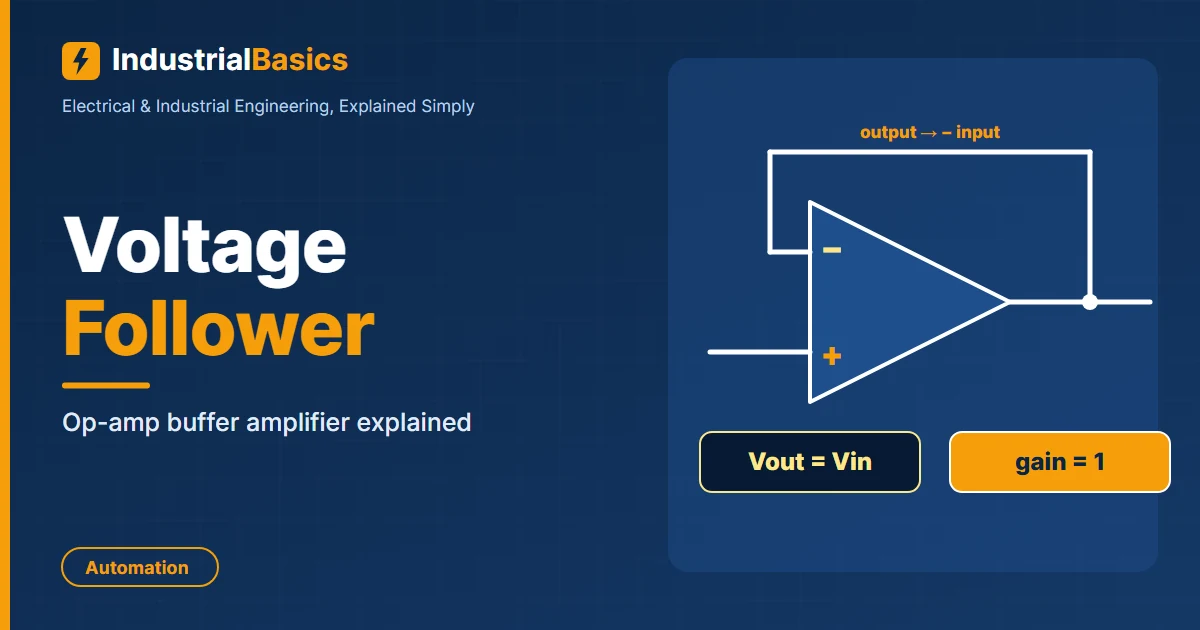
A voltage follower is an op-amp circuit with gain of exactly 1: the signal goes into the non-inverting (+) input and the output is wired straight back to the inverting (−) input, so Vout = Vin. Its value is not gain but impedance: it draws almost no current from the source and can drive a load with very low output impedance. That makes it the standard buffer amplifier for isolating a high-impedance source, such as a resistor divider, potentiometer or sensor, from whatever it feeds. Example: a 10 kΩ/10 kΩ divider giving 5 V drops to 3.33 V when it drives a 10 kΩ load directly, but stays at 5 V through a follower.
How the Voltage Follower Works
Texas Instruments’ Handbook of Operational Amplifier Applications analyzes it in two lines: the voltage at the non-inverting input is EI; negative feedback drives the inverting input to the same voltage; and the inverting input is the output. So EO = EI. Because no current flows into the non-inverting input, the ideal follower’s input impedance is infinite, and its output impedance is that of the op amp itself, ideally zero.
TI also points out that the follower is a special case of the non-inverting amplifier: with Rf = 0 (or Rg removed), the gain 1 + Rf/Rg becomes exactly 1. All the open-loop gain is traded for accuracy and control.
Why Use a Buffer? The Loading Problem
Wikipedia explains that a voltage buffer transfers a signal from a circuit with high output impedance to one with low input impedance, and that “the interposed buffer amplifier prevents the second circuit from loading the first circuit unacceptably”. Without it, the second circuit’s input impedance forms a voltage divider with the first circuit’s output impedance and the signal sags.
A rule of thumb: if the load resistance is less than about 100 times the source resistance, the loading error exceeds about 1% and a buffer is worth considering. The calculator above shows the actual error for your values.
Voltage Follower vs Other Buffers
| Buffer | Voltage gain | Input impedance | Notes |
|---|---|---|---|
| Op-amp voltage follower | 1 (accurate) | Very high (1 MΩ–10 TΩ op-amp input) | No offset from a junction drop; limited by op-amp output current and swing |
| BJT emitter follower | Slightly below 1 | Moderate (β × load) | Output is one base-emitter drop below the input |
| MOSFET source follower | Below 1 | Very high at DC | Output offset by the gate-source voltage |
| Op amp + transistor (boosted follower) | 1 | Very high | Transistor inside the feedback loop adds output current; Wikipedia calls it an “ideal transistor” |
Choosing an Op Amp for a Follower
- Unity-gain stable. Analog Devices tutorial MT-033 notes that noise gain, not signal gain, is relevant for stability. A follower runs at the lowest possible noise gain (1), so op amps that are only stable above a minimum gain will oscillate.
- Input and output range. The input must stay within the op amp’s common-mode range and the output within its swing; older op amps swing only to within a volt or two of the rails, while rail-to-rail types get within millivolts at light load (Wikipedia).
- Bandwidth and slew rate. As a follower the small-signal bandwidth is roughly the gain-bandwidth product; large, fast signals are limited by slew rate.
- Capacitive loads. Long cables and large capacitors on the output can make a follower ring or oscillate; a small series resistor at the output, inside or outside the loop per the data sheet, is the usual fix.
- Current-feedback op amps need the feedback resistor recommended in the data sheet; TI notes their stability depends entirely on it.
Common Uses in Industrial and Control Circuits
- Buffering resistor dividers and potentiometers that set a reference or a speed command, so the downstream input does not shift the value. See potentiometer speed control.
- Sensor front ends for high-impedance sensors such as pH electrodes and piezoelectric sensors, before gain or filtering stages; see types of industrial sensors.
- Driving ADC inputs and analog outputs, where the converter’s input draws current spikes.
- Isolating filter stages so one stage does not load the next.
- Reference distribution to several circuits from one precision reference.
Frequently Asked Questions
What is a voltage follower?
An op-amp circuit with the output connected directly to the inverting input and the signal applied to the non-inverting input. The output voltage follows the input (gain = 1), but the circuit has very high input impedance and very low output impedance.
What is a voltage follower used for?
As a buffer: to stop one circuit loading another. Texas Instruments says unity-gain circuits “are used as electrical buffers to isolate circuits or devices from one another”, letting a source with little current capability drive a heavier load.
Is a buffer amplifier the same as a voltage follower?
A voltage follower is the most common voltage buffer. Wikipedia defines a buffer amplifier as one that copies a signal while transforming its impedance; a unity-gain voltage buffer is also called a voltage follower. Current buffers and transistor followers are other types.
What is the gain of a voltage follower?
Exactly 1 (0 dB) in voltage. It does provide current gain, which is the point: the output supplies the load current instead of the source.
What is the input impedance of a voltage follower?
Very high. Wikipedia gives op-amp input impedance as 1 MΩ to 10 TΩ, and feedback raises the effective value further. Ideally it is infinite.
Why use a voltage follower if the gain is 1?
Because it changes impedance, not voltage. A high-impedance source, such as a resistor divider, a pH probe or a potentiometer, would be pulled down by a low-impedance load; the follower prevents that.
Can any op amp be used as a voltage follower?
Only one that is unity-gain stable. Analog Devices notes that noise gain, not signal gain, determines stability; a follower has the lowest possible noise gain (1), so decompensated op amps that need a minimum gain can oscillate.
What is the bandwidth of a voltage follower?
About the op amp’s full gain-bandwidth product, because the noise gain is 1. A 1 MHz GBW op amp gives roughly 1 MHz small-signal bandwidth as a follower, though slew rate limits large signals.
Can I put a resistor in the feedback of a voltage follower?
Yes. TI notes that no current flows in the feedback path of an ideal follower, so a resistor there changes nothing in theory; with current-feedback op amps the data sheet’s recommended feedback resistor is required for stability.
What is a transistor voltage follower?
An emitter follower (BJT) or source follower (MOSFET). Wikipedia describes these as single-transistor buffers whose output follows the input, offset by the base-emitter or gate-source voltage.
Sources and Further Reading
- Texas Instruments: Handbook of Operational Amplifier Applications (PDF): voltage follower analysis and buffer use.
- Wikipedia: Buffer amplifier: voltage buffers, impedance transformation and transistor followers.
- Analog Devices MT-033: Voltage feedback op amp gain and bandwidth (PDF): noise gain and stability.
- Wikipedia: Operational amplifier: output swing and gain-bandwidth.



