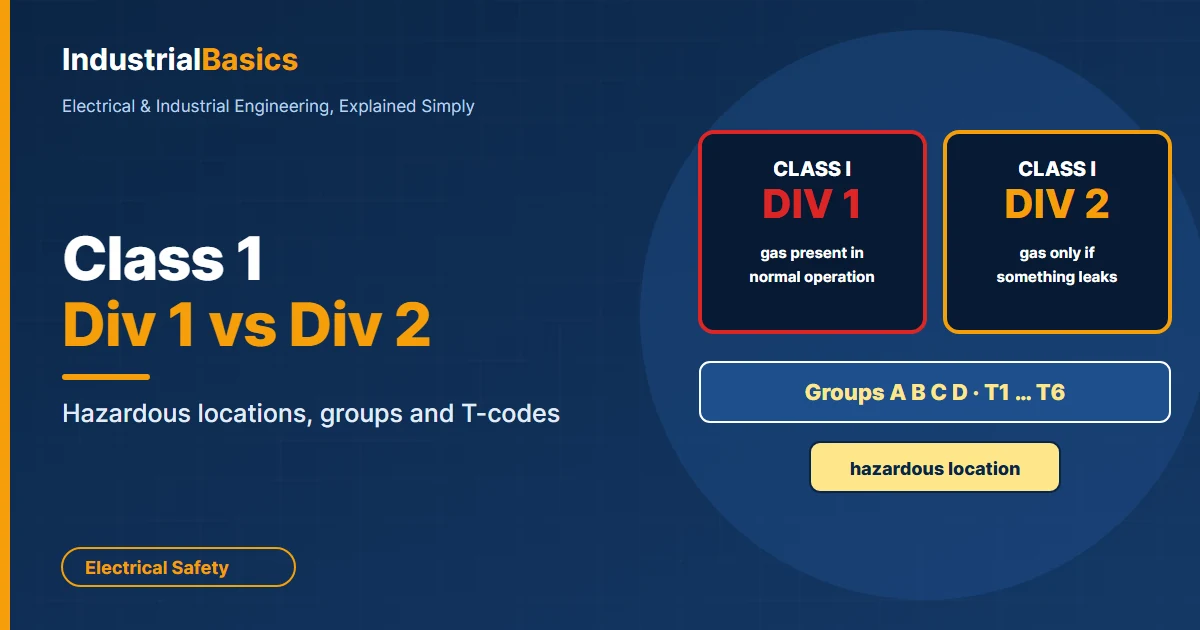
Class I, Division 1 (C1D1) is a location where ignitable concentrations of flammable gases or vapors exist, or may exist, under normal operating conditions. Class I, Division 2 (C1D2) is a location where they exist only under abnormal conditions, such as a leak, rupture or equipment failure. Division 1 is the more hazardous and requires explosion-proof, intrinsically safe or purged and pressurized equipment; Division 2 also permits nonincendive circuits, hermetically sealed contacts and, in many cases, general-purpose equipment. Equipment rated for Division 1 can be used in Division 2 of the same class, group and temperature class, but not the reverse.
Class I Division 1 vs Division 2 at a Glance
| Class I, Division 1 | Class I, Division 2 | |
|---|---|---|
| When the hazard exists | Under normal operating conditions, all or some of the time | Only under abnormal conditions (leaks, failures) |
| Zone equivalent | Zone 0 + Zone 1 | Zone 2 |
| Example | Vapor space of a vented tank and the area close to its vent | Surroundings of closed process equipment that could leak |
| Protection methods | Explosion-proof, intrinsically safe, purged/pressurized | All Div 1 methods plus nonincendive, hermetically sealed, and others |
| Boxes and fittings | Identified for Class I, Division 1 | Explosion-proof where required; relief provisions in Art. 501 |
| Equipment interchange | Can be used in Div 2 | Cannot be used in Div 1 |
Classes, Divisions and Groups Explained
EC&M summarizes NEC Article 500 like this: a location is Class I if flammable or combustible gases or vapors may be present in ignitable quantities, Class II if combustible dust is the threat, and Class III if ignitable fibers or flyings are. In Classes I and II, it is Division 1 if the threat is present during ordinary conditions and Division 2 if it is present only during abnormal conditions. Class I is the most stringent class and Division 1 is more stringent than Division 2.
| Class | Group | Representative materials |
|---|---|---|
| Class I (gases, vapors) | A | Acetylene |
| Class I | B | Hydrogen |
| Class I | C | Ethylene |
| Class I | D | Propane, methane |
| Class II (dusts) | E | Metal dusts such as magnesium (Division 1 only) |
| Class II | F | Carbonaceous dusts such as carbon and charcoal |
| Class II | G | Non-conductive dusts such as flour, grain, wood and plastic |
| Class III (fibers, flyings) | — | Cotton lint, flax, rayon |
Within Class I, the group describes how easily the material ignites and how violent the explosion is: Group A (acetylene) is the most severe and Group D (propane, methane) the least. Equipment must be listed for the specific group, and Wikipedia notes that the zone system’s IIC, IIB and IIA groups map onto NEC Groups A/B, C and D.
Division 1 vs Zone 0 and Zone 1
Wikipedia explains that a Class I, Division 1 area “encompasses the combination of Zone 0 and Zone 1”. Zone 0 is where ignitable concentrations are present continuously or for long periods, such as the vapor space above the liquid in a tank, with a guide of more than 1,000 hours a year. Zone 1 is where they are likely under normal operation (about 10 to 1,000 hours a year). Division 2 equals Zone 2, where they should be present for less than about 10 hours a year. The NEC allows either system: Article 500 for divisions and Article 505 for zones.
Temperature Codes (T-codes)
| T-code | Max surface temp (°C) | T-code | Max surface temp (°C) |
|---|---|---|---|
| T1 | 450 | T3A | 180 |
| T2 | 300 | T3B | 165 |
| T2A | 280 | T3C | 160 |
| T2B | 260 | T4 | 135 |
| T2C | 230 | T4A | 120 |
| T2D | 215 | T5 | 100 |
| T3 | 200 | T6 | 85 |
A T-code tells you the hottest any surface of the equipment can get. Wikipedia’s example: equipment marked T3 will not rise above 200 °C. That temperature must stay below the autoignition temperature of every flammable material in the area, which you find on its safety data sheet. Hot process surfaces matter too; Wikipedia notes a high-pressure steam pipe can exceed the autoignition temperature of some fuel-air mixtures.
Protection Methods
| Method | How it prevents ignition | Typical use |
|---|---|---|
| Explosion-proof (flameproof) | Contains an internal explosion and cools escaping gases through flame paths so the outside atmosphere is not ignited | Motors, lighting, junction boxes, control stations |
| Intrinsically safe | Limits electrical and thermal energy below what can ignite the atmosphere, even under fault | Instrumentation, sensors, 4-20 mA loops |
| Purged / pressurized | Keeps clean air or inert gas at positive pressure inside the enclosure | Analyzers, control panels, motors |
| Nonincendive (Division 2) | Circuits that cannot ignite the atmosphere in normal operation | Instrument and control wiring in Div 2 |
| Hermetically sealed / encapsulated | Keeps the atmosphere away from arcing contacts | Relays, switches |
EC&M stresses what “explosion-proof” means: the goal is to contain combustion inside the electrical system so it does not spread, not to survive an explosion that starts outside. That is why Article 501 has extensive sealing and drainage requirements for Class I conduits, more than three pages compared with under a quarter page for Class II. Wikipedia lists NEMA Type 7 (indoor) and Type 9 (dust) enclosures as certified for Class I Groups A–D and Class II Groups E–G respectively.
Wiring Differences Between Division 1 and Division 2
- Wiring methods: EC&M notes the NEC permits specific conduit types in Class I, and that tubing is not among the permitted wiring methods.
- Boxes and fittings: in Division 1 they must be identified for Class I, Division 1; in Division 2 the requirements are relaxed (EC&M).
- Seals: conduit seals limit the passage of gases and flames between areas and at the Division 1/Division 2 boundary.
- Division 2 relief: nonincendive circuits and hermetically sealed contacts are allowed, which is why many Division 2 instrument installations look much like ordinary ones.
For the wider picture of electrical risk in plants, see electrical hazards in industry; for instrument loops that are often made intrinsically safe, see our 4-20 mA guide.
Reading a Hazardous Location Label
Wikipedia notes that a North American label always lists the class and division and may list the group and temperature code, next to the mark of the listing agency. A marking such as Class I, Division 1, Groups C and D, T4 means: suitable for gases and vapors, in areas hazardous under normal conditions, for ethylene- and propane-type atmospheres, with surfaces that never exceed 135 °C.
Frequently Asked Questions
What is the difference between Class 1 Div 1 and Class 1 Div 2?
In a Class I, Division 1 location, ignitable concentrations of flammable gas or vapor can exist under normal operating conditions. In Division 2 they exist only under abnormal conditions, such as a leak or equipment failure. Division 1 is the more hazardous and has stricter equipment rules.
What does C1D1 mean?
Class I, Division 1: a location where flammable gases or vapors are, or may be, present in ignitable concentrations during normal operation. C1D2 is Class I, Division 2.
Can Class 1 Div 1 equipment be used in Div 2?
Yes, if it matches the class, group and temperature class. Equipment approved for Division 1 may be used in Division 2, but Division 2 equipment cannot be used in Division 1.
What are Class II and Class III locations?
Class II covers combustible dust (Groups E, F, G) and Class III covers ignitable fibers and flyings, such as cotton lint. Each also has Division 1 and Division 2.
What are Groups A, B, C and D?
Gas groups in Class I based on how easily the material ignites and how violent the explosion is: A is acetylene, B hydrogen, C ethylene, D propane and methane. Equipment must be listed for the group present.
What is a temperature code (T-code)?
The maximum surface temperature the equipment can reach, from T1 (450 °C) down to T6 (85 °C). It must be below the autoignition temperature of the gas or vapor present.
Is a Class 1 Div 2 enclosure explosion-proof?
Not necessarily. Division 2 allows several protection methods, including nonincendive circuits and hermetically sealed contacts; EC&M notes that Division 2 boxes and fittings need only be explosion-proof where the rules call for it, while Division 1 boxes must be identified for Division 1.
What is the difference between explosion-proof and intrinsically safe?
Explosion-proof equipment contains any internal explosion and stops it igniting the surrounding atmosphere. Intrinsically safe equipment limits electrical and thermal energy so it cannot cause ignition in the first place.
How do Divisions relate to Zones?
Class I, Division 1 corresponds to Zones 0 and 1; Division 2 corresponds to Zone 2. Zone 0 is where gas is present continuously or for long periods, such as the vapor space of a tank.
Who decides whether an area is Division 1 or 2?
An area classification study by qualified people from operations, process, safety and electrical disciplines, documented on area classification drawings. The authority having jurisdiction enforces the NEC requirements for the result.
Sources and Further Reading
- EC&M: NEC class and division basics: Class I, II, III and Division 1 vs 2.
- EC&M: NEC Article 501 summary: explosion-proof meaning, boxes and fittings, sealing.
- Wikipedia: Electrical equipment in hazardous areas: zones, groups, temperature codes and protection methods.
- Wikipedia: NEMA enclosure types: Type 7 and Type 9 hazardous location enclosures.