
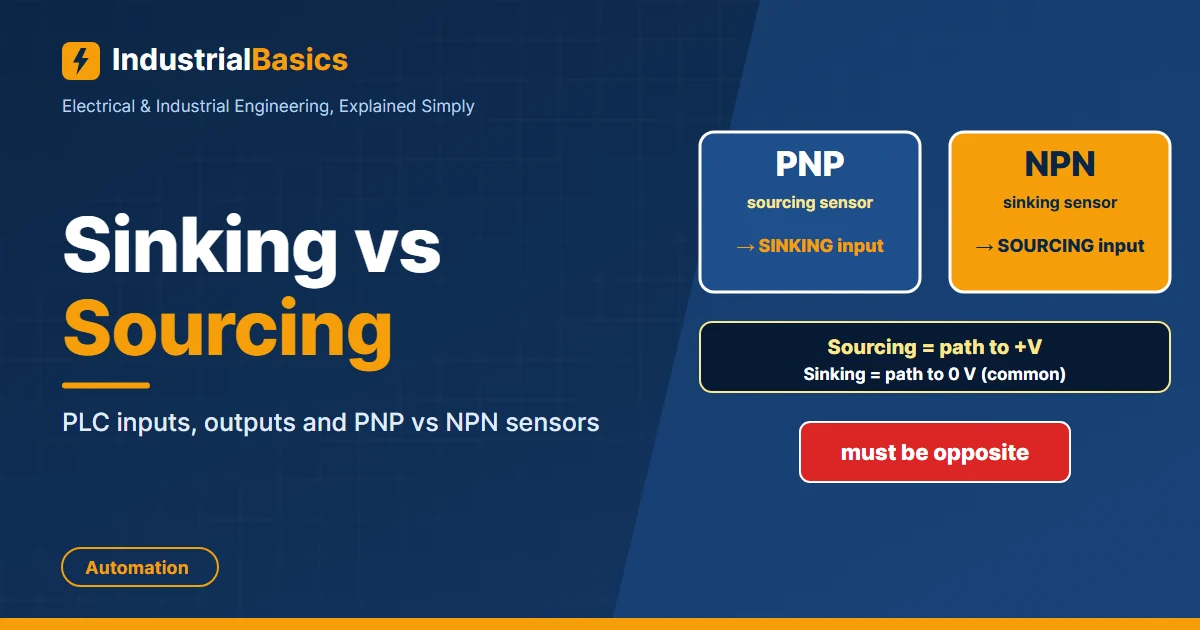
Sinking and sourcing describe which way DC current flows through a PLC input, output or sensor. A sourcing device supplies current from the positive (+) side; a sinking device provides the path to the negative (−) common. PNP sensors are sourcing and NPN sensors are sinking, and the PLC input must be the opposite type: a PNP sensor needs a sinking input, and an NPN sensor needs a sourcing input. For outputs, a sourcing output feeds +24 V to the load, while a sinking output switches the load’s return to 0 V. The terms apply only to DC circuits.
Sinking vs Sourcing at a Glance
| Sourcing | Sinking | |
|---|---|---|
| Definition | Provides a path to the supply source (+) | Provides a path to the supply common (−) |
| 3-wire DC sensor type | PNP: switches +24 V onto the signal wire | NPN: switches the signal wire to 0 V |
| PLC input of this type accepts | NPN (sinking) sensors | PNP (sourcing) sensors |
| Input looks for | 0 V on the input = true | +24 V on the input = true |
| Input common connects to | +24 V | 0 V |
| PLC output of this type | Supplies +24 V to the load; load returns to 0 V | Load fed from +24 V; output switches it to 0 V |
| IEC term (AutomationDirect) | Input: negative logic; output: positive logic | Input: positive logic; output: negative logic |
What Sinking and Sourcing Mean
AutomationDirect’s guide starts with the key point: the diagrams involve only DC, so “sinking and sourcing terminology applies only to DC input and output circuits.” Sinking and sourcing points conduct current in one direction only, so if you connect the supply and field device the wrong way round, current tries to flow the wrong way and the circuit does not operate. Once you understand which side each device switches, you can wire it correctly every time.
Its short definitions: sinking provides a path to supply common (−) and sourcing provides a path to supply source (+). To wire a sinking input, follow the current: from the supply (+), through the switch or sensor, into the input terminal, through the input sensing circuit, out of the common terminal, and back to supply (−).
PLC Inputs: PNP and NPN Sensors
RS Expert Advice explains that the PLC input type must be complementary (opposite) to the field device: a sinking input suits PNP sensors and looks for +24 V from the sensor’s switched lead; a sourcing input suits NPN sensors and looks for 0 V. It also warns that module diagrams sometimes use the terms the other way, describing an input as “compatible with sourcing field devices”, which means the input itself is sinking. Always read the wiring diagram.
Sink/source inputs
Many modern cards are sink/source: the circuitry conducts in either direction, so the polarity you put on the common terminal decides the behavior. AutomationDirect adds two rules: wire all points that share a common the same way (all sinking or all sourcing), and never use an AC supply on a DC sink/source point.
PLC Outputs: Sourcing vs Sinking
With a sourcing output, the PLC switches +24 V to the load, and the load’s other side goes to 0 V. With a sinking output, the load is always connected to +24 V and the PLC output closes the path to 0 V. Match the output type to the load and to any device it drives, such as another controller’s input. For protecting output and input circuits, see PLC I/O fuse protection.
PNP vs NPN: Which Should You Use?
- Regional practice: RS notes most European and North American designers choose PNP sensors with sinking inputs, while Asian equipment has tended toward NPN with sourcing inputs. US distributors usually stock far more PNP sensors.
- Troubleshooting: with PNP, +24 V = on = true, which RS says is easier for technicians to work with than 0 V = on.
- Damaged cables: RS points out that a PNP signal shorted to ground may damage the sensor, while an NPN signal shorted to ground can create a false “on” without damage.
- Check part numbers: PNP and NPN versions often differ by one character, and some sensors can be configured either way.
- Leakage current: RS warns a device with high off-state leakage can falsely turn on an input with a low switching threshold; this is more of an AC issue, but check DC data sheets too.
Troubleshooting Sinking and Sourcing Problems
- Sensor LED on, PLC input off: sensor and input are the same type, or the input common is on the wrong supply rail.
- Input always on: an NPN sensor with a cable fault to 0 V on a sourcing input, or excessive leakage current.
- Some inputs on a common work, others do not: mixed sinking and sourcing devices on one common.
- Output on but load dead: load wired to the wrong rail for the output type, or a blown output fuse.
Use a meter to check the signal wire against 0 V and +24 V: a PNP sensor that is on should read about +24 V to 0 V; an NPN sensor that is on should read near 0 V to 0 V (and 24 V to +24 V). See our guide on how to check amps with a multimeter for measuring the input current, and what is a PLC for how inputs and outputs fit into the scan.
Contact naming is the other half of control wiring basics; see SPDT vs DPDT for poles, throws and relay contact forms.
Frequently Asked Questions
What is the difference between sinking and sourcing?
A sourcing device supplies current: it connects the load or input to the positive (+) supply. A sinking device provides the return path: it connects to the negative (−) supply common. AutomationDirect sums it up as sinking = path to supply common (−), sourcing = path to supply source (+).
Is PNP sinking or sourcing?
PNP sensors are sourcing: they switch +24 V onto the signal wire when on. NPN sensors are sinking: they switch the signal wire to 0 V.
Which PLC input do I use for a PNP sensor?
A sinking input. RS notes a sinking DI suits PNP field devices and looks for +24 V from the sensor to indicate true.
Which PLC input do I use for an NPN sensor?
A sourcing input, which looks for 0 V from the sensor to indicate true.
Do sinking and sourcing apply to AC circuits?
No. AutomationDirect explains the terms apply only to DC input and output circuits, because they depend on + and − polarity.
What happens if I wire a PNP sensor to a sourcing input?
It will not work: both try to supply current and neither provides the return path. Sinking and sourcing points conduct current in one direction only, so the input never turns on.
What is a sink/source input?
An input whose circuit conducts either way. The polarity you connect to the common terminal decides how it behaves, but every point sharing that common must be wired the same way, and AC must not be used on a DC sink/source point (AutomationDirect).
Which is more common in the US, PNP or NPN?
PNP. RS notes that most European and North American designers choose PNP sensors with sinking inputs, while Asian equipment has tended toward NPN sensors with sourcing inputs.
Why is PNP often preferred?
RS explains that +24 V = on = true is easier for programmers and technicians to troubleshoot than 0 V = on, and points out the different failure behavior when a cable is damaged.
What is the IEC terminology?
AutomationDirect labels a sinking input as IEC “positive logic” and a sourcing input as “negative logic”; for outputs, sourcing is positive logic and sinking is negative logic.
Sources and Further Reading
- AutomationDirect: Sinking and sourcing concepts (PDF): definitions, the four I/O circuits and sink/source rules.
- RS Expert Advice: Sensor connections, PNP versus NPN and sourcing versus sinking: matching sensors to inputs, regional practice and leakage current.



