
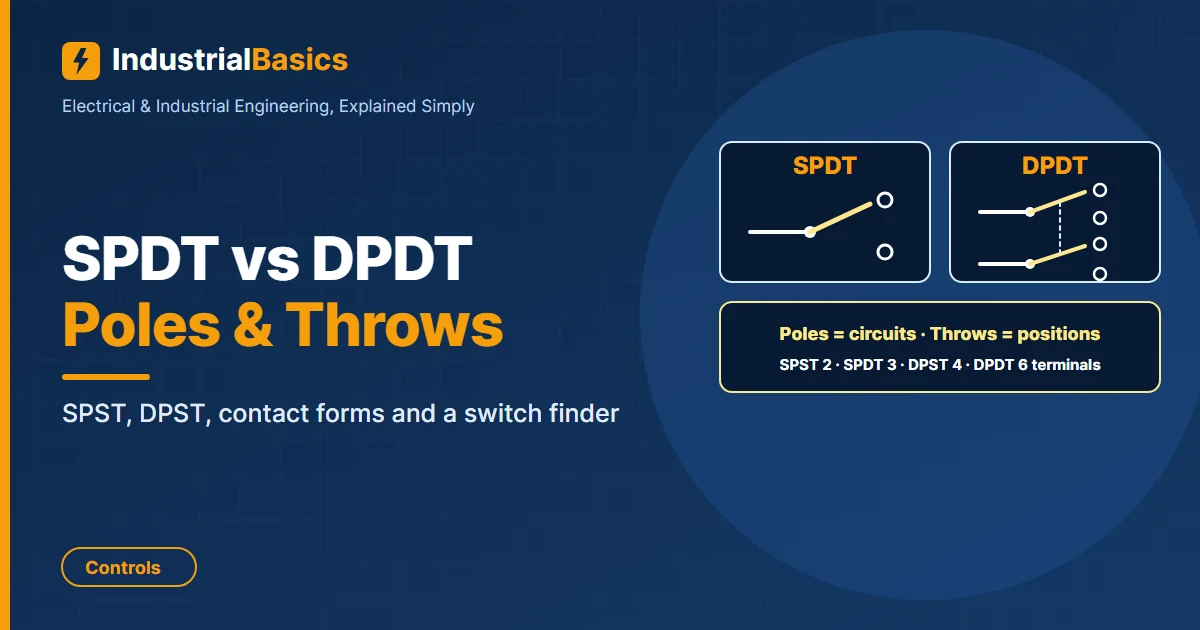
SPDT (single pole, double throw) switches one circuit between two outputs and has 3 terminals. DPDT (double pole, double throw) is two SPDT switches on one actuator: it switches two separate circuits at once and has 6 terminals. SPST is a plain one-circuit on/off switch (2 terminals), and DPST switches two circuits on/off together (4 terminals). Poles are the circuits; throws are the positions each circuit can connect to.
SPST vs SPDT vs DPST vs DPDT
| Type | Meaning | Terminals (switch / relay) | Contact form | Equivalent to |
|---|---|---|---|---|
| SPST | Single pole, single throw | 2 / 4 | Form A (NO) or Form B (NC) | Simple on/off |
| SPDT | Single pole, double throw | 3 / 5 | Form C (break-before-make) | Changeover; US “3-way” |
| DPST | Double pole, single throw | 4 / 6 | 2 × Form A or B | Two SPST on one actuator |
| DPDT | Double pole, double throw | 6 / 8 | 2 × Form C | Two SPDT on one actuator |
Poles and Throws Explained
Wikipedia defines the number of poles as the number of electrically separate switches controlled by one actuator. A 2-pole switch has two separate sets of contacts that open and close together. The number of throws is how many separate positions each pole can connect to: one for on/off, two for a changeover. Larger switches are named by number, such as 3PST or SP4T (a four-position selector).
- Normally open (NO) / normally closed (NC): for momentary switches and relays, NO contacts close when actuated and NC contacts open.
- Break-before-make: a standard SPDT (Form C) disconnects one side before connecting the other, so the common never touches both. Form D (make-before-break) briefly connects both.
- Center off: some suppliers call a changeover with a stable center-off position SPCO/DPCO (or on-off-on). A center position can also be “on”, connected to both sides.
Switch Type Finder
Common Uses
| Need | Switch | Why |
|---|---|---|
| Turn one load on and off | SPST | Simplest; one circuit |
| Choose between two outputs (A or B) | SPDT | Common connects to either side |
| Light from two locations (US 3-way) | SPDT ×2 | Each switch is a changeover |
| Three or more locations (4-way) | DPDT crossover in the middle | Swaps the two travelers |
| Disconnect both conductors | DPST | Opens line and neutral (or both hots) together |
| Reverse a DC motor | DPDT (cross-wired) | Swaps polarity to the motor |
| Switch two signals together | DPDT | Two independent changeovers on one actuator |
A DPDT switch has six terminals. Because polarity reversal is such a common use, Wikipedia notes that some DPDT switches are internally cross-wired for it and bring out only four terminals; these are called crossover or reversing switches. The same pole-and-throw names apply to relays: an SPDT relay has five terminals, including two for the coil, and a DPDT relay has eight. For control-wiring logic, see sinking vs sourcing.
The solid-state version of a DPDT reversing circuit is the H-bridge, which also adds PWM speed control and braking.
Frequently Asked Questions
What is the difference between SPDT and DPDT?
An SPDT (single pole, double throw) switch connects one common terminal to either of two others: 3 terminals. A DPDT (double pole, double throw) is two SPDT switches worked by one actuator: 6 terminals, switching two separate circuits at once.
What does SPST mean?
Single pole, single throw: one circuit, one on position. It is the simplest on/off switch, with two terminals. SPST-NO is Form A; SPST-NC is Form B.
What is the difference between SPST and DPST?
DPST is two SPST switches on one actuator, so it switches two circuits on and off together, with 4 terminals. It is used to disconnect both conductors of a circuit.
What are poles and throws in a switch?
Poles are the number of electrically separate circuits a single actuator controls. Throws are the number of positions (output terminals) each pole can connect its common to.
What does DPDT stand for?
Double pole, double throw: two independent changeover contacts operated together.
What is an SPDT switch used for?
Selecting one of two circuits from one input, such as switching a signal between two outputs, or as a US “3-way” switch controlling a light from two locations.
How many terminals does a DPDT switch have?
Six: two commons and four throw terminals. A DPDT relay adds two coil terminals for eight in total (Wikipedia).
Can I use a DPDT switch instead of an SPDT?
Yes. Use one pole and leave the other unconnected, as long as the ratings suit the load.
What is Form C?
Form C is the relay-industry name for an SPDT break-before-make (transfer) contact: the common connects to one side or the other, never both at once.
What is a center-off switch?
A changeover switch with a stable middle position connected to neither side, often sold as SPCO/DPCO or on-off-on. Schematically it is still SPDT/DPDT.
Sources and Further Reading
- Wikipedia: Switch: poles, throws, SPST/SPDT/DPST/DPDT, center-off, crossover and three-way.
- Wikipedia: Relay: contact forms A, B, C, D and relay terminal counts.



