
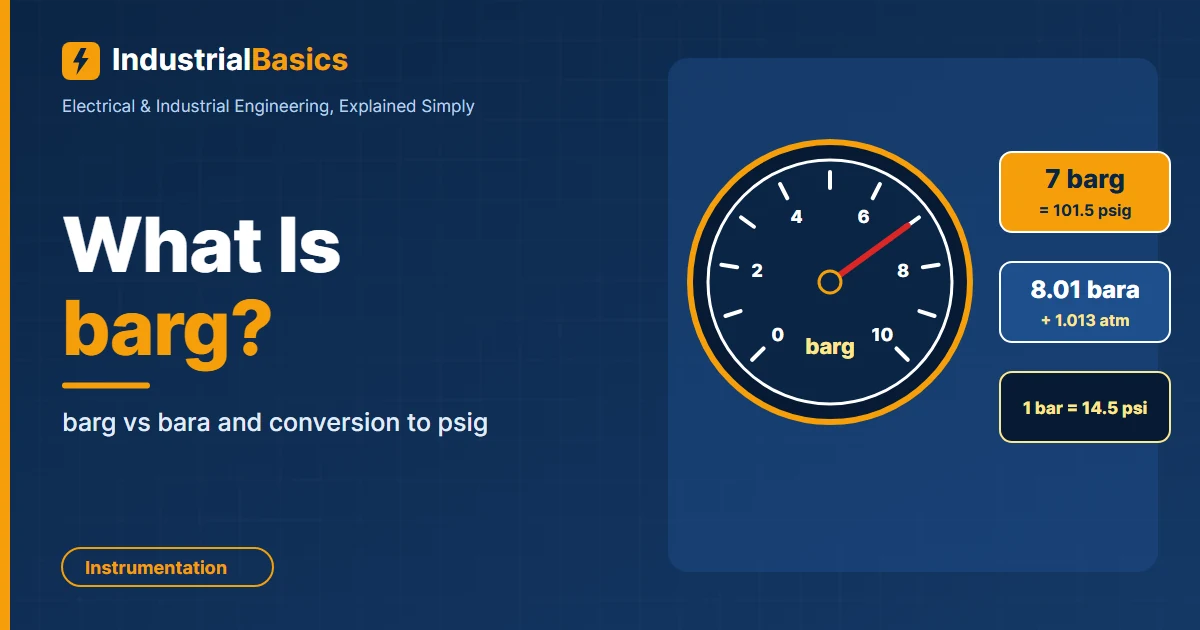
barg means bar gauge: pressure in bar measured from the surrounding atmosphere, so an open gauge reads 0 barg. bara (bar absolute) is measured from a perfect vacuum, so bara = barg + atmospheric pressure, about 1.013 bar at sea level. One bar is exactly 100,000 Pa (100 kPa), equal to 14.504 psi, which makes barg the metric counterpart of psig: 7 barg = 101.5 psig = about 8.01 bara.
What Is the Bar Unit?
Wikipedia defines the bar as a metric unit of pressure equal to 100,000 Pa (100 kPa or 1,000 hPa). It is not part of the SI, but it is widely used because 1 bar is close to atmospheric pressure: standard sea-level atmosphere is about 1.013 bar. The bar and millibar were introduced by Norwegian meteorologist Vilhelm Bjerknes. In industry, Wikipedia notes hydraulic machinery is rated in hundreds of bar (300 bar is common), and ship piping systems are often measured in bar.
barg vs bara
| barg (gauge) | bara (absolute) | |
|---|---|---|
| Zero point | Local atmospheric pressure | Perfect vacuum |
| Open to air reads | 0 barg | About 1.013 bara at sea level |
| Can be negative? | Yes (vacuum) | No |
| US equivalent | psig | psia |
| Typical use | Process and hydraulic gauges, equipment ratings | Vacuum, gas calculations, compressor ratios |
Wikipedia notes that “barg” and “bara” are deprecated abbreviations that still prevail in the oil industry, and recommends fuller wording such as “gauge pressure of 2 bar”. It also explains why: gauge pressure is relative to the local atmosphere, which varies by about 50 mbar, so barg and bara cannot be converted exactly without knowing the actual atmospheric pressure. For the full gauge vs absolute explanation in US units, see our psig vs psia guide.
barg Converter
barg to psig Chart
| barg | psig | bara (sea level) | kPa gauge |
|---|---|---|---|
| 0.5 | 7.3 | 1.51 | 50 |
| 1 | 14.5 | 2.01 | 100 |
| 2 | 29.0 | 3.01 | 200 |
| 3 | 43.5 | 4.01 | 300 |
| 4 | 58.0 | 5.01 | 400 |
| 5 | 72.5 | 6.01 | 500 |
| 6 | 87.0 | 7.01 | 600 |
| 7 | 101.5 | 8.01 | 700 |
| 8 | 116.0 | 9.01 | 800 |
| 10 | 145.0 | 11.01 | 1,000 |
| 12 | 174.0 | 13.01 | 1,200 |
| 16 | 232.1 | 17.01 | 1,600 |
| 20 | 290.1 | 21.01 | 2,000 |
| 25 | 362.6 | 26.01 | 2,500 |
| 40 | 580.2 | 41.01 | 4,000 |
| 100 | 1,450.4 | 101.01 | 10,000 |
| 160 | 2,320.6 | 161.01 | 16,000 |
| 250 | 3,625.9 | 251.01 | 25,000 |
| 350 | 5,076.3 | 351.01 | 35,000 |
Common reference points: shop compressed air at 7 barg is about 101.5 psig; 10 barg is 145 psig; 16 barg is 232 psig; 300 bar hydraulics is about 4,350 psi.
When to Use barg or bara
- barg: checking pipe, vessel, hose and fitting ratings; reading local gauges; setting pressure switches and regulators.
- bara: gas law and density calculations, vacuum measurement, compressor pressure ratios, and anything that must not depend on the weather. See SCFM vs CFM for flow conversions that use absolute pressure.
- At altitude: use the local atmospheric pressure in bar; our pressure at altitude calculator gives it.
Frequently Asked Questions
What is barg?
Bar gauge: pressure in bar measured relative to the surrounding atmosphere. A gauge open to the air reads 0 barg. It is the metric counterpart of psig.
What is the difference between barg and bara?
barg is gauge pressure (zero = atmosphere); bara is absolute pressure (zero = perfect vacuum). bara = barg + atmospheric pressure, about 1.013 bar at sea level, so 5 barg ≈ 6.01 bara.
What is 1 bar in psi?
14.50 psi. NIST gives 1 psi = 6,894.757 Pa, and 1 bar is exactly 100,000 Pa, so 1 bar = 14.5038 psi.
How do you convert barg to psig?
Multiply by 14.504. 7 barg = 101.5 psig; 10 barg = 145.0 psig. Gauge stays gauge.
Is bar an SI unit?
No. Wikipedia notes the bar is a metric unit defined as 100,000 Pa (100 kPa) but is not part of the SI. It is accepted in practice for pressure in industry and weather.
Is 1 bar the same as 1 atmosphere?
Close but not equal: 1 standard atmosphere is 1.01325 bar. Wikipedia notes 1 bar is roughly atmospheric pressure at about 111 m altitude.
Can barg be negative?
Yes. A vacuum reads below 0 barg, down to about −1.013 barg at sea level. bara can never be negative.
Why are barg and bara “not interconvertible”?
Because gauge pressure depends on the local atmosphere, which varies by about 50 mbar with weather (and more with altitude). Wikipedia notes this is why the barg/bara suffixes are discouraged; you need the actual atmospheric pressure to convert accurately.
What does “bar” stand for?
It comes from the Greek baros, weight, as in barometer. The unit was introduced by meteorologist Vilhelm Bjerknes.
Where is barg used?
Wikipedia notes the barg/bara usage prevails in the oil industry, and bar is common for hydraulics (300 bar is typical for industrial machinery), tire pressures outside the US, ship piping systems and European equipment data plates.
Sources and Further Reading
- Wikipedia: Bar (unit): definition, history, barg/bara usage and applications.
- NIST SP 811, Appendix B.8: bar and psi in pascals.



