
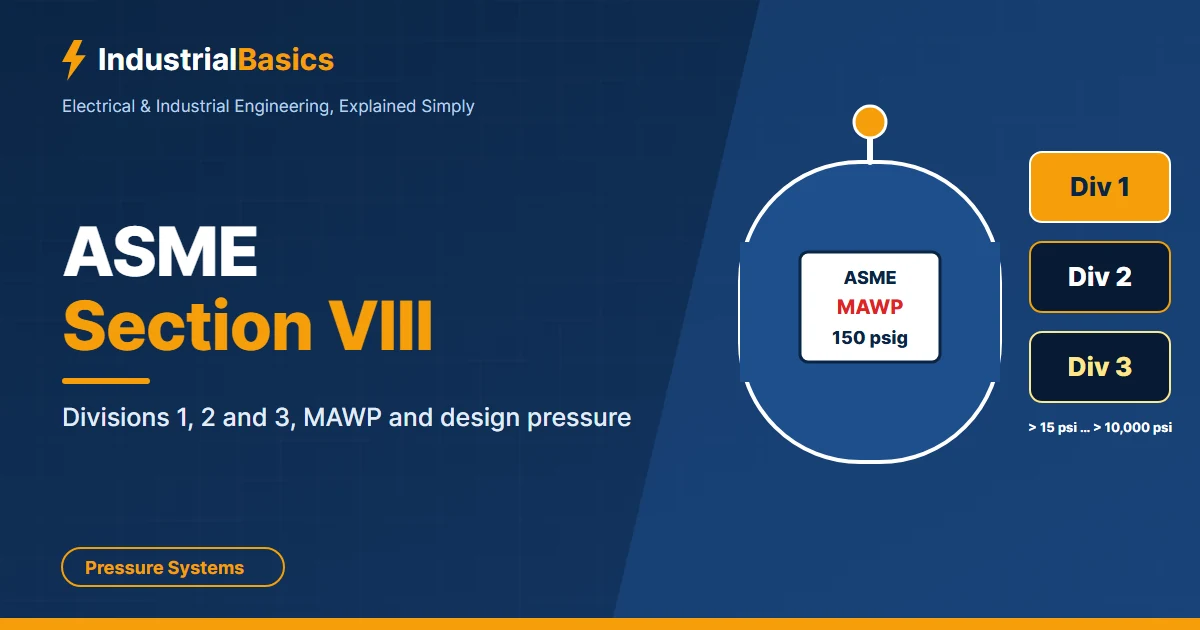
ASME Section VIII is the part of the ASME Boiler and Pressure Vessel Code that governs the design, fabrication, inspection, testing and certification of pressure vessels. Division 1 covers vessels above 15 psi (100 kPa); Division 2 gives alternative, more rigorous rules that allow higher design stresses; Division 3 covers high-pressure vessels, generally above 10,000 psi. Every Section VIII vessel carries a nameplate with its MAWP (maximum allowable working pressure), the pressure that must never be exceeded in operation, with relief valves set at or below it.
The Three Divisions of Section VIII
| Division 1 | Division 2 | Division 3 | |
|---|---|---|---|
| Scope (Wikipedia) | Vessels with internal or external pressure above 15 psi (100 kPa) | Alternative rules to Division 1 | High-pressure vessels, above 10,000 psi (70 MPa) |
| Design approach | Design by rule (formulas) | Design by rule and design by analysis (FEA) | Specialized high-pressure rules |
| Allowable stress | Lower | Higher allowed | Specific to high pressure |
| Material, design and NDE requirements | Standard | More onerous | Most demanding |
| Typical use | Air receivers, tanks, heat exchangers, process vessels | Large or high-value vessels where thinner walls save cost | Very high-pressure equipment |
Wikipedia describes Division 1 as covering materials, design, fabrication, inspection and testing, markings and reports, overpressure protection and certification for fired or unfired vessels above 15 psi. Its rules are organized into subsections and lettered parts, such as Part UG (general requirements for all methods of construction and all materials). Division 2 rules can be used as an alternative; they are generally more onerous for materials, design and nondestructive examination, but higher design stress values are allowed, and Part 5 permits design by analysis with finite element methods.
MAWP, Design Pressure and Operating Pressure
| Term | Meaning (Wikipedia) |
|---|---|
| Operating pressure | The pressure the vessel normally runs at; maximum expected operating pressure (MEOP) is the highest expected. |
| Design pressure | The pressure the item is designed to, higher than any expected operating pressure. |
| MAWP | Maximum pressure, based on the design code, that the weakest component can handle; stamped on the equipment and not to be exceeded. |
| MAOP | Limit usually set by a regulator for pipelines and gas systems; less than MAWP. |
| Relief set pressure | Set at the design pressure (or MAWP), with sizing based on the allowed overpressure. |
Because vessels are built from standard plate and pipe thicknesses, Wikipedia notes many components end up with a MAWP higher than the required design pressure. All these pressures are defined at the highest point of the vessel in its operating position and exclude static head, so designers must allow for the extra liquid head lower down; see psi to feet of head and hoop stress for the wall stress behind the numbers.
Relief Valves and Overpressure
Wikipedia notes relief valves are set at the design pressure and sized to prevent over-pressurization, and that ASME Section VIII Divisions 1 and 2 allow a 10% overpressure (accumulation) when sizing, with an additional 10% allowance for a fire relief case. In practice that means a vessel stamped 150 psig may briefly reach 165 psig while the valve relieves, or about 182 psig in a fire case. Steam boilers follow different ASME criteria.
The Nameplate and U-Stamp
Wikipedia’s pressure vessel article notes that a vessel’s nameplate shows information such as the maximum allowable working pressure and maximum temperature, the minimum design metal temperature, the manufacturer, the date, its National Board registration number and the ASME stamp for pressure vessels (U-stamp). Keep the nameplate visible and legible: inspectors, insurers and anyone setting a relief valve or pressure switch need it.
- Compressed air receivers are among the most common Section VIII vessels in plants; check that the compressor’s maximum discharge pressure and the receiver relief setting stay within the receiver’s MAWP. See psig vs psia for pressure references.
- Re-rating a vessel to a higher pressure requires engineering calculations and authorization under the applicable inspection code.
- Repairs and alterations to code vessels are done by authorized repair organizations and documented.
Frequently Asked Questions
What is ASME Section VIII?
Section VIII of the ASME Boiler and Pressure Vessel Code (BPVC) sets rules for the construction of pressure vessels: materials, design, fabrication, inspection and testing, markings, overpressure protection and certification. It has three divisions.
What does ASME Section VIII Division 1 cover?
Wikipedia: mandatory requirements, prohibitions and guidance for pressure vessels with internal or external pressure exceeding 15 psi (100 kPa), fired or unfired. It is the division used for most general-purpose pressure vessels.
What is the difference between Division 1 and Division 2?
Division 2 is a set of alternative rules. Wikipedia notes they are generally more onerous for materials, design and nondestructive examination, but allow higher design stress values, and include design by analysis (finite element analysis). The trade-off is thinner, lighter vessels for more engineering and inspection.
What is ASME Section VIII Division 3?
Alternative rules for high-pressure vessels, generally above 10,000 psi (70 MPa), per Wikipedia.
What is MAWP?
Maximum allowable working pressure: the maximum pressure, based on the design code, that the weakest component of the vessel can handle at its design temperature. It is stamped on the nameplate and must not be exceeded in operation.
What is the difference between design pressure and MAWP?
Design pressure is what the vessel was designed for and is higher than any expected operating pressure. Because standard plate and pipe thicknesses are used, the finished vessel often has a MAWP higher than the design pressure.
What is the difference between MAWP and MAOP?
MAOP (maximum allowable operating pressure) is a limit usually set by a regulator for pipelines and gas systems; Wikipedia notes MAOP is less than MAWP.
Where is the relief valve set relative to MAWP?
At or below MAWP for a single valve. Wikipedia notes ASME Section VIII allows an overpressure (accumulation) of 10% when sizing relief valves, with an additional allowance for fire cases (up to 121% of MAWP).
What is the U-stamp?
The ASME certification mark for Section VIII Division 1 pressure vessels. Wikipedia notes the vessel nameplate shows design data such as MAWP and temperature, the manufacturer, National Board registration and the ASME stamp.
Is static head included in MAWP?
Wikipedia notes that for pressure vessels the pressures are defined at the highest point of the unit and do not include static head; the designer must account for higher pressure lower in the vessel. See psi to feet of head.
Sources and Further Reading
- Wikipedia: ASME Boiler and Pressure Vessel Code: Section VIII divisions and scope.
- Wikipedia: Maximum allowable operating pressure: MAWP, MAOP, design pressure and relief overpressure.
- Wikipedia: Pressure vessel: nameplate data and U-stamp.



