
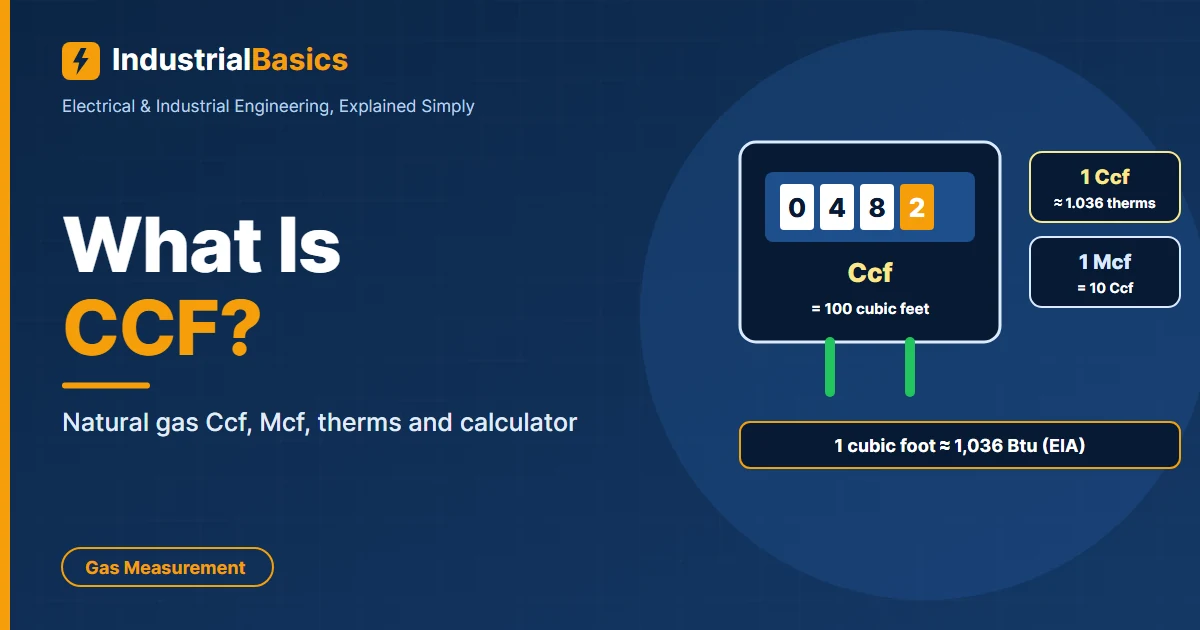
Ccf (CCF) is a natural gas volume unit equal to 100 cubic feet, measured at standard conditions. The C is the Roman numeral for 100, so 1 Mcf = 1,000 cubic feet = 10 Ccf. At the U.S. average heating value of 1,036 Btu per cubic foot (EIA), one Ccf holds about 103,600 Btu, or roughly 1.04 therms. Utilities convert your Ccf to therms with the “therm factor” printed on the bill.
Ccf, Mcf, MMcf and Therms Explained
| Unit | Meaning | Cubic feet | Energy at 1,036 Btu/ft³ |
|---|---|---|---|
| cf | cubic foot | 1 | 1,036 Btu |
| Ccf | hundred cubic feet | 100 | 103,600 Btu |
| Mcf | thousand cubic feet | 1,000 | 1,036,000 Btu |
| MMcf | million cubic feet | 1,000,000 | 1,036 MMBtu |
| Bcf | billion cubic feet | 1,000,000,000 | 1,036,000 MMBtu |
| therm | 100,000 Btu (energy) | ≈ 96.5 | 100,000 Btu |
| Dth (dekatherm) | 1,000,000 Btu (energy) | ≈ 965 | 1 MMBtu |
Wikipedia notes that gas industry multiples use Roman-numeral prefixes rather than metric ones: C for hundred, M for thousand and MM for million. So an Mcf is a thousand cubic feet, not a million, and MMcf is a million. Bcf (billion) and Tcf (trillion) appear in production and reserves figures.
Why Your Bill Converts Ccf to Therms
A gas meter measures volume, but what you are buying is heat. The heating value of natural gas varies with its makeup: more ethane, propane or butane raises it, while carbon dioxide or nitrogen lowers it. Utilities therefore multiply the Ccf used by a therm factor (also called a Btu factor) to get therms (Wikipedia, Therm). Wikipedia gives typical heating values of about 975 to 1,100 Btu per cubic foot, so the factor is usually close to 1.0. The EIA U.S. average of 1,036 Btu/ft³ gives 1.036 therms per Ccf.
| Your meter reading | Therm factor | Therms billed | Btu |
|---|---|---|---|
| 20 Ccf | 1.036 | 20.72 | 2,072,000 |
| 50 Ccf | 1.036 | 51.80 | 5,180,000 |
| 80 Ccf | 1.036 | 82.88 | 8,288,000 |
| 120 Ccf | 1.036 | 124.32 | 12,432,000 |
CCF Gas Calculator
Standard vs Actual Cubic Feet
A standard cubic foot (scf) is the amount of gas in one cubic foot at reference conditions. For natural gas these are 60 °F and about 14.73 psia (some definitions use 14.696 or 14.70 psia). Compressed industrial gases in the U.S. use 70 °F and 14.696 psia (Wikipedia). Gas at higher pressure or lower temperature packs more scf into each actual cubic foot. Utilities correct for this when meters run at elevated pressure.
Wikipedia’s example: 1 actual cubic foot at 50 psig and 80 °F, with 13.6 psi atmospheric pressure and a 14.73 psia base, is 1 × (63.6/14.73) × (519.67/539.67) = 4.16 scf. For compressed air flow rates (SCFM, ACFM), see SCFM vs CFM, and for gauge vs absolute pressure see psig vs psia.
Common Natural Gas Conversions
| From | To | Multiply by |
|---|---|---|
| Ccf | cubic feet | 100 |
| Mcf | Ccf | 10 |
| Ccf | therms | × therm factor (≈ 1.036) |
| Ccf | Btu | 103,600 |
| Ccf | kWh (heat) | 30.36 |
| Mcf | MMBtu | 1.036 |
| MMBtu | scf | 965 |
| cubic feet | cubic meters | 0.02832 |
| therm | kWh | 29.31 |
How to Read a Gas Meter in Ccf
- Note the units printed on the meter face: it may register cubic feet, hundreds of cubic feet (Ccf) or cubic meters.
- Take two readings a known time apart. The difference is the gas used in that period.
- Convert to therms with your utility’s therm factor if you want to check the bill.
- Watch for pressure correction: commercial meters at elevated pressure have a pressure multiplier on the bill that converts actual to standard cubic feet.
Frequently Asked Questions
What is a Ccf?
Ccf (often written CCF) means 100 cubic feet of natural gas measured at standard conditions. The C is the Roman numeral for 100. In the United States, natural gas is commonly billed in Ccf or therms (Wikipedia).
What does Ccf stand for on a gas bill?
One hundred cubic feet (C is the Roman numeral for 100). Your meter reading difference, in hundreds of cubic feet, is the number of Ccf you used.
How many therms are in a Ccf?
About 1.036 at the U.S. average heating value of 1,036 Btu per cubic foot (EIA, 2026 estimate). Your utility prints the exact therm factor on the bill. With heating values of about 975 to 1,100 Btu/ft³, it falls roughly between 0.975 and 1.10.
What is the difference between Ccf and Mcf?
A Ccf is 100 cubic feet; an Mcf is 1,000 cubic feet, so 1 Mcf = 10 Ccf. Mcf is common in wholesale and industrial gas; MMcf (a million cubic feet) and Bcf (a billion) are used for pipelines and production.
How many Btu are in a cubic foot of natural gas?
EIA uses 1,036 Btu per cubic foot for gas delivered to U.S. consumers (2026 estimate). Wikipedia gives a range of about 975 to 1,100 Btu/ft³ depending on the mix of gases.
What is a standard cubic foot (scf)?
One cubic foot of gas at reference conditions. For natural gas that is 60 °F and about 14.73 psia (some sources use 14.696 or 14.70 psia). Industrial gases in the U.S. use 70 °F and 14.696 psia.
How do I convert MMBtu to scf?
Divide 1,000,000 Btu by the heating value. At 1,036 Btu/scf, 1 MMBtu ≈ 965 scf, or about 0.965 Mcf.
How do I convert actual cubic feet to standard cubic feet?
Multiply by the absolute line pressure over base pressure and by base temperature over line temperature (both absolute). Wikipedia’s example: 1 ft³ at 50 psig and 80 °F (13.6 psi atmosphere) is about 4.16 scf.
How many kWh is a Ccf of gas?
About 30.4 kWh of heat content: 103,600 Btu ÷ 3,412 Btu per kWh (EIA).
Is a Ccf the same as a therm?
No. A Ccf is a volume and a therm (100,000 Btu) is energy. They are close, because 100 cubic feet of typical gas holds a little over 100,000 Btu, but the therm factor on your bill converts one to the other.
Sources and Further Reading
- U.S. EIA: Energy conversion calculators: 1 cubic foot of natural gas = 1,036 Btu (2026 estimate), 1 kWh = 3,412 Btu.
- U.S. EIA: Units and calculators explained: 1 therm = 100,000 Btu and fuel comparison method.
- Wikipedia: Standard cubic foot: scf reference conditions, ccf/Mcf/MMcf, actual-to-standard conversion.
- Wikipedia: Therm: therm, dekatherm, therm factor, heating value range, CO2 per therm.



