
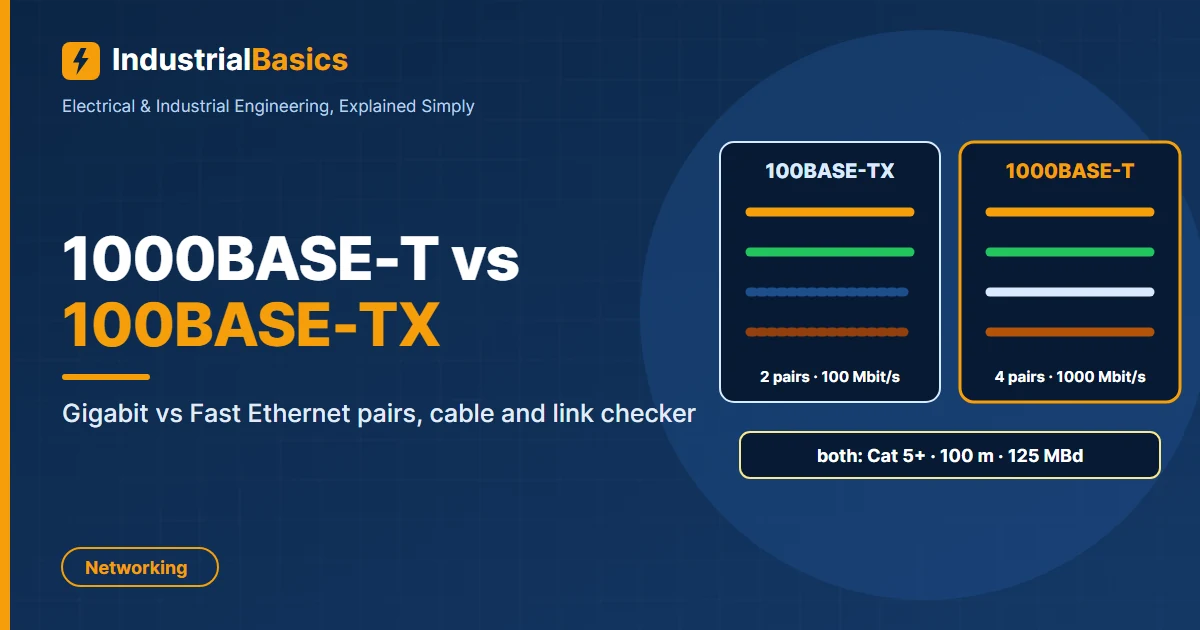
1000BASE-T is Gigabit Ethernet (1000 Mbit/s) over all four pairs of Cat 5 or better cable, sending and receiving on every pair at once. 100BASE-TX is Fast Ethernet (100 Mbit/s) over two pairs: one to transmit and one to receive. Both reach 100 m (328 ft) per segment, and gigabit ports fall back to 100BASE-TX automatically. 1000BASE-T is defined by IEEE 802.3ab (1999) and 100BASE-TX by IEEE 802.3u (1995).
1000BASE-T vs 100BASE-TX Comparison
| 100BASE-TX | 1000BASE-T | |
|---|---|---|
| Name | Fast Ethernet | Gigabit Ethernet |
| Standard | IEEE 802.3u (1995) | IEEE 802.3ab (1999) |
| Data rate | 100 Mbit/s | 1000 Mbit/s |
| Pairs used | 2 (pins 1-2 and 3-6) | All 4 |
| Direction | One pair each way | All pairs both ways (echo cancellation) |
| Encoding | 4B5B + MLT-3 (three levels) | 4D-PAM-5 with trellis coding (five levels) |
| Symbol rate | 125 MBd | 125 MBd per pair |
| Cable | Cat 5 or better | Cat 5, 5e or 6 |
| Max segment | 100 m (328 ft) | 100 m (328 ft) |
| Autonegotiation | Supported by most equipment (with Auto MDI-X) | Required (sets master/slave clock) |
| Spare pairs | Free for PoE, phone or a second link | None: all four carry data |
How 1000BASE-T Gets 10× the Speed
The two standards use the same 125 MBd symbol rate, so 1000BASE-T fits through cable rated for 100BASE-TX. It gets ten times the throughput in three ways:
- Four pairs instead of one per direction: 1000BASE-T uses all four pairs.
- Both directions at once: hybrid circuits with echo cancellation let each pair send and receive at the same time, as telephone hybrids do.
- More bits per symbol: five-level PAM-5 carries more information per symbol than three-level MLT-3. Four-dimensional trellis coding gives about 6 dB of coding gain, so noise immunity matches 100BASE-TX.
100BASE-TX first encodes 4-bit groups as 5-bit symbols (4B5B) at 125 MBd, then uses MLT-3 to cut the fundamental frequency to 31.25 MHz. Its transmitter sends +1 V, 0 V or −1 V. On the cable, 1000BASE-T uses five nominal levels between +1 V and −1 V.
Ethernet Link Checker
Why a Gigabit Port Links at 100 Mbit/s
Autonegotiation runs on only two pairs. If two gigabit ports are joined by a cable with only two working pairs, they can agree on 1000 Mbit/s and then never bring the link up, because 1000BASE-T needs all four pairs (Wikipedia, Gigabit Ethernet). Most 1000BASE-T chips have a diagnostic register that reports this. A link stuck at 100 Mbit/s on gigabit hardware usually means:
- A broken or unterminated pair (often pins 4-5 or 7-8) at a jack or plug.
- An old two-pair patch cord, or a cable split to carry two 100BASE-TX links.
- A port or device that is genuinely 10/100 only (many older PLCs, HMIs and drives).
- A run over 100 m, or cable below Cat 5.
Other Gigabit Variants: 1000BASE-X, TX and T1
| Standard | Medium | Reach | Notes |
|---|---|---|---|
| 1000BASE-T | 4-pair Cat 5/5e/6 copper | 100 m | The common copper gigabit port |
| 1000BASE-SX | Multimode fiber, 770–860 nm | 220–550 m (fiber grade) | 802.3z; up to ~1 km on OM3/OM4 per manufacturers |
| 1000BASE-LX | Single-mode fiber, 1,270–1,355 nm | Up to 5 km | Also 550 m on multimode |
| 1000BASE-CX | Shielded balanced copper | 25 m | Predates 1000BASE-T; rarely used |
| 1000BASE-TX | Twisted pair, 2 pairs each way | — | TIA/EIA-854 (2001); not widely adopted |
| 1000BASE-T1 | Single twisted pair | Up to 40 m (type B) | 802.3bp-2016; automotive and industrial |
| 100BASE-T1 | Single twisted pair | 15 m | Automotive Ethernet |
“1000BASE-X” is the umbrella name for the fiber variants (and 1000BASE-CX/KX copper) that use 8b/10b encoding, based on Fibre Channel physical layers. Long runs between buildings, or through electrically noisy areas, use fiber to get past the 100 m copper limit.
In Industrial Networks
- Device ports: many PLCs, drives, remote I/O and HMIs still have 10/100 ports. A gigabit switch handles them at 100 Mbit/s automatically. Gigabit matters for backbones, vision cameras and data collection.
- Connectors: the 8P8C (RJ45) has a fragile latch. Factory automation often uses the M12X connector (IEC 61076-2-109), with four shielded pairs rated to Cat 6A.
- Spare pairs: on 100BASE-TX links the spare pairs can carry PoE. Single-pair Ethernet can carry power with PoDL, up to 50 W.
- Serial alternatives: for slow fieldbus links over long distances, RS-485 is still common; see RS-232 vs RS-485.
Most industrial devices on these cables speak an automation protocol on top; see what is Profinet and how it compares with EtherNet/IP.
Frequently Asked Questions
What is 1000BASE-T?
Gigabit Ethernet over twisted-pair copper, defined by IEEE 802.3ab (1999). It runs 1000 Mbit/s over all four pairs of Cat 5 or better cable, up to 100 m (328 ft) per segment.
What is 100BASE-TX?
Fast Ethernet over twisted-pair copper, defined by IEEE 802.3u (1995). It runs 100 Mbit/s over two pairs of Cat 5 or better cable, up to 100 m, one pair in each direction.
Is 1000BASE-T backward compatible with 100BASE-TX?
Yes, in practice. Gigabit ports are normally 10/100/1000 and use autonegotiation to pick the fastest mode both ends support, so a gigabit switch links to a Fast Ethernet device at 100 Mbit/s.
Why does my gigabit port only connect at 100 Mbit/s?
Usually because only two pairs are connected or one pair is damaged. 100BASE-TX needs two pairs; 1000BASE-T needs all four. Check the cable with a tester and re-terminate it.
Does 1000BASE-T need Cat 6?
No. IEEE 802.3ab works on Category 5, 5e or 6 cable. Cat 5e is the usual minimum for new installs, and Cat 6 gives more margin.
What is the difference between 1000BASE-T and 1000BASE-TX?
1000BASE-TX (TIA/EIA-854, 2001) was a TIA design using two pairs to transmit and two to receive, meant to simplify the electronics. 1000BASE-T, not 1000BASE-TX, is the copper gigabit standard found on equipment.
What is 1000BASE-X?
The family of Gigabit Ethernet fiber standards (and 1000BASE-CX/KX copper) from IEEE 802.3z: 1000BASE-SX on multimode fiber and 1000BASE-LX on single-mode fiber up to 5 km, using 8b/10b encoding.
What is 1000BASE-T1?
Gigabit Ethernet over a single twisted pair (IEEE 802.3bp-2016), mainly for automotive and industrial use. It reaches up to 40 m with link segment type B and uses new single-pair connectors (IEC 63171).
Can I run two 100BASE-TX links on one cable?
Yes. 100BASE-TX uses only pins 1-2 and 3-6, so the spare pairs can carry a second link, phone lines or PoE. This is not possible with gigabit, which needs all four pairs.
What do TX and RX mean on an Ethernet port?
Transmit and receive. On 100BASE-TX a host (MDI) transmits on pins 1-2 and receives on 3-6, and a switch (MDI-X) does the reverse. 1000BASE-T sends and receives on all four pairs at once, so the TX/RX split does not apply.
Sources and Further Reading
- Wikipedia: Gigabit Ethernet: 802.3ab/802.3z, 1000BASE-T signaling, two-pair failure, 1000BASE-X/TX/SX/LX.
- Wikipedia: Fast Ethernet: 802.3u, 100BASE-TX pairs, 4B5B and MLT-3.
- Wikipedia: Ethernet over twisted pair: MDI/MDI-X, signal levels, spare pairs, single-pair Ethernet, connectors.
- Wikipedia: Automotive Ethernet: 100BASE-T1 and 1000BASE-T1.



