
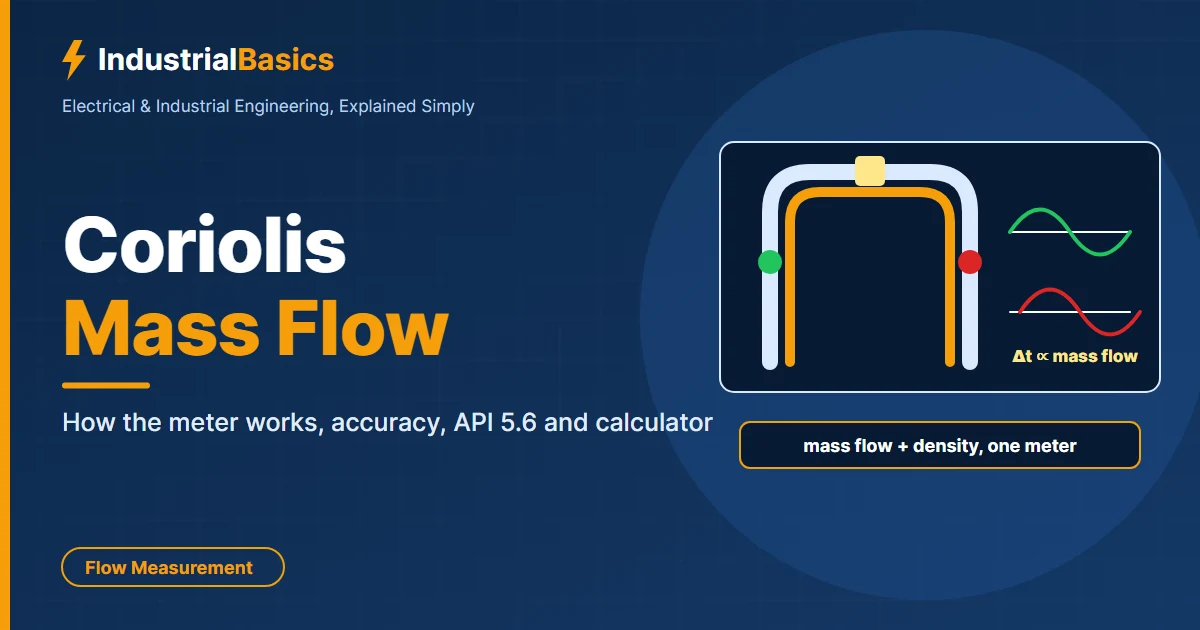
Coriolis mass flow measurement uses a vibrating tube that twists as fluid flows through it. The time shift between sensors at the inlet and outlet is proportional to the mass flow rate, and the tube’s vibration frequency gives the fluid density. A Coriolis meter therefore reads mass flow, density and volume flow directly, for liquids or gases, with no moving parts in the flow and no need to correct for pressure or temperature.
How a Coriolis Meter Works
- Vibration: a drive coil vibrates the flow tube (or a pair of parallel tubes) at its natural frequency. Depending on meter size this is 80 to 1,000 Hz, too small an amplitude to see but enough to feel.
- Twist: fluid flowing away from the vibration axis must be sped up and fluid flowing back must be slowed down. So the inlet arm lags behind the vibration and the outlet arm leads it.
- Measurement: pickoff sensors on each arm see the same frequency but shifted in phase. The time lag τ is proportional to mass flow.
- Density: the natural frequency depends on the combined mass of tube and fluid, so it gives the fluid density. Mass flow ÷ density = volume flow.
Wikipedia gives the mass flow of a U-tube meter as Qm = (Ku − Iuω²) τ / (2Kd²). Here Ku is the temperature-dependent tube stiffness, K a shape factor, d the tube width, τ the time lag, ω the vibration frequency and Iu the tube’s inertia. Twin tubes vibrating in opposition make the meter less sensitive to outside vibration.
Mass Flow to Volume Flow Calculator
Example: 12,000 kg/h of a liquid at 850 kg/m³ is 14.12 m³/h, or about 62.2 US gpm. Because the meter measures density continuously, the volume reading stays right when the product or temperature changes.
Advantages and Limitations
| Advantages | Limitations |
|---|---|
| Direct mass flow: no pressure or temperature correction for gases | Tube damage (pitting, coating, erosion, corrosion) shifts calibration over time |
| Measures density as well, so it also gives volume flow | Changes in tube stiffness with temperature and pressure must be compensated |
| Works on liquids and gases, conductive or not | Entrained gas (multiphase flow) complicates measurement |
| No moving parts in the flow stream | Viscous fluids may need a larger, less accurate model (Daya Bay example) |
| Very high accuracy and repeatability | Accuracy depends on staying above the minimum flow in the specification |
Coriolis vs Other Flow Meters
| Meter | Measures | Principle | Key requirement |
|---|---|---|---|
| Coriolis | Mass flow + density | Tube twist from the Coriolis effect | Tube full of fluid; check for entrained gas |
| Magnetic (magmeter) | Velocity → volume flow | Faraday’s law | Conductive liquid, non-conducting liner |
| Ultrasonic transit-time | Velocity → volume flow | Time difference with and against flow | Clean fluid: bubbles and solids reduce accuracy |
| Ultrasonic Doppler | Velocity | Doppler shift off particles | Enough particles or bubbles to reflect sound |
| Thermal mass | Mass flow (gases) | Heat transfer to the flow | Known, constant gas properties |
| Turbine | Volume flow | Rotor speed | Low viscosity, clean fluid; straight pipe |
| Orifice / DP | Volume flow (from √ΔP) | Bernoulli | Long straight runs; permanent pressure loss |
For differential-pressure meters, see the orifice flow equation. For gas flow units, see SCFM vs CFM. More instruments are covered in types of industrial sensors.
Calibration, Verification and API MPMS 5.6
Both mass flow and density depend on how the tube vibrates, so anything that changes tube rigidity shifts the calibration. Temperature and pressure effects are compensated with zero and span factors. Wear such as pitting, cracking, coating, erosion or corrosion cannot be compensated dynamically. It is monitored with regular calibration or verification checks, and an accepted offset can be added to the calibration factor (Wikipedia).
For custody transfer of liquid hydrocarbons, API MPMS Chapter 5.6, “Measurement of Liquid Hydrocarbons by Coriolis Meters”, describes how to reach custody-transfer accuracy. It covers the API standards that apply, proving and verification by both mass- and volume-based methods, and installation, operation and maintenance. Its appendix gives mass- and volume-based calculation procedures (API publications catalog).
A Short History
Gaspard-Gustave de Coriolis published the physics in 1835. Vibrating mass flowmeters were developed in the Soviet Union from 1969 (Rivkin, Shishkin and Skugorov) for multiphase oil-gas-water flow. In the U.S., James E. Smith built a curved U-tube meter in 1977 and founded Micro Motion in Boulder, Colorado. Micro Motion introduced the dual-tube design in 1983 to cancel plant vibration. Endress+Hauser (1987) and KROHNE (1994) added straight-tube designs for hygienic food and pharmaceutical processes (Wikipedia).
For the pressure drop of viscous fluids in laminar flow through small tubes, see the Hagen-Poiseuille equation and its calculator.
Frequently Asked Questions
What is Coriolis mass flow measurement?
Measuring the mass flow rate of a liquid or gas directly from the Coriolis effect: fluid moving through a vibrating tube makes the tube twist, and the twist (seen as a time or phase shift between two sensors) is proportional to mass flow.
How does a Coriolis flow meter work?
A drive coil vibrates the flow tubes at their natural frequency. With flow, the inlet side lags and the outlet side leads the vibration. Pickoff sensors on each side measure the time lag, which the transmitter converts to mass flow.
Does a Coriolis meter measure density?
Yes. The tubes’ natural frequency depends on the mass of tube plus contents, so measuring the frequency gives fluid density. The transmitter divides mass flow by density to give volume flow (Wikipedia).
How accurate is a Coriolis meter?
Very accurate for both liquids and gases. As an example, one manufacturer’s sensors are specified at 0.1% maximum linearity error and 0.05% repeatability above a minimum flow (from the Daya Bay detector paper). Accuracy falls at very low flow, and depends on calibration and installation.
Can a Coriolis meter measure gas?
Yes. Coriolis meters measure gas mass flow directly, independent of pressure and temperature effects, and can be used on natural gas (Wikipedia).
What affects Coriolis meter accuracy?
Changes in tube stiffness from temperature and pressure (compensated by the transmitter), and long-term tube damage such as pitting, cracking, coating, erosion or corrosion, which cannot be compensated dynamically and needs verification checks (Wikipedia).
What is API MPMS Chapter 5.6?
The API Manual of Petroleum Measurement Standards chapter “Measurement of Liquid Hydrocarbons by Coriolis Meters”. It describes how to reach custody-transfer accuracy, covering proving and verification by mass and volume methods, plus installation, operation and maintenance.
What is the difference between a Coriolis and a magnetic flow meter?
A magmeter measures velocity (and so volume flow) of a conductive liquid using Faraday’s law. A Coriolis meter measures mass flow and density directly, and works on non-conductive liquids and on gases.
Who invented the Coriolis flow meter?
Practical vibrating-tube meters were developed independently in the Soviet Union (Rivkin and colleagues, from 1969) and the U.S., where James E. Smith built a curved U-tube design in 1977 and founded Micro Motion. Dual-tube designs followed in 1983, and straight-tube designs from Endress+Hauser (1987) and KROHNE (1994).
How is it spelled: coriolis, coriolus or coreolis?
Coriolis, after the French mathematician Gaspard-Gustave de Coriolis, who published the physics of the effect in 1835.
Sources and Further Reading
- Wikipedia: Mass flow meter: Coriolis principle, mass flow equation, density, calibration effects and history.
- Wikipedia: Flow measurement: Coriolis, magnetic, ultrasonic, thermal, turbine and DP meters.
- API: Petroleum Measurement publications catalog (PDF): scope of MPMS Chapter 5.6.
- arXiv: The Daya Bay Antineutrino Detector Filling System and Liquid Mass Measurement (PDF): Coriolis meters in a 0.1%-class mass measurement, example specifications.



