
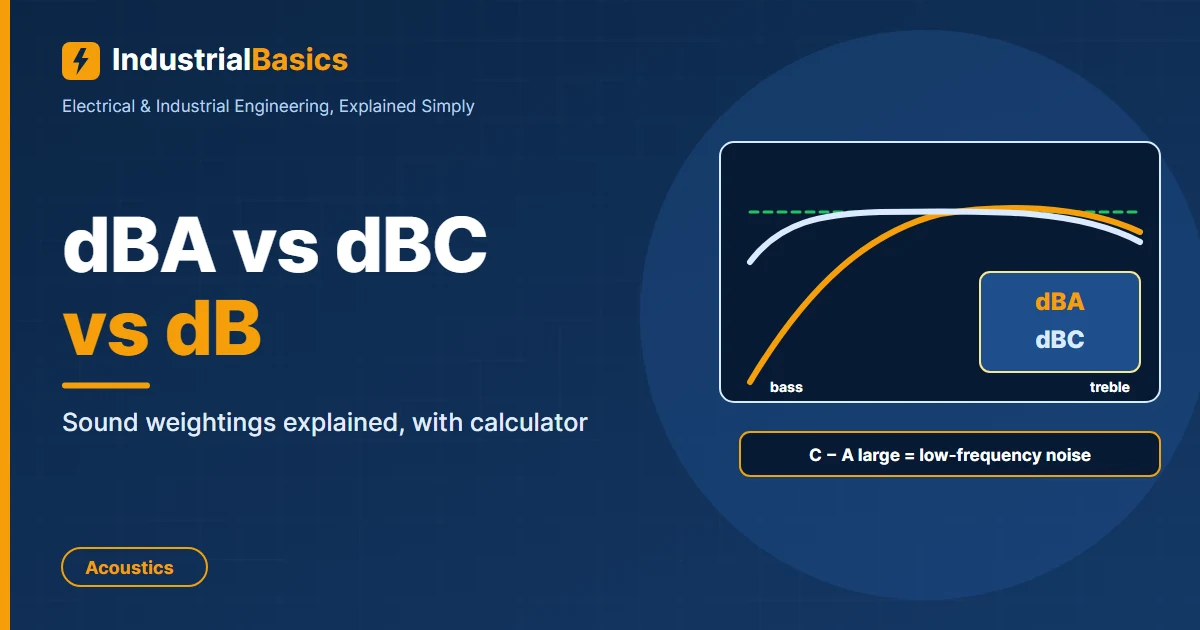
dBA (dB(A)) is a sound level measured with A-weighting, which cuts low and very high frequencies to match how people hear moderate sounds. dBC uses C-weighting, which is almost flat and keeps the bass. The same noise therefore reads higher in dBC when it has strong low-frequency content. Plain dB (dBZ or dB SPL) is unweighted. Use dBA for environmental noise and hearing risk, and dBC for loud, bass-heavy sound and peaks.
dBA vs dBC vs dBZ
| dBA | dBC | dBZ / dB SPL | |
|---|---|---|---|
| Weighting | A (IEC 61672) | C (IEC 61672) | Z: flat 10 Hz–20 kHz |
| Based on | 40-phon equal-loudness contour | Loud-sound hearing; nearly flat | No weighting |
| Low frequencies | Strongly reduced (−26.2 dB at 63 Hz) | Slightly reduced (-3.0 dB at 31.5 Hz) | Unchanged |
| Typical use | Environmental and workplace noise, appliances | Music/PA, machinery bass, peak levels | Analysis, peak, frequency spectra |
| Required on meters | All sound level meters | Class 1 meters (at least for testing) | Introduced in 2003 |
A and C Weighting by Octave Band
| Octave band (Hz) | 31.5 | 63 | 125 | 250 | 500 | 1000 | 2000 | 4000 | 8000 |
|---|---|---|---|---|---|---|---|---|---|
| A-weighting (dB) | -39.5 | -26.2 | -16.2 | -8.7 | -3.2 | +0.0 | +1.2 | +1.0 | -1.1 |
| C-weighting (dB) | -3.0 | -0.8 | -0.2 | -0.0 | +0.0 | +0.0 | -0.2 | -0.8 | -3.0 |
Wikipedia notes that A-weighting was based on the 40-phon Fletcher–Munson equal-loudness curve and is applied to all sound level meters under IEC 61672. Research has since shown that pure-tone loudness curves do not match how people perceive noise, especially low-frequency noise. A-weighted readings can therefore understate how annoying a low hum is, and comparing dBA with dBC helps.
Octave Band to dBA and dBC Calculator
With the sample spectrum (machinery with strong low-frequency content), the overall level is 93.2 dBZ, 91.7 dBC and only 80.8 dBA, a C − A difference of 10.9 dB. A large C − A gap is a common sign of low-frequency noise, the case where A-weighted limits may not reflect complaints.
Which Weighting to Use
- Hearing conservation and workplace noise: dBA for time-weighted exposure; Wikipedia notes daily exposure above 85 dB(A) raises the risk of hearing damage. Peak levels are measured with C or Z weighting.
- Environmental noise (road, rail, aircraft): dBA.
- Equipment noise ratings: appliances, fans and compressors usually publish A-weighted sound power or pressure.
- Music, PA and low-frequency machinery: dBC shows the bass energy that dBA discounts.
- Diagnostics: dBZ with octave or one-third-octave bands shows what frequencies to treat.
Decibel Basics
Sound pressure level is 20·log₁₀(p/p₀) with p₀ = 20 µPa, so 0 dB SPL is the reference. Levels from independent sources add on an energy basis, not arithmetically. Two equal 80 dB sources make 83 dB, and a source 10 dB quieter adds only about 0.4 dB. The same logarithmic idea underlies electrical decibels, but lowercase dBc in electronics means decibels relative to a carrier, not C-weighted sound. Motors and drives are a common machinery noise source; see kW to hp for motor sizing basics.
Frequently Asked Questions
What does dBA mean?
A-weighted decibels, written dB(A) or dBA: a sound level measured through the A-weighting filter, which reduces low and very high frequencies to approximate how the human ear hears sound at moderate levels. It is the usual unit for environmental and workplace noise.
What is the difference between dBA and dBC?
Both are sound pressure levels, but dBC uses C-weighting, which is nearly flat (−3 dB points at about 31.5 Hz and 8 kHz). dBA cuts low frequencies heavily (about −26 dB at 63 Hz). So bass-heavy noise reads much higher in dBC than in dBA.
What is the difference between dB and dBA?
Plain dB (dB SPL) is the unweighted sound pressure level relative to 20 µPa. dBA applies the A-weighting first. For a 1 kHz tone they are equal; for low-frequency sound dBA is lower.
What is dBZ?
Z-weighted (zero) level: a flat response from 10 Hz to 20 kHz, introduced in IEC 61672 (2003) to replace manufacturers’ various “linear” settings.
When should I use dBC?
For loud and low-frequency sound: music and PA systems, engines, compressors and transformer hum, and for peak measurements, where national rules typically call for C or Z weighting.
How loud is 50 dBA?
It is an A-weighted level 50 dB above the 20 µPa reference and 35 dB below the 85 dB(A) daily-risk level. Because decibels are logarithmic, 35 dB less means about 3,000 times less sound power.
What dBA level damages hearing?
Wikipedia notes that daily exposure above 85 dB(A) increases the risk of hearing damage. Workplace rules set limits based on level and duration.
What is the OSHA exchange rate?
US OSHA dosimetry uses a 5 dB exchange rate: every 5 dB increase halves the permitted exposure time. Most other countries use 3 dB (the equal-energy rule).
Can I convert dB to dBA?
Only if you know the frequency content. With octave-band levels, add the A-weighting correction to each band and combine the bands on an energy basis, as the calculator does. A single unweighted number cannot be converted.
What does dBc mean in electronics?
Lowercase dBc means decibels relative to the carrier, a radio and signal measurement unrelated to C-weighted sound level dB(C).
Sources and Further Reading
- Wikipedia: A-weighting: IEC 61672 A, C, Z weightings, formulas, 85 dB(A) risk level.
- Wikipedia: Sound level meter: meter classes, peak weighting, OSHA 5 dB exchange rate.
- Wikipedia: Decibel: definitions, adding levels, dBc.



