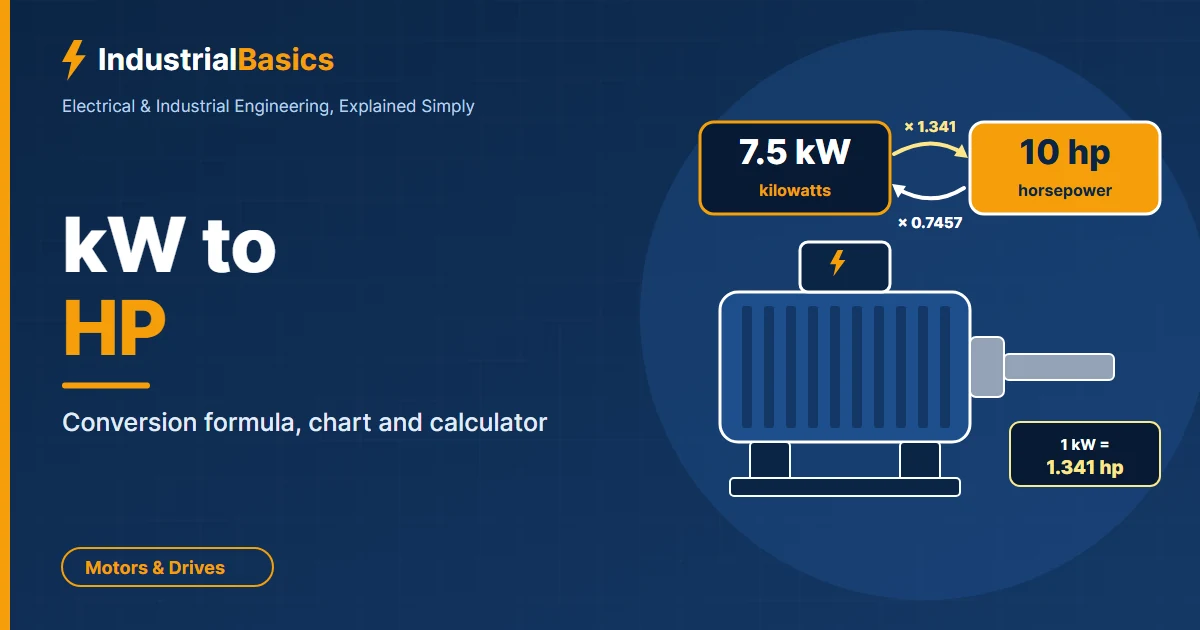
To convert kW to hp, multiply by 1.341. To convert hp to kW, multiply by 0.7457. One mechanical horsepower, the unit used for US motors and engines, is 745.7 watts, so 1 kW = 1.341 hp and 1 hp = 0.7457 kW. For example, 3 kW = 4.02 hp, 20 kW = 26.8 hp and 100 hp = 74.6 kW. For an electric motor, the result is shaft output; the power it draws from the supply is higher, because no motor is 100% efficient.
kW to HP Formula
NIST Special Publication 811 lists the horsepower (550 ft·lbf/s) as 745.6999 W. That is the mechanical horsepower James Watt standardized at 33,000 foot-pounds per minute, and it is the unit behind US motor nameplates, engine ratings and pump curves. Dividing 1,000 W by 745.6999 W gives the conversion factor:
- hp = kW × 1.341 (or kW ÷ 0.7457)
- kW = hp × 0.7457 (or hp ÷ 1.341)
- W = hp × 745.7
Worked examples
- 3 kW to hp: 3 × 1.341 = 4.02 hp.
- 25 kW to hp: 25 × 1.341 = 33.5 hp.
- 260 kW to hp: 260 × 1.341 = 348.7 hp.
- 2 hp to kW: 2 × 0.7457 = 1.49 kW.
- 600 hp to kW: 600 × 0.7457 = 447.4 kW.
kW to HP Calculator
kW to HP Conversion Chart
| kW | hp | kW | hp |
|---|---|---|---|
| 0.5 kW | 0.67 | 45 kW | 60.35 |
| 0.75 kW | 1.01 | 50 kW | 67.05 |
| 1 kW | 1.34 | 55 kW | 73.76 |
| 1.5 kW | 2.01 | 75 kW | 100.58 |
| 2 kW | 2.68 | 80 kW | 107.28 |
| 2.2 kW | 2.95 | 90 kW | 120.69 |
| 3 kW | 4.02 | 100 kW | 134.10 |
| 4 kW | 5.36 | 110 kW | 147.51 |
| 5 kW | 6.71 | 132 kW | 177.01 |
| 5.5 kW | 7.38 | 150 kW | 201.15 |
| 7.5 kW | 10.06 | 160 kW | 214.56 |
| 8 kW | 10.73 | 200 kW | 268.20 |
| 10 kW | 13.41 | 202 kW | 270.89 |
| 11 kW | 14.75 | 232 kW | 311.12 |
| 15 kW | 20.12 | 250 kW | 335.26 |
| 18.5 kW | 24.81 | 260 kW | 348.67 |
| 19.4 kW | 26.02 | 280 kW | 375.49 |
| 20 kW | 26.82 | 300 kW | 402.31 |
| 22 kW | 29.50 | 315 kW | 422.42 |
| 25 kW | 33.53 | 334 kW | 447.90 |
| 30 kW | 40.23 | 339 kW | 454.61 |
| 33 kW | 44.25 | 400 kW | 536.41 |
| 34.5 kW | 46.27 | 500 kW | 670.51 |
| 37 kW | 49.62 |
HP to kW Conversion Chart
| hp | kW | hp | kW |
|---|---|---|---|
| 0.5 hp | 0.37 | 75 hp | 55.93 |
| 1 hp | 0.75 | 85 hp | 63.38 |
| 1.5 hp | 1.12 | 90 hp | 67.11 |
| 2 hp | 1.49 | 100 hp | 74.57 |
| 3 hp | 2.24 | 125 hp | 93.21 |
| 5 hp | 3.73 | 150 hp | 111.85 |
| 7.5 hp | 5.59 | 200 hp | 149.14 |
| 10 hp | 7.46 | 250 hp | 186.42 |
| 15 hp | 11.19 | 300 hp | 223.71 |
| 20 hp | 14.91 | 400 hp | 298.28 |
| 25 hp | 18.64 | 493 hp | 367.63 |
| 30 hp | 22.37 | 500 hp | 372.85 |
| 40 hp | 29.83 | 600 hp | 447.42 |
| 50 hp | 37.28 | 1000 hp | 745.70 |
| 60 hp | 44.74 |
Mechanical, Electric and Metric Horsepower
| Unit | Watts (NIST SP 811) | kW to this unit | Where you see it |
|---|---|---|---|
| Mechanical hp (550 ft·lbf/s) | 745.6999 | × 1.341 | US motor nameplates, engines, pumps, compressors |
| Electric hp | 746 (exact) | × 1.340 | Some electrical calculations and older references |
| Metric hp (PS, CV, ch) | 735.4988 | × 1.360 | European and Asian vehicle and equipment specs |
| Boiler hp | 9,809.50 | × 0.102 | Steam boiler capacity only |
The Wikipedia horsepower article explains that metric horsepower is the power to lift 75 kg by one meter in one second, which works out to 735.5 W, or 98.6% of a mechanical horsepower. Converting a European spec sheet in PS with the US factor overstates the power by about 1.4%. Boiler horsepower is not a motor unit at all: it measures the rate a boiler evaporates water, about 33,475 Btu/h, so it never belongs in a motor kW to hp conversion.
Motor kW vs HP: Output, Input and Nameplates
Wikipedia notes that electric motor nameplates show “available shaft power output, not the electrical power input”, stated in kilowatts in most of the world and in horsepower in the United States. So converting a 10 hp nameplate to 7.46 kW tells you the mechanical power at the shaft, not the load the motor puts on your panel.
The US Department of Energy Motor Challenge fact sheet gives the input power at full rated load as Pin = hp × 0.7457 ÷ ηfl, where ηfl is the full-load efficiency from the nameplate. Engineering ToolBox writes the same relationship as efficiency = (hp × 746) ÷ input watts. Motor efficiency rises with size: the IEC 60034-30-1 premium (IE3) minimums in ABB’s technical note run from 82.5% at 0.75 kW to 95.0% at 75 kW for 4-pole motors at 50 Hz.
| Nameplate | Shaft output | Example efficiency | Electrical input at full load |
|---|---|---|---|
| 1 hp | 0.75 kW | 82.5% | 0.90 kW |
| 5 hp | 3.73 kW | 88.6% | 4.21 kW |
| 10 hp | 7.46 kW | 90.4% | 8.25 kW |
| 25 hp | 18.64 kW | 92.6% | 20.13 kW |
| 50 hp | 37.28 kW | 93.9% | 39.71 kW |
| 100 hp | 74.57 kW | 95.0% | 78.49 kW |
Calculating kW from volts and amps on a 3-phase motor
The DOE fact sheet uses this equation with the average line-to-line voltage, average current and average power factor of the three phases. Its worked example is a 40 hp, 1,800 rpm motor measured at 469.7 V, 37 A and 0.763 power factor: √3 × 469.7 × 37 × 0.763 ÷ 1,000 = 22.97 kW of input power, which the fact sheet reports as 22.9 kW. Comparing that with the full-load input (40 × 0.7457 ÷ η) tells you how heavily the motor is loaded. This is how “kW to hp conversion 3 phase” works in practice: measure kW in, then use efficiency to estimate hp out.
NEMA HP vs IEC kW Motor Sizes
US motors built to NEMA MG 1 are rated in horsepower steps; IEC motors are rated in kilowatt steps. The steps do not line up exactly, so a direct conversion rarely lands on a standard size. The table pairs each IEC rating with the closest NEMA horsepower, and shows the next NEMA size up wherever the closest one would deliver less power than the IEC motor it replaces.
| IEC rating | Exact hp | Closest NEMA size | NEMA size with no less output |
|---|---|---|---|
| 0.75 kW | 1.01 | 1 hp | same |
| 1.1 kW | 1.48 | 1.5 hp | same |
| 1.5 kW | 2.01 | 2 hp | same |
| 2.2 kW | 2.95 | 3 hp | same |
| 3 kW | 4.02 | 5 hp | same |
| 4 kW | 5.36 | 5 hp | 7.5 hp |
| 5.5 kW | 7.38 | 7.5 hp | same |
| 7.5 kW | 10.06 | 10 hp | same |
| 11 kW | 14.75 | 15 hp | same |
| 15 kW | 20.12 | 20 hp | same |
| 18.5 kW | 24.81 | 25 hp | same |
| 22 kW | 29.50 | 30 hp | same |
| 30 kW | 40.23 | 40 hp | same |
| 37 kW | 49.62 | 50 hp | same |
| 45 kW | 60.35 | 60 hp | same |
| 55 kW | 73.76 | 75 hp | same |
| 75 kW | 100.58 | 100 hp | same |
| 90 kW | 120.69 | 125 hp | same |
| 110 kW | 147.51 | 150 hp | same |
| 132 kW | 177.01 | 175 hp | same |
| 160 kW | 214.56 | 200 hp | 250 hp |
| 200 kW | 268.20 | 250 hp | 300 hp |
| 250 kW | 335.26 | 350 hp | same |
| 315 kW | 422.42 | 400 hp | 450 hp |
Consulting-Specifying Engineer points out that a NEMA motor usually carries a 1.15 service factor while IEC motors have no service factor (effectively 1.0). Where equipment such as a compressor was sized to use the service factor, an IEC replacement may need the next power rating up. It also notes that NEMA and IEC frames differ in shaft size and mounting dimensions, so matching the power is only the first check.
kW, HP and Torque at Motor Speed
Power on its own does not tell you how hard a motor can turn a load; torque and speed do. The Wikipedia horsepower article gives the US form, in which 5,252 is 33,000 ÷ 2π. The SI form uses 9,549, which is 60,000 ÷ 2π:
| Motor | kW | Torque at 1,750 rpm (lb·ft) | Torque at 3,450 rpm (lb·ft) |
|---|---|---|---|
| 1 hp | 0.75 | 3.0 | 1.5 |
| 5 hp | 3.7 | 15.0 | 7.6 |
| 10 hp | 7.5 | 30.0 | 15.2 |
| 25 hp | 19 | 75.0 | 38.1 |
| 50 hp | 37 | 150.1 | 76.1 |
| 100 hp | 75 | 300.1 | 152.2 |
A 4-pole motor (about 1,750 rpm at 60 Hz) gives roughly twice the torque of a 2-pole motor (about 3,450 rpm) of the same horsepower. For how speed relates to supply frequency, see Hz and rpm explained.
Where You Will Meet kW and HP in the US
- Motor nameplates: NEMA motors show hp; imported IEC motors show kW, and often hp too.
- VFDs and soft starters: often listed in both hp and kW. Size drives by the motor’s full-load amps as well as power.
- Generators and utility bills: always kW and kWh. A generator’s kW is electrical output, so the motor it can start depends on starting current, not just hp.
- Electric vehicles: EV motors are rated in kW; a 150 kW motor is about 201 hp.
- Engines: US car and truck engines are rated in SAE net horsepower at the crankshaft; European specs often use PS (metric hp) or kW.
For the motor control side of the job, see types of motor starters, and for how power factor changes the current a motor draws, read leading vs lagging power factor.
Common kW to HP Mistakes
- Using the metric factor (1.36) on US equipment. It overstates mechanical hp by about 1.4%.
- Treating nameplate hp as electrical load. Convert to kW and divide by efficiency to get input power.
- Confusing kW with kVA. kVA is apparent power; real power is kVA × power factor. A transformer or generator kVA rating is not motor horsepower.
- Assuming a converted value is a standard size. 4 kW is 5.36 hp, not 5 hp. Check the next standard size up.
- Using boiler horsepower in a motor calculation. It is about 13 times larger than mechanical hp.
Sizing a pump motor starts with head and flow; see psi to feet of head for converting pressure readings into the head on a pump curve.
Pump and engine data sheets often quote brake horsepower; see what is brake horsepower for what bhp means and how to calculate it for a pump.
Motors and fans are common noise sources; see dBA vs dBC for how their noise is measured and rated.
Frequently Asked Questions
How do you convert kW to hp?
Multiply kilowatts by 1.341. For example, 3 kW × 1.341 = 4.02 hp. The exact factor comes from NIST: one mechanical horsepower is 745.6999 W, so 1 kW = 1,000 ÷ 745.6999 = 1.341 hp.
How do you convert hp to kW?
Multiply horsepower by 0.7457. A 100 hp motor is 100 × 0.7457 = 74.57 kW of shaft output.
Is kW the same as hp?
No. Both measure power, but 1 kW is about 1.34 hp, so a kilowatt is roughly a third larger than a horsepower. 1 hp is about three quarters of a kilowatt.
How many hp is 1 kW?
1 kW = 1.341 mechanical hp, or 1.360 metric hp (PS).
Why do some sites use 1.36 instead of 1.34?
They are converting to metric horsepower (PS, CV), which is 735.5 W. US motors and engines are rated in mechanical horsepower (745.7 W), so 1.341 is the right factor in the US.
Is a motor rated in hp the input or the output?
The output. The nameplate hp of an electric motor is the power available at the shaft. The motor draws more than that from the supply because of its losses: input kW = hp × 0.7457 ÷ efficiency.
How do you calculate kW for a 3-phase motor?
Measured input power is kW = √3 × volts × amps × power factor ÷ 1,000. The DOE example motor at 469.7 V, 37 A and 0.763 power factor draws about 23 kW (22.9 kW in the fact sheet). That is electrical input, not shaft hp.
What size motor in kW is a 5 hp motor?
5 hp is 3.73 kW of output. The closest IEC rating is 4 kW (5.36 hp); the 3.7 kW rating is also sold. Check the full-load current and frame before swapping a NEMA motor for an IEC one.
How many kW is a 100 hp motor?
A 100 hp motor delivers 74.6 kW at the shaft. At a typical premium efficiency of about 95%, it draws roughly 78.5 kW from the supply at full load.
What is 1 hp in watts?
745.7 W for mechanical horsepower, exactly 746 W for electric horsepower and 735.5 W for metric horsepower, per NIST SP 811.
Sources and Further Reading
- NIST SP 811, Appendix B.8: Factors for units listed alphabetically: mechanical, electric, metric and boiler horsepower in watts.
- US DOE Motor Challenge: Determining Electric Motor Load and Efficiency (PDF): input power equations and the 40 hp worked example.
- Wikipedia: Horsepower: definitions, nameplate output and the 5,252 torque constant.
- ABB technical note: IEC 60034-30-1 efficiency classes (PDF): IEC kW ratings and IE3 minimum efficiencies.
- Consulting-Specifying Engineer: Differences between NEMA and IEC electric motors: service factor, frames and efficiency classes.
- Engineering ToolBox: Electric motors, torque vs power and speed: hp, kW and torque table.
- Engineering ToolBox: Electric motor efficiency: efficiency with output in hp.