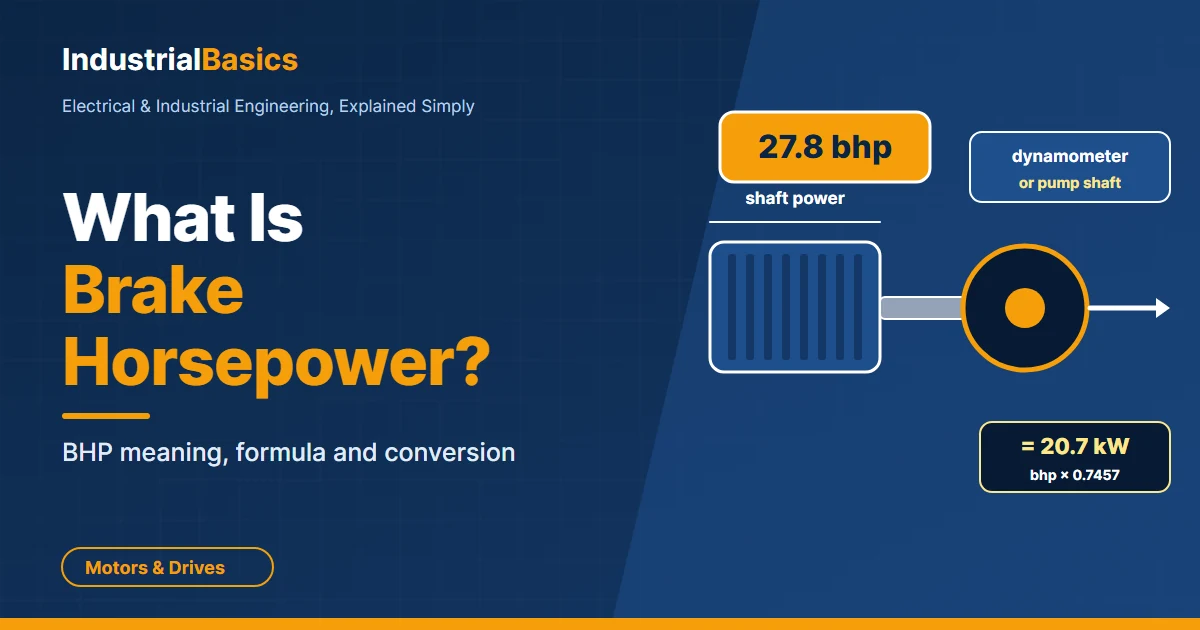
Brake horsepower (bhp) is the power a machine delivers at its output shaft, measured with a brake or dynamometer that loads the shaft, before any losses in gearboxes, drive belts or wheels. It uses the same unit as ordinary horsepower (1 hp = 745.7 W, so 1 bhp = 0.7457 kW), but it tells you where the power was measured. On pumps and fans, brake horsepower is the power the motor must supply to the shaft: BHP = gpm × head (ft) × SG ÷ (3,960 × pump efficiency).
What Brake Horsepower Means
The Wikipedia horsepower article defines brake horsepower as “the power measured using a brake type (load) dynamometer at a specified location, such as the crankshaft, output shaft of the transmission, rear axle or rear wheels.” The word brake refers to the device that loads the engine to hold it at a chosen speed while torque and speed are measured. Horsepower was once measured with a Prony brake on the output shaft; modern dynamometers do the same job electronically.
So bhp is not a different-sized unit. It is ordinary mechanical horsepower with a statement attached: this is the power available at the shaft. Wikipedia lists the chain from indicated horsepower (in the cylinders) to brake horsepower (at the crankshaft, after internal friction) to shaft horsepower (after the transmission) to wheel horsepower.
BHP vs HP vs Other Horsepower Ratings
| Rating | Where it is measured | Typical use |
|---|---|---|
| Indicated hp (ihp) | Inside the cylinders, from pressure | Engine design and old steam engines |
| Brake hp (bhp) | At the output shaft, under a brake load | Engines, pumps, fans, compressors |
| Shaft hp (shp) | At the propeller or turbine shaft | Turboprops, turbines, ships |
| Wheel hp (whp) | At the driven wheels, on a chassis dyno | Vehicle performance testing |
| Water hp (whp, pumps) | Power actually given to the liquid | Pump efficiency calculations |
| Motor nameplate hp | Rated shaft output of an electric motor | Motor selection |
| Boiler hp (also “BHP”) | Steam output, not shaft power | Industrial boilers only |
In cars, Wikipedia notes that before the 1972 model year US automakers advertised SAE gross brake horsepower, measured on a bare test engine, and then moved to SAE net horsepower (SAE J1349), measured with the production accessories fitted. Both are crankshaft (brake) ratings; net is lower because the alternator, water pump and exhaust take their share. Europe’s DIN 70020 measures in metric PS.
Converting BHP to kW, Watts and HP
Because bhp is mechanical horsepower, the conversions are the same as for any horsepower: NIST lists 1 hp as 745.6999 W.
| bhp | kW | W | Metric hp (PS) |
|---|---|---|---|
| 1 | 0.75 | 746 | 1.0 |
| 5 | 3.73 | 3,728 | 5.1 |
| 10 | 7.46 | 7,457 | 10.1 |
| 25 | 18.64 | 18,642 | 25.3 |
| 50 | 37.28 | 37,285 | 50.7 |
| 100 | 74.57 | 74,570 | 101.4 |
| 150 | 111.85 | 111,855 | 152.1 |
| 185 | 137.95 | 137,954 | 187.6 |
| 200 | 149.14 | 149,140 | 202.8 |
| 300 | 223.71 | 223,710 | 304.2 |
| 500 | 372.85 | 372,850 | 506.9 |
For the other direction and a full conversion chart, see our kW to hp conversion. Note that “brake horsepower to horsepower” needs no conversion factor: they are the same unit, measured at different points.
Brake Horsepower of a Pump
In pump work bhp is the shaft power the pump needs. Wilo’s formula sheet gives water horsepower = gpm × head (ft) × SG ÷ 3,960 and pump brake horsepower = water horsepower ÷ pump efficiency. Engineering ToolBox gives the same formula and works the example of 600 gpm against 110 ft of head at 60% efficiency: 27.8 hp at the pump shaft.
Why the constant is 3,960
One water horsepower lifts 3,960 gallons of water one foot per minute: 33,000 ft·lbf/min (one horsepower) divided by the 8.33 lb weight of a US gallon of water (Wilo) is about 3,960. Specific gravity scales it for other liquids, and the head in feet comes from the pump curve or from pressure readings. Our psi to feet of head guide shows how to turn gauge readings into head.
Sizing a Motor from Brake Horsepower
A centrifugal pump’s brake horsepower usually rises as flow increases, so the duty point is not the worst case. If the system lets the pump run further out on its curve (a pipe break, an open bypass, a second pump stopped), the bhp can climb past the motor rating. Practical rules:
- Read the maximum bhp on the pump curve for your impeller diameter, at the end of the curve, and size the motor to at least that value (a “non-overloading” selection).
- Correct for specific gravity. Curves are usually drawn for water; a liquid with SG 1.2 needs 20% more bhp.
- Pick the next standard size up. NEMA motors come in steps such as 20, 25, 30, 40 and 50 hp.
- Do not rely on service factor for normal running. Consulting-Specifying Engineer notes most NEMA motors carry a 1.15 service factor while IEC motors effectively have 1.0, so a design that uses the service factor may need a larger IEC motor.
Electrical input is higher again: the motor’s own efficiency adds its losses. At a 93% motor efficiency, the 27.8 bhp pump draws about 22.3 kW from the supply. Motor starting and protection are covered in types of motor starters.
Brake Horsepower in Engines and Aircraft
Engine bhp is measured on an absorbing dynamometer. Wikipedia’s dynamometer article explains that the power absorption unit loads the engine, converts the absorbed power to heat, and holds the chosen speed while torque is measured; absorbers include water brakes, eddy-current and magnetic powder brakes, and electric machines. Power is then calculated from torque and speed.
In aviation, the FAA Pilot’s Handbook of Aeronautical Knowledge uses brake horsepower for the power delivered to the propeller. It describes propeller efficiency as the ratio of thrust horsepower to brake horsepower, varying from about 50 to 87 percent depending on how much the propeller slips.
Common Mistakes
- Using water horsepower as the motor size. Divide by pump efficiency first.
- Sizing to the duty point only. Check the highest bhp on the curve.
- Forgetting specific gravity. Heavier liquids need proportionally more bhp.
- Confusing BHP with boiler horsepower. One boiler hp is about 9.8 kW, roughly 13 times larger.
- Comparing bhp with wheel hp. Wheel figures are always lower because of driveline losses.
Boiler ratings use a different unit entirely; see boiler horsepower for the steam-output definition and conversions.
Frequently Asked Questions
What is brake horsepower?
Brake horsepower (bhp) is the power an engine, motor or turbine delivers at its output shaft, measured with a brake-type load (a dynamometer). For a pump or fan, it is the power the driver must put into the shaft.
What is the difference between bhp and hp?
Both use the same unit (1 hp = 745.7 W). “hp” is the unit; “bhp” says where and how the power was measured: at the shaft, under a brake load, before transmission or driveline losses.
How do you convert bhp to kW?
Multiply by 0.7457: 100 bhp = 74.57 kW. To go from kW to bhp, multiply by 1.341.
How do you calculate pump brake horsepower?
BHP = gpm × head (ft) × specific gravity ÷ (3,960 × pump efficiency). For 600 gpm at 110 ft with a 60% efficient pump on water: 600 × 110 ÷ (3,960 × 0.6) = 27.8 bhp.
Why is it called brake horsepower?
Because it was measured with a brake. Early tests used a Prony brake clamped to the output shaft; modern dynamometers use water, eddy-current or electric absorbers to load the engine and measure torque and speed.
Is bhp more than hp at the wheels?
Yes. Brake horsepower is measured at the crankshaft, so it is higher than wheel horsepower, which has gearbox, differential, bearing and tire losses taken off.
What does brake horsepower mean on a pump curve?
It is the power the pump absorbs at each flow, at the impeller diameter shown. It usually rises with flow on a centrifugal pump, so the highest value on the curve is what the motor must be able to supply.
What motor size do I need for a given bhp?
Choose the next standard motor size at or above the maximum bhp on the pump curve. A 27.8 bhp duty point needs at least a 30 hp motor; check the end of the curve before settling on that.
Is BHP the same as boiler horsepower?
No. Boiler horsepower is a steam-output unit equal to about 9.8 kW (33,475 Btu/h), roughly 13 mechanical hp. It is also abbreviated BHP, so check the context.
What is brake horsepower in aviation?
It is the power the engine delivers to the propeller shaft. The FAA describes propeller efficiency as thrust horsepower divided by brake horsepower, typically 50 to 87 percent depending on propeller slip.
Sources and Further Reading
- Wikipedia: Horsepower: brake, indicated and shaft horsepower, SAE and DIN ratings.
- Wilo: Pump engineering conversions and formulas (PDF): water and brake horsepower formulas.
- Engineering ToolBox: Pump power: hydraulic and shaft power with a worked example.
- Wikipedia: Dynamometer: how absorbing dynamometers measure brake power.
- FAA Pilot’s Handbook of Aeronautical Knowledge, Chapter 5 (PDF): propeller efficiency and brake horsepower.
- Consulting-Specifying Engineer: NEMA vs IEC motors: service factor.
- NIST SP 811, Appendix B.8: horsepower in watts.