
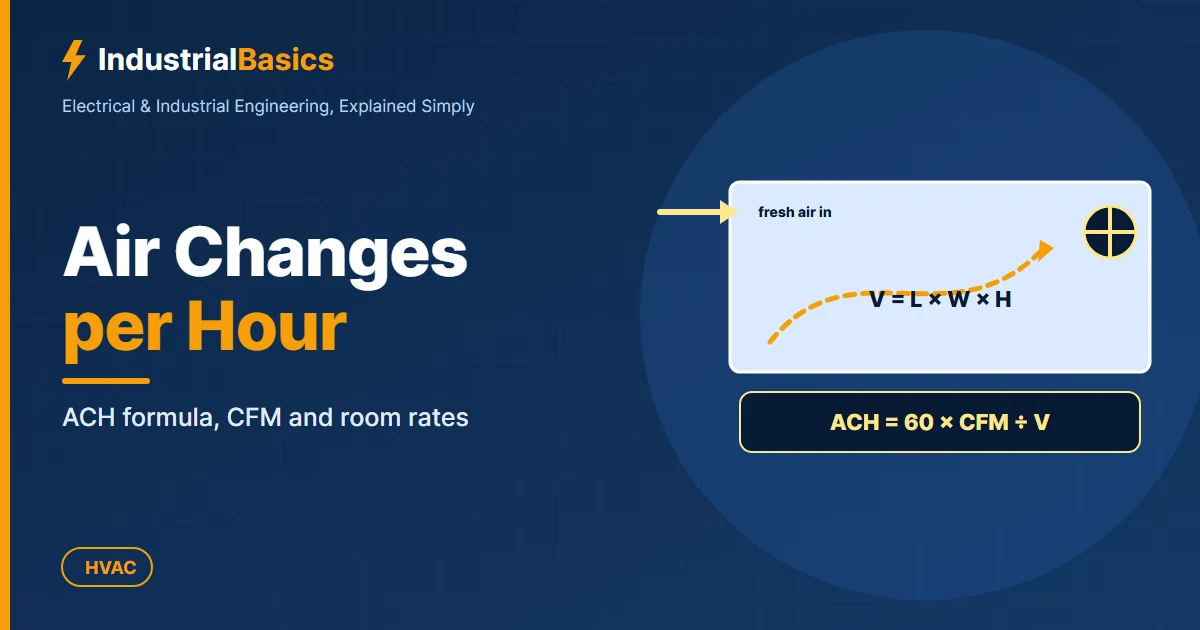
Air changes per hour (ACH) is the ventilation airflow divided by the room volume, per hour: ACH = 60 × CFM ÷ room volume (ft³). To size airflow, use CFM = ACH × volume ÷ 60. A 40 × 30 × 12 ft shop at 6 ACH needs 1,440 cfm. Typical rule-of-thumb rates run from 2–4 ACH for ordinary factory space to 10–15 with fumes or moisture and 15–20 for boiler rooms. In a perfectly mixed room, 1 ACH leaves 36.8% of a contaminant after an hour.
ACH Formula
Wikipedia defines ACH as the ratio of volumetric airflow to space volume, expressed per hour. It notes the definition does not mean the whole initial air volume is replaced at each nominal change. Only with uniform or perfectly mixed air does ACH equal the number of times the air is replaced. Supply and return airflow must balance to hold the room at equilibrium pressure. For airflow units, see SCFM vs CFM.
Air Changes per Hour Calculator
How Fast Ventilation Clears a Room
For a perfectly mixed space with no ongoing source, the concentration falls exponentially: C/C₀ = e−ACH·t. At 1 ACH, 36.8% remains after one hour, a 63.2% reduction (Wikipedia). Removing 90% takes 2.3/ACH hours and 99% takes 4.6/ACH hours. Real spaces have dead zones and short-circuiting between supply and exhaust, so clearing takes longer.
Recommended Air Change Rates
| Room or building | Air changes per hour |
|---|---|
| All spaces in general | min 4 |
| Factory buildings, ordinary | 2 – 4 |
| Factory buildings, with fumes or moisture | 10 – 15 |
| Machine shops | 6 – 12 |
| Foundries | 15 – 20 |
| Paint shops | 10 – 15 |
| Boiler rooms | 15 – 20 |
| Engine rooms | 4 – 6 |
| Pump rooms | 5 |
| Transformer rooms | 10 – 30 |
| Substation, electric | 5 – 10 |
| Computer rooms | 15 – 20 |
| Warehouses | 2 (up to 6 – 30 listed) |
| Garages, repair | 20 – 30 |
| Precision manufacturing | 10 – 50 |
| Offices, private | 4 |
| Kitchens | 15 – 60 |
| Residences | 1 – 2 |
Electrical rooms appear on the list because equipment heat must be removed: transformer rooms 10–30 ACH and substations 5–10. Heat removal is a separate calculation from air quality. Compare the airflow’s heat capacity with the equipment losses, and see the convection coefficient of air for surface heat transfer.
Frequently Asked Questions
What is air changes per hour (ACH)?
The ratio of the ventilation airflow to the room volume, expressed per hour: how many room volumes of air are supplied or exhausted each hour. It does not mean all the original air is physically replaced each time (Wikipedia).
How do you calculate air changes per hour?
ACH = 60 × Q / V, with Q in cubic feet per minute and V the room volume in cubic feet (length × width × height). In metric, ACH = Q / V with Q in m³/h.
How do you convert ACH to CFM?
CFM = ACH × room volume (ft³) ÷ 60. A 40 × 30 × 12 ft room at 6 ACH needs 6 × 14,400 ÷ 60 = 1,440 cfm.
How many air changes per hour do I need?
It depends on the use. Engineering ToolBox lists rules of thumb such as 2–4 ACH for ordinary factory buildings, 6–12 for machine shops, 10–15 for factories with fumes or moisture and 15–20 for boiler rooms. Codes and the number of occupants often govern instead.
What does 1 air change per hour remove?
In a perfectly mixed room with no ongoing source, 1 ACH leaves about 36.8% of a contaminant after one hour, a 63.2% reduction (Wikipedia).
How long does it take to clear a room?
With perfect mixing, removing 99% takes ln(100)/ACH ≈ 4.6/ACH hours: about 46 minutes at 6 ACH. Real rooms with poor mixing take longer.
What is ACH in HVAC?
The same measure used to size ventilation and exhaust: supply or exhaust airflow divided by room volume per hour. It is a common rule of thumb but is seldom the actual basis of code design.
How is ACH related to CFM per person?
Ventilation per person R_p = ACH × floor area per person × ceiling height ÷ 60 (in cfm/person, with feet).
What is equivalent ACH (eACH)?
The effect of filtration or air cleaning expressed as the air change rate that would give the same contaminant removal; it adds to outdoor-air ACH.
Is ACH used for code compliance?
Sometimes (for example hospital rooms), but residential and many commercial ventilation codes calculate required outdoor air from floor area and occupants rather than ACH (Wikipedia).
Sources and Further Reading
- Wikipedia: Air changes per hour: definition, formulas, decay relation, per-person conversion, eACH.
- Engineering ToolBox: Air change rates in typical rooms and buildings: rule-of-thumb ACH table.



