
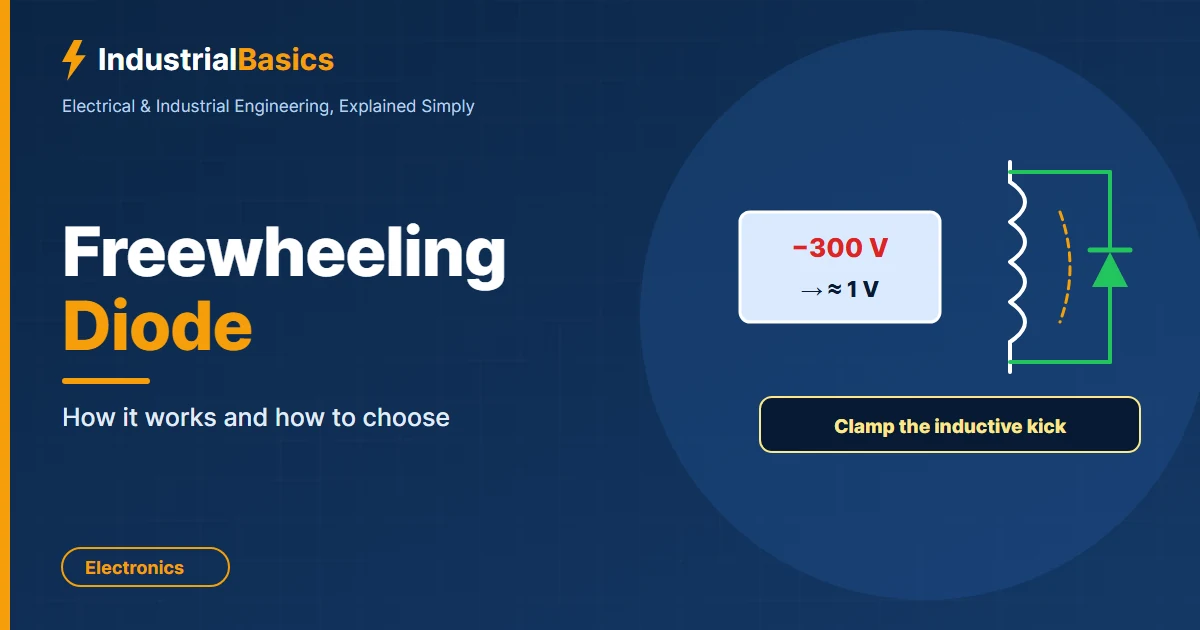
A freewheeling diode, also called a flyback diode, is a diode connected across an inductive load such as a relay coil, solenoid or DC motor. When the switch turns off, it gives the stored current a path to circulate and die away, instead of producing a high-voltage spike. It is reverse-biased in normal operation, with the cathode to the positive side. Without it, a 24 V solenoid can kick to hundreds of volts, arcing contacts and destroying transistors. With it, the switch sees only the supply plus about one volt. The trade-off is a slower release.
How a Freewheeling Diode Works
When a switch closes on an inductor, current rises at a rate set by V/L, storing energy in the magnetic field until it settles at V/R. When the switch opens, the inductor fights the sudden drop in current with a large reverse voltage, the inductive “kick”. That kick appears across the switch. It can arc and pit contacts, or destroy a transistor switch (Wikipedia).
A diode across the coil is reverse-biased while the switch is on, so it does not affect normal operation. At turn-off, the reversed coil voltage forward-biases it. The coil current then circulates through the diode, and the coil voltage is clamped to the diode drop of about 0.7–1.5 V. The current decays as the stored energy is lost in the winding resistance, typically over a few milliseconds for a small coil.
Freewheeling Diode Calculator
Default example: a 24 V solenoid with 48 Ω and 200 mH draws 0.5 A and stores 25 mJ. With a 1 V diode drop, the current freewheels to zero in about 13 ms, while the switch sees about 25 V. A 47 Ω series resistor raises the switch voltage to about 48.5 V but clears the current much faster.
Choosing a Freewheeling Diode
- Reverse voltage: above the supply voltage with margin, since it blocks the supply during normal operation.
- Current: at least the steady coil or motor current, which the diode carries briefly at turn-off. For PWM it carries load current every off-period, so rate it for the average current.
- Speed: a general-purpose rectifier such as the 1N4007 is fine for relays and solenoids. For switching converters, H-bridges and PWM motor drives, Wikipedia notes Schottky diodes are preferred for their low ~0.2 V drop and fast response.
- Placement: mount the diode at the coil, not at the controller, so the loop carrying the circulating current stays small.
Freewheeling Diodes in Motor Drives and PWM
In PWM speed control of DC motors and solenoids, the diode does more than suppress spikes. During each off-time it carries the motor’s load current, which keeps flowing, or “freewheels”, through the diode and winding. That is where the name comes from. In H-bridges, the MOSFET body diodes or dedicated diodes play the same role (see H-bridge). In buck converters and inverters, the freewheeling diode passes the inductor current between switching pulses.
Relay Coils and PLC Outputs
DC relay and contactor coils driven by PLC transistor outputs need suppression. Many outputs and relay sockets include it, but check before relying on it. Our relay snubber diode guide compares diode, diode-Zener, TVS and RC suppression, including why a plain diode can make relay contacts weld. For driving larger loads from PLC outputs, see interposing relays.
Frequently Asked Questions
What is a freewheeling diode?
A diode connected across an inductive load (coil, solenoid, motor or inductor) to give its current a path when the supply is switched off, preventing the large voltage spike called flyback. It is also called a flyback, snubber, commutating, suppressor, clamp or catch diode (Wikipedia).
How does a freewheeling diode work?
While the switch is on, the diode is reverse-biased and does nothing. When the switch opens, the coil’s induced voltage reverses and forward-biases the diode, so the stored current circulates through coil and diode and decays as heat in the winding resistance.
Which way does a freewheeling diode go?
Reverse-biased to the supply: cathode to the positive end of the coil, anode to the end that goes to the switch or ground side. Installed backwards it shorts the supply when the switch closes.
Why is a freewheeling diode needed?
Without it, opening the circuit makes the coil produce a voltage spike much larger than the supply. It arcs and pits relay contacts and can destroy transistors. Wikipedia shows a 24 V solenoid spiking to about −300 V, reduced to about −1.4 V with a diode.
Does a freewheeling diode slow relay dropout?
Yes. The circulating current holds the armature in briefly, delaying contact opening. Adding a series resistor or Zener speeds it up at the cost of a higher voltage at the switch.
What diode should I use as a freewheeling diode?
A diode whose reverse voltage rating exceeds the supply and whose current rating covers the coil current; a 1N4007 is common for small DC coils. For switching converters and PWM, Schottky diodes are preferred for their low forward drop (~0.2 V) and fast response.
Can a freewheeling diode be used on AC coils?
No. A diode across an AC coil would short every other half-cycle. AC coils use RC snubbers or varistors instead (see our relay snubber guide).
What is the difference between a flyback diode and a freewheeling diode?
They are the same thing. “Freewheeling” is common in motor drives and power electronics, where the diode carries load current during PWM off-time; “flyback” is common for relay and solenoid coils.
What happens if the freewheeling diode fails open?
The protection disappears: the switch sees the inductive spike again, causing contact arcing or a failed transistor. A shorted diode instead blows the fuse or overloads the driver when the switch turns on.
How long does the freewheeling current last?
Typically a few milliseconds for a small coil (Wikipedia). It decays roughly with the coil’s L/R time constant; the calculator above estimates it.
Sources and Further Reading
- Wikipedia: Flyback diode: operation, names, 24 V solenoid oscilloscope example, drop-out delay, Schottky diodes.



