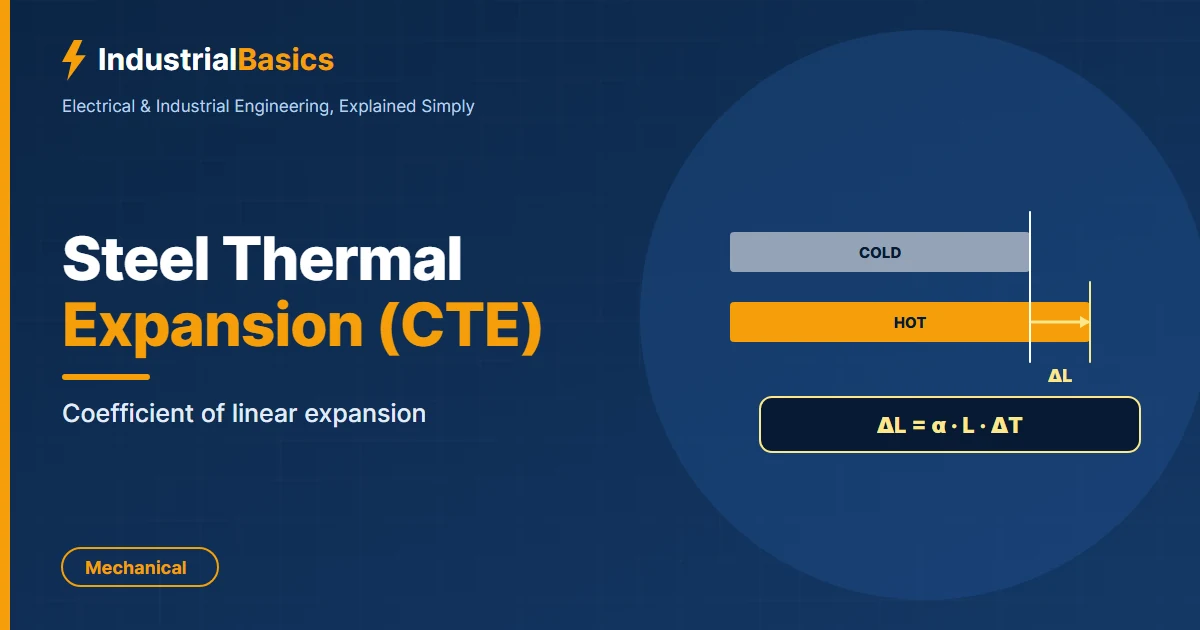
The coefficient of linear thermal expansion of carbon steel is about 10.8–12.5 × 10⁻⁶ per °C (6.0–6.9 × 10⁻⁶ per °F). Austenitic stainless expands more: 304 at 17.3 and 316 at 16.0 × 10⁻⁶/°C. Ferritic 410 stainless is close to carbon steel at 9.9. Use ΔL = α × L × ΔT. A 100 ft carbon steel pipe heated by 100 °F grows about 0.8 in (20 mm), so long runs need expansion loops or joints.
Thermal Expansion Coefficients of Steel and Other Materials
| Material | α (10⁻⁶ per °C) | α (10⁻⁶ per °F) |
|---|---|---|
| Carbon steel | 10.8 – 12.5 | 6.0 – 6.9 |
| Stainless 304 | 17.3 | 9.6 |
| Stainless 316 | 16 | 8.9 |
| Stainless 410 (ferritic) | 9.9 | 5.5 |
| Cast iron, gray | 10.8 | 6.0 |
| Aluminum | 23 | 12.8 |
| Copper | 16 – 16.7 | 8.9 – 9.3 |
| Brass | 18 – 19 | 10.0 – 10.6 |
| Concrete | 13 – 14 | 7.2 – 7.8 |
| Titanium | 8.5 – 9 | 4.7 – 5.0 |
| Nickel | 13 | 7.2 |
| Glass, plate | 9 | 5.0 |
| CPVC | 63 – 66 | 35.0 – 36.7 |
Thermal Expansion Formula
Engineering ToolBox explains that when an object is heated or cooled, its length changes in proportion to the original length and the temperature change. For isotropic solids, Wikipedia gives the area coefficient as about twice and the volumetric coefficient as about three times the linear value. That matters for tanks and enclosed volumes, while length change matters for piping, rails, ducts and machine frames.
Thermal Expansion Calculator
Why It Matters in Plants and Machines
- Piping: hot lines grow; use expansion loops, bellows and guides so anchors and equipment nozzles are not overloaded.
- Mixed materials: stainless bolted to carbon steel, or aluminum to steel, expand differently and can loosen joints or warp assemblies.
- Machine accuracy: a 1 m steel part grows about 12 μm per °C, which matters for precision measurement and machining (see tool center point).
- Structures and rails: long members need expansion joints; restrained expansion turns into stress.
- Busbars and conductors: copper and aluminum move with load temperature, so terminations need allowance (see what is a busbar).
For how cold work changes steel properties, see work hardening. For heat transfer from hot surfaces, see the convection coefficient of air.
Frequently Asked Questions
What is the coefficient of linear expansion of steel?
About 10.8–12.5 × 10⁻⁶ per °C for carbon steel (6.0–6.9 × 10⁻⁶ per °F), per Engineering ToolBox. A value of 12 × 10⁻⁶/°C is commonly used for estimates.
What is the CTE of 304 stainless steel?
17.3 × 10⁻⁶ per °C (9.6 × 10⁻⁶ per °F), about 45% more than carbon steel (Engineering ToolBox).
What is the CTE of 316 stainless steel?
16.0 × 10⁻⁶ per °C (8.9 × 10⁻⁶ per °F).
Why does stainless expand more than carbon steel?
It depends on the family: austenitic grades such as 304 and 316 expand noticeably more than carbon steel, while ferritic 410 stainless is close to carbon steel at 9.9 × 10⁻⁶/°C (Engineering ToolBox).
How much does a 100 ft steel pipe expand?
For a 100 °F rise, about 0.8 in using 12 × 10⁻⁶/°C (6.67 × 10⁻⁶/°F): ΔL = 6.67e-6 × 1,200 in × 100 = 0.8 in.
What is the formula for linear thermal expansion?
ΔL = α × L × ΔT, where α is the linear coefficient, L the original length and ΔT the temperature change.
How do I convert α from per °C to per °F?
Multiply by 5/9: 12 × 10⁻⁶/°C = 6.67 × 10⁻⁶/°F.
What is the volumetric expansion coefficient of steel?
For isotropic solids, about three times the linear coefficient (Wikipedia), so roughly 36 × 10⁻⁶ per °C for carbon steel.
Why do steel and concrete work together?
Their coefficients are similar (steel about 12, concrete 13–14 × 10⁻⁶/°C), so reinforcing steel and concrete expand together with little relative movement.
What happens if thermal expansion is restrained?
The material develops thermal stress instead of moving, which can buckle pipes and rails or overload anchors, supports and welds. Expansion loops, joints and sliding supports relieve it.
Sources and Further Reading
- Engineering ToolBox: Linear thermal expansion coefficients of materials.
- Wikipedia: Thermal expansion: linear, area and volumetric coefficients.