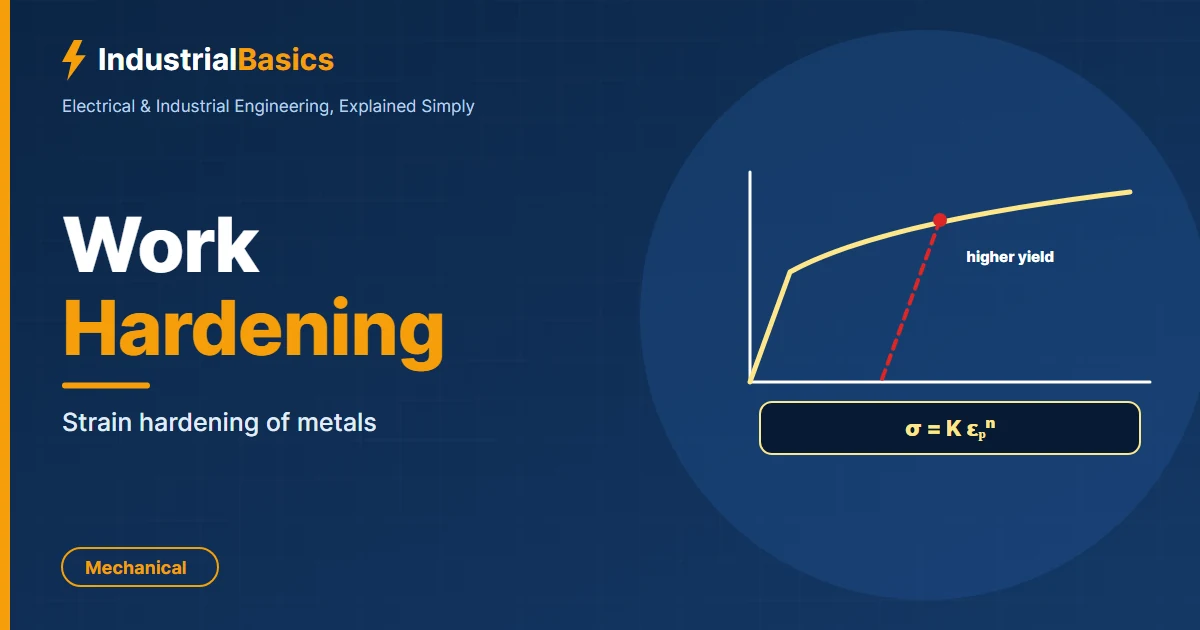
Work hardening, also called strain hardening, is the increase in strength and hardness a metal gains when it is permanently (plastically) deformed below its recrystallization temperature. Deformation multiplies and tangles dislocations in the crystal lattice, so more stress is needed to deform it further, while ductility drops. Cold rolling, wire drawing and bolt heading use it on purpose. Annealing reverses it. The Hollomon equation σ = Kεₚⁿ describes it, with n typically 0.2–0.5.
What Happens When Metal Work Hardens
A metal first deforms elastically, and the atomic bonds stretch and recover. Beyond the yield stress it deforms plastically as dislocations move through the lattice. Wikipedia explains that the deformation creates many new dislocations. They accumulate, interact and pin one another, so each further increment of strain needs more stress. Sub-grain boundaries also form and add Hall-Petch strengthening. The material gets stronger and harder, but less ductile.
Unload a work-hardened bar and it springs back along a line parallel to the original elastic slope, keeping its permanent strain. Reload it and it stays elastic up to the stress it reached before. That is why a cold-worked part has a higher yield strength than the annealed stock.
Hollomon Equation and Strain Hardening Exponent
Here σ is the true stress, K the strength coefficient, εₚ the plastic strain and n the strain hardening exponent. Wikipedia notes that K depends on structure and processing, while n is a material property normally between 0.2 and 0.5. Ludwik’s equation adds the initial yield stress: σ = σ₀ + Kεₚⁿ. For steels, more cold work and higher strength generally mean a lower n.
Cold Work Calculator
Cold Working Processes
Cold working shapes metal below its recrystallization temperature, usually at room temperature. The cold-forming groups are squeezing, bending, drawing and shearing. Applications include heading bolts and cap screws and finishing cold-rolled steel, using tool-steel or carbide dies at high speed and pressure. The result is higher hardness, yield strength and tensile strength (Wikipedia). For fastener dimensions, see 10-24 screw dimensions.
| Effect of more cold work | Direction |
|---|---|
| Yield strength | Increases |
| Tensile strength | Increases |
| Hardness | Increases |
| Ductility (elongation) | Decreases |
| Strain hardening exponent n (steels) | Tends to decrease |
Annealing: Reversing Work Hardening
Heating to a high enough temperature lets recovery and recrystallization reduce the dislocation density, restoring a soft, ductile, nearly defect-free lattice. Coppersmiths exploit this: copper gets harder and less ductile as it is hammered, so it is re-annealed periodically. Annealing stops near the final shape, so the finished part keeps the strength it needs (Wikipedia).
When Work Hardening Is a Problem
- Machining: early cutter passes can work-harden the surface and damage the tool on later passes. Superalloys such as Inconel need strategies that account for it. Keep feeds positive and avoid rubbing (see G83 peck drilling).
- Springs and flexing parts: special alloys and heat treatments are used to avoid work hardening and fatigue.
- Excessive cold work: worked beyond a certain hardness, metal tends to fracture, which is why copper is re-annealed during shaping (Wikipedia).
For bolt strength under load, see bolt shear stress.
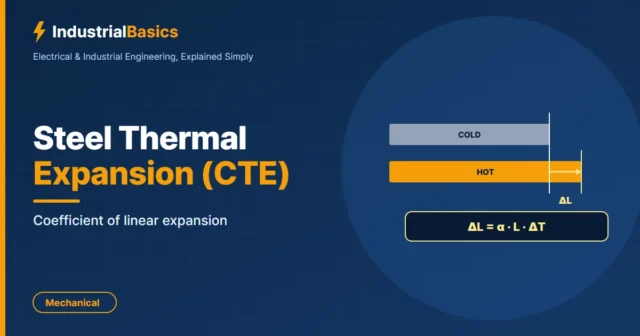
Temperature changes steel dimensions too: see the coefficient of linear expansion of steel.
Frequently Asked Questions
What is work hardening?
Also called strain hardening: the increase in a metal’s strength and hardness during plastic (permanent) deformation, caused by the generation and tangling of dislocations in the crystal lattice (Wikipedia).
What is the difference between strain hardening and work hardening?
None: they are two names for the same effect. “Cold working” is the deliberate use of it in processes such as rolling, drawing, bending and heading.
Why does work hardening make metal stronger?
Plastic deformation multiplies dislocations. They interact and pin one another, so further slip needs more stress. Strength rises roughly with the square root of dislocation density, while ductility falls.
How do you reverse work hardening?
Anneal it: heating above the recrystallization temperature lets recovery and recrystallization reduce the dislocation density and restore ductility. Coppersmiths re-anneal copper repeatedly while shaping it.
Which metals cannot be heat treated but can be work hardened?
Alloys not amenable to heat treatment, including low-carbon steel, are often strengthened by work hardening; pure copper and aluminum can be strengthened only this way (Wikipedia).
Why does work hardening cause problems in machining?
Early cutter passes can harden the surface, so later passes cut harder material and damage the tool. Superalloys such as Inconel are particularly prone (Wikipedia).
What is the Hollomon equation?
σ = K εₚⁿ: true flow stress as a power law of plastic strain, with K the strength coefficient and n the strain hardening exponent, normally 0.2–0.5.
What does the strain hardening exponent n mean?
How quickly a metal strengthens as it deforms: n = d(log σ)/d(log ε). Wikipedia notes that, for steels, more prior cold work and higher strength tend to mean a lower n.
Is work hardening good or bad?
It depends. It is how cold-formed bolts, cold-rolled steel and drawn wire gain strength, but it is unwanted in springs (which use special alloys and heat treatment) and in machining hard-to-cut alloys.
How is work hardening measured?
From the stress-strain curve of a tensile test (fitting K and n), or with hardness tests before and after the forming process.
Sources and Further Reading
- Wikipedia: Work hardening: mechanism, dislocations, Hollomon and Ludwik equations, cold working, annealing, examples.
- Engineering ToolBox: Stress, strain and Young’s modulus.