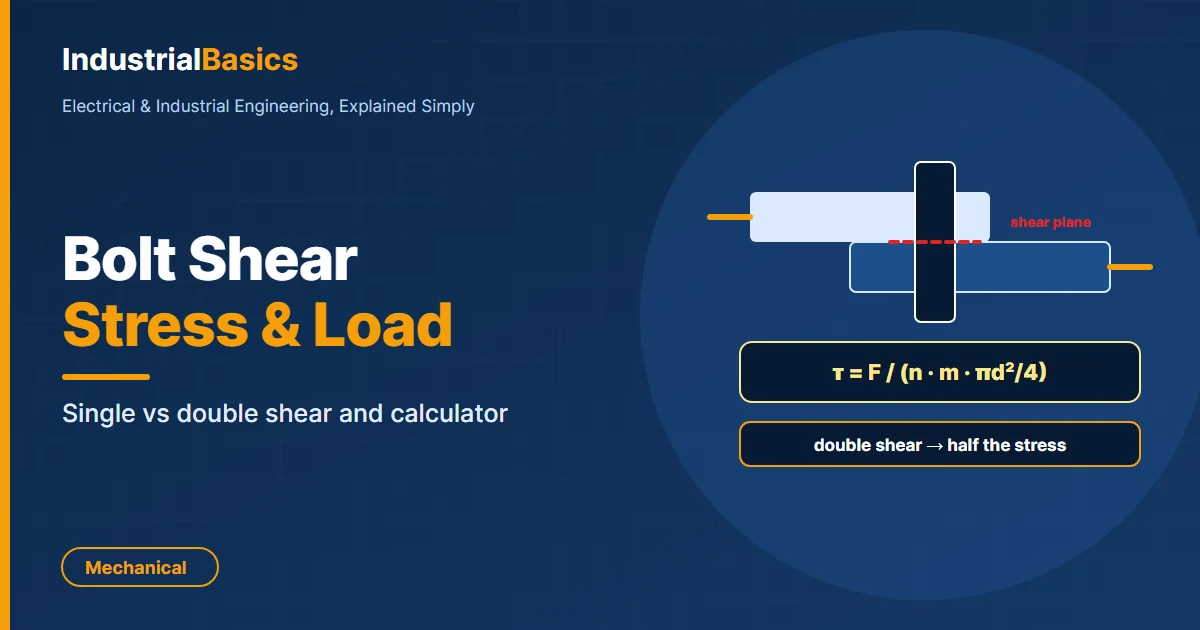
Shear load on a bolt is a force acting across its cross-section, parallel to the joint faces. Average bolt shear stress is τ = F / A, with A = πd²/4 per shear plane. A bolt in double shear (clevis) has two planes and half the stress of single shear (lap joint). For example, 2,000 lbf on a 3/8 in bolt in single shear gives about 18,108 psi, and about 9,054 psi in double shear. Shear strength is often estimated at about 60% of ultimate tensile strength.
Bolt Shear Stress Formula
| Symbol | Meaning |
|---|---|
| τ | Average shear stress |
| F | Total shear load |
| n | Number of bolts sharing the load equally |
| m | Shear planes per bolt (1 single, 2 double) |
| d | Diameter in the shear plane (shank, or thread minor diameter) |
Single vs Double Shear
In a lap joint, two plates pull in opposite directions and the bolt is cut along one plane, so it is in single shear. In a clevis or double-strap joint, the center plate pulls one way and the two outer plates the other, so the bolt crosses two planes. Each plane carries half the load, which halves the average shear stress. That is why clevis pins can be smaller than lap-joint bolts for the same load.
Shank vs Threads in the Shear Plane
Bolt diameter in the formula is the diameter where the shear plane cuts the bolt. If the plane crosses the threads, use the thread root (minor) diameter, which for 60° threads is about D − 1.0825 × pitch. For a 3/8-16 bolt that is 0.3073 in, which raises the single-shear stress in the example from 18,108 psi to about 26,959 psi. See thread pitch diameter for the thread diameters.
Bolt Shear Stress Calculator
Shear Strength of Materials
| Material | Ultimate shear ≈ | Shear yield ≈ |
|---|---|---|
| Steels | 0.75 × UTS | 0.58 × tensile yield |
| Ductile iron | 0.9 × UTS | 0.75 × tensile yield |
| Malleable iron | 1.0 × UTS | — |
| Wrought iron | 0.83 × UTS | — |
| Cast iron | 1.3 × UTS | — |
| Aluminums | 0.65 × UTS | 0.55 × tensile yield |
Because published shear values are scarce, designers often use 0.6 × UTS. The calculator uses that more conservative figure for steel than the 0.75 rough guide. Material properties such as yield strength are covered in 6061 aluminum yield strength.
How Bolted Joints Carry Shear
- Bearing-type shear joint: bolts are snug but not precisely preloaded. The parts slip until the shank bears on the hole walls, and the bolt carries the shear directly. A clevis linkage is an example (Wikipedia).
- Slip-critical (friction) joint: bolts are tightened to a set preload, and friction between the clamped faces carries the shear without relative movement.
- Tension joint: loads act along the bolt axis; preload must exceed the external load to prevent separation.
Cold-headed bolts gain part of their strength from work hardening during forming.
Frequently Asked Questions
What is shear load?
A force that acts parallel to a surface or cross-section, tending to slide one part past another. In a bolted joint, a shear load pulls the joined plates in opposite directions across the bolt.
How do you calculate bolt shear stress?
Average shear stress τ = F / A, where A is the bolt cross-section, πd²/4. With n bolts sharing the load and m shear planes per bolt, τ = F / (n·m·πd²/4).
What is the difference between single and double shear?
In single shear (a lap joint) the bolt is loaded across one plane. In double shear (a clevis) it crosses two planes, so each plane carries half the load and the stress is halved.
What is the shear strength of a steel bolt?
Shear strength is not published like tensile strength; it is commonly estimated as about 60% of ultimate tensile strength (Wikipedia). Wikipedia’s rough guide gives about 0.75 × UTS for steels in ultimate shear and 0.58 × yield in shear yield.
Should I use the shank or thread diameter?
Use the shank diameter if the shear plane passes through the unthreaded shank, and the smaller thread root (minor) diameter if threads are in the shear plane, which lowers capacity.
Do bolts carry shear in friction joints?
In slip-critical (friction) joints, preload clamps the parts so friction transfers the shear and the bolt is not loaded in shear until the joint slips. In bearing-type joints, the bolt shank bears on the hole walls and carries the shear (Wikipedia, Bolted joint).
What is a shear pin?
A pin designed to fail in shear at a set load to protect a drive or machine from overload, sacrificing itself before more expensive parts break.
What is the shear strength of a dowel pin?
Estimate it the same way: pin area × number of shear planes × the material’s shear strength (about 0.6 × UTS for steel); hardened dowels have high UTS, but check the maker’s rated double-shear load.
Do ductile and brittle materials fail differently?
Yes: ductile materials such as aluminum tend to fail in shear, while brittle materials such as cast iron tend to fail in tension (Wikipedia).
Is this enough for structural design?
No. Structural and machine connections must follow the applicable code (for example AISC for steel buildings), with load factors, bolt grades, edge distances, bearing and combined tension-shear checks, reviewed by a qualified engineer.
Sources and Further Reading
- Wikipedia: Shear stress: average shear stress τ = F/A.
- Wikipedia: Shear strength: bolt shear formula, material ratios, 60% UTS estimate, ductile vs brittle.
- Wikipedia: Bolted joint: bearing, slip-critical and tension joints.
- Wikipedia: Shear pin: sacrificial overload protection.