
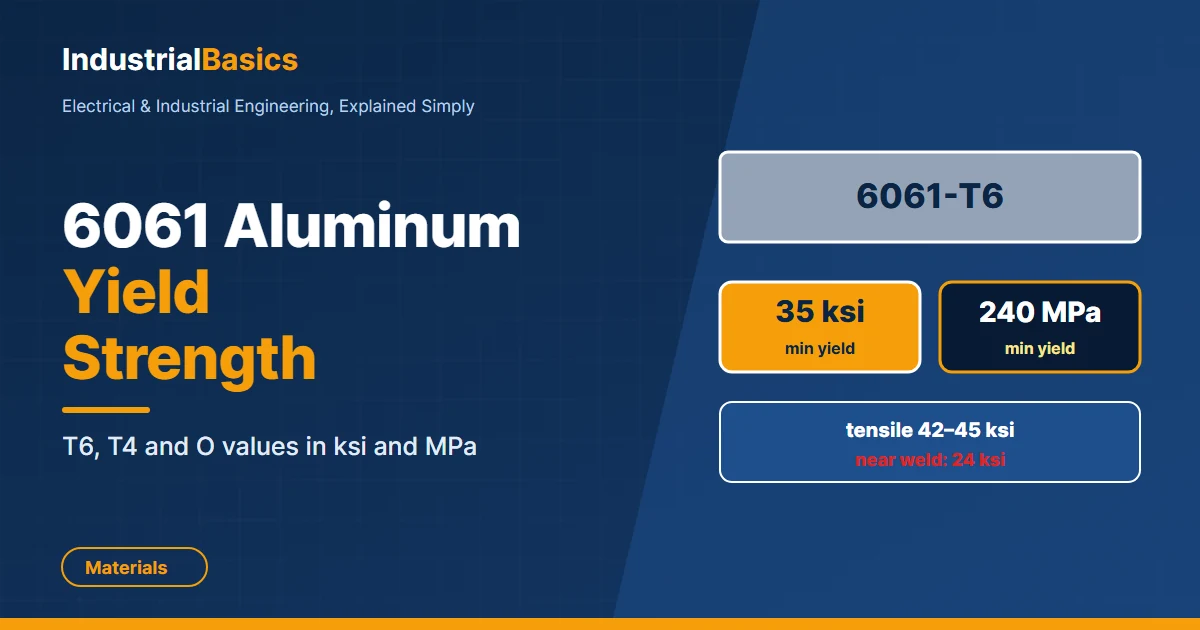
The yield strength of 6061-T6 aluminum is at least 35 ksi (240 MPa), with typical values around 39–40 ksi (270–276 MPa). Its ultimate tensile strength is at least 42 ksi (290 MPa), typically 45 ksi (310 MPa). Temper matters: annealed 6061-O yields at no more than 12 ksi, and 6061-T4 at a minimum of 16 ksi. Welding a T6 part drops the strength next to the weld to about T4 levels; the Aluminum Association design value there is 24 ksi (165 MPa).
6061 Strength by Temper
| Temper | Yield strength | Ultimate tensile strength | Elongation |
|---|---|---|---|
| 6061-O (annealed, sheet/plate) | max 12 ksi (83 MPa) | max 22 ksi (150 MPa) | 10–18% |
| 6061-T4 | min 16 ksi (110 MPa) | min 30 ksi (210 MPa) sheet/plate | 10–16% |
| 6061-T6 / T651 minimum | min 35 ksi (240 MPa) | min 42 ksi (290 MPa) | 8–10% |
| 6061-T6 typical | 39 ksi (270 MPa) | 45 ksi (310 MPa) | — |
| Near a weld, as welded (design value) | 24 ksi (165 MPa) | — | — |
Wikipedia notes that 6061’s mechanical properties “greatly depend on the temper, or heat treatment”, while Young’s modulus stays about 69 GPa (10,000 ksi) whatever the temper. T6 receives the maximum precipitation hardening, which gives the highest yield strength; Wikipedia adds that this can exceed the yield strength of certain stainless steels. T651 (stress-relieved by stretching) has similar properties to T6.
What “Yield Strength” Means for Aluminum
Steel often shows a clear yield point; aluminum alloys do not. Wikipedia explains that where there is no precise yield point, the offset yield point (proof stress) “is taken as the stress at which 0.2% plastic deformation occurs”, and that high-strength aluminum alloys rely on this offset definition. So a 35 ksi yield strength means that loading to 35 ksi leaves about 0.2% permanent stretch, not that the part suddenly gives way.
6061-T6 vs Other Aluminum Alloys
| Alloy and temper | Yield (ksi) | Tensile (ksi) | Yield (MPa) |
|---|---|---|---|
| 1100-H12 | 11 | 14 | 76 |
| 3003-H18 | 25 | 27 | 172 |
| 5052-H32 | 23 | 31 | 159 |
| 6063-T6 | 25 | 30 | 172 |
| 6061-T4 | 16 | 30 | 110 |
| 6061-T6 | 35 | 42 | 241 |
| 2024-T3 | 42 | 64 | 290 |
| 7075-T6 | 70 | 78 | 483 |
Wikipedia describes 6061 as a precipitation-hardened alloy with magnesium and silicon, developed in 1935, with good mechanical properties, good weldability and excellent extrudability; it is one of the most common alloys for general use. Engineers pick it over 7075 when weldability, corrosion resistance and cost matter more than maximum strength.
Welding 6061-T6: The Strength Loss
6061 is readily welded by TIG or MIG, but heat ruins the T6 temper next to the weld. Wikipedia states that after welding the properties near the weld are typically those of 6061-T4, “a loss of strength of around 40%”, and that the Aluminum Association recommends taking the design strength of the material adjacent to the weld as 165 MPa (24,000 psi) without proper post-weld heat treatment. The part can be re-heat-treated to restore near-T6 properties, and some strength returns by natural aging, mostly within the first few days to a few weeks. Typical filler alloys are 4043 and 5356.
Simple Tension Check
Example: a 0.25 in² 6061-T6 tie rod carrying 5,000 lbf sees 20 ksi, a safety factor of 1.75 on the 35 ksi minimum yield. If that rod is welded at the end, the factor near the weld drops to 24 ÷ 20 = 1.2.
Other Useful Properties of 6061-T6
| Property | Value | Source |
|---|---|---|
| Young’s modulus | 69 GPa (10,000 ksi) | Wikipedia; Engineering ToolBox 10.0 × 10⁶ psi |
| Shear modulus | 3.8 × 10⁶ psi (26 GPa) | Engineering ToolBox |
| Poisson’s ratio | 0.33 | Wikipedia |
| Fatigue limit | 97 MPa (14 ksi) at 5 × 10⁸ reversed cycles | Wikipedia |
| Thermal conductivity (T6, 77 °F) | About 152 W/m·K | Wikipedia |
Wikipedia notes that aluminum has no well-defined “knee” on its fatigue curve, so the 14 ksi fatigue figure depends on the cycle count chosen and is reduced by real-world loading, stress gradients and surface finish. For pressurized tubes and pipes, see our hoop stress guide; for threading 6061, 4-40 tap drill size recommends the 75% thread drill for aluminum.
For how strength values feed into fastener checks, see bolt shear stress and the single versus double shear calculation.
Frequently Asked Questions
What is the yield strength of 6061-T6 aluminum?
At least 35 ksi (240 MPa), with typical values around 39–40 ksi (270–276 MPa). Wikipedia gives a minimum of 240 MPa (35 ksi) and a typical 270 MPa (39 ksi); Engineering ToolBox lists 35 ksi.
What is the tensile strength of 6061-T6?
At least 42 ksi (290 MPa), typically about 45 ksi (310 MPa).
What is the yield strength of 6061-T6 in MPa?
Minimum 240 MPa; Wikipedia gives 270 MPa (39 ksi) as typical. The 275–276 MPa figure you often see is simply 40 ksi converted to MPa.
What is the yield strength of aluminum in general?
It varies hugely with alloy and temper: about 11 ksi for 1100-H12, 25 ksi for 6063-T6, 35 ksi for 6061-T6 and 70 ksi for 7075-T6, per Engineering ToolBox. “Aluminum” alone does not define a strength.
Does welding weaken 6061-T6?
Yes. Wikipedia notes the metal near the weld typically drops to about 6061-T4 properties, a loss of around 40%, and the Aluminum Association recommends a design strength of 165 MPa (24 ksi) next to the weld unless the part is re-heat-treated.
What filler is used to weld 6061?
Wikipedia lists 4043 or 5356 as typical filler alloys. 6061 welds well by TIG or MIG.
What is the Young’s modulus of 6061?
About 69 GPa (10,000 ksi) regardless of temper, roughly one third of steel’s.
What does T6 mean?
Solution heat-treated and then artificially aged for maximum precipitation hardening. T651 adds stress relief by stretching and has similar mechanical properties.
What is the shear strength of 6061-T6?
Our sources do not list a shear strength. For a rough estimate of shear yield, engineers often use about 0.58 × tensile yield (the von Mises relation), roughly 20 ksi for 35 ksi material; use your design code’s value for real work.
Why does aluminum use 0.2% offset yield?
Because, as Wikipedia notes, aluminum alloys do not show a distinct yield point; the stress at 0.2% permanent strain is used instead.
Sources and Further Reading
- Wikipedia: 6061 aluminium alloy: temper properties, welding strength loss and other properties.
- Engineering ToolBox: Aluminum alloys mechanical properties: yield, tensile and moduli of common alloys.
- Wikipedia: Yield (engineering): 0.2% offset yield definition.



