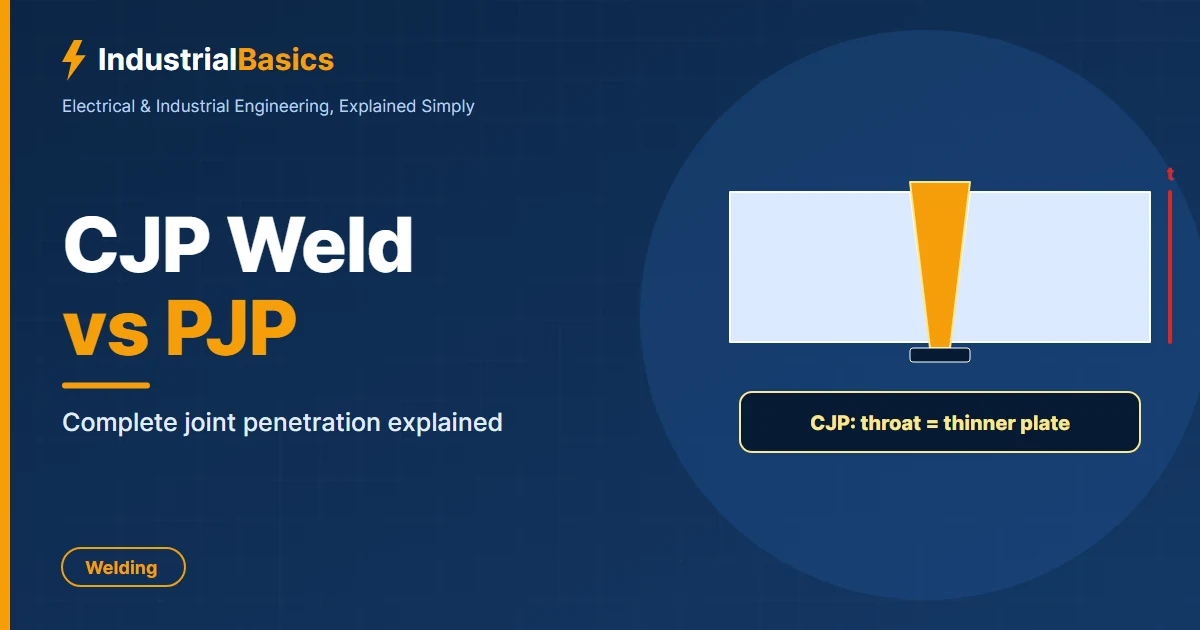
A CJP (complete joint penetration) weld is a groove weld that fuses through the full thickness of the joint, from one face to the other. Its effective throat equals the thickness of the thinner part, and with matching filler metal it is as strong as the base metal. It is made against a backing bar or by back-gouging and welding the second side. A PJP (partial joint penetration) weld stops at a specified depth E, and its strength is based on that throat. CJP welds in tension usually need ultrasonic or radiographic testing.
CJP vs PJP
| CJP (complete joint penetration) | PJP (partial joint penetration) | |
|---|---|---|
| Penetration | Through the full joint thickness | To a specified depth; root left unfused by design |
| Effective throat | Thickness of the thinner part joined | Specified effective throat E (from the prequalified detail) |
| Strength | Equal to base metal with matching filler | Weld metal on E × L, plus base metal check |
| Joint prep | Backing bar, or back-gouge and weld second side | No backing or back-gouging; little or no root opening |
| Symbol | “CJP” in the welding symbol tail | Groove size and throat shown as S(E) |
| Inspection | UT or RT often required (tension, cyclic) | Often visual and MT, per specification |
| Use | Moment connections, column splices, full-strength joints | Lower demand: shear, compression, stiffeners |
How a CJP Weld Is Made
- Prepare the groove to a prequalified detail (single- or double-V, bevel, J or U), with the specified root opening, groove angle and root face.
- Option 1, backing: weld from one side onto a steel backing bar that fuses into the root.
- Option 2, back-gouge: weld the first side, then gouge or grind the root from the back to sound metal and weld the second side. This is common for double-V and thick joints.
- Inspect: visual inspection, plus UT or RT where the specification requires it.
Clause5 stresses that CJP is defined by the result, not the joint shape. The same V-groove can be CJP when back-gouged and back-welded, or PJP when welded from both sides without back-gouging. AWS D1.1 prequalified CJP details may be used without procedure qualification testing (no PQR). This holds only if the process is SMAW, SAW, GMAW (not GMAW-S) or FCAW and the base and filler metals are from the code tables. For welding gas setup, see MIG welding gas flow rate.
CJP vs PJP Strength Comparison
Example: a 1/2 in plate, 6 in long, A36 steel (Fy 36 ksi). As CJP, the nominal tension strength is 36 × 0.5 × 6 = 108 kips. As PJP with a 1/4 in effective throat and E70 electrodes, the weld metal nominal strength is 0.6 × 70 × 0.25 × 6 = 63 kips. Design values need the code’s resistance or safety factors and the base-metal checks.
Fillet Welds vs Groove Welds
Fillet welds join surfaces at an angle (tee, lap and corner joints) and are measured by leg size. Their effective throat is about 0.707 × leg for equal legs, so a 1/4 in fillet has a 0.177 in throat. Groove welds (CJP or PJP) are placed in a prepared groove between the parts. Wikipedia describes the parts of a fillet weld as root, toe, face, leg and throat, and the fillet symbol as a triangle on the reference line.
For coloring titanium parts after fabrication, see our titanium anodizing color chart.
Frequently Asked Questions
What is a CJP weld?
A complete joint penetration groove weld: weld metal extends through the full thickness of the joint, fusing from one surface to the other, so the joint has the same cross-sectional strength as the base metal (with matching filler).
What does CJP stand for in welding?
Complete joint penetration, the AWS structural term. Pressure-equipment and pipeline codes usually say “full penetration”.
What is the difference between CJP and PJP?
CJP fuses the full thickness; its effective throat equals the thinner part’s thickness. PJP is intentionally welded to a specified depth (effective throat E) less than the thickness, with an unfused root, and its strength is calculated from E.
How is a CJP weld achieved?
Either welding against a steel backing bar, or welding from one side, back-gouging the root to sound metal and welding the second side. AWS D1.1 prequalified CJP details in Figure 5.1 specify the root opening, groove angle, root face and backing.
What is the effective throat of a CJP weld?
The thickness of the thinner part joined. Weld reinforcement is not counted.
How is a CJP weld shown on a drawing?
With a groove weld symbol and “CJP” in the tail of the welding symbol; PJP welds show groove depth and effective throat as S(E).
Do CJP welds need inspection?
CJP welds in tension typically require volumetric testing, ultrasonic (UT) or radiographic (RT), especially in cyclically loaded connections, in addition to visual inspection by a certified welding inspector.
Which processes are prequalified for CJP under D1.1?
SMAW, SAW, GMAW (except GMAW-S, short-circuit transfer) and FCAW. Short-circuit transfer (GMAW-S) is not prequalified.
What is the effective throat of a fillet weld?
For an equal-leg fillet, the throat is the leg times sin 45°, about 0.707 × leg: a 1/4 in fillet has a throat of about 0.177 in.
What are a WPS and a PQR?
A Welding Procedure Specification gives welders the required variables; a Procedure Qualification Record documents the test weld that qualified it. Prequalified D1.1 joints can be used without a PQR if every condition is met.
Sources and Further Reading
- MaterialWelding: CJP vs PJP weld: definitions, strength, symbols, backing and back-gouging.
- Clause5: CJP weld (complete joint penetration): D1.1 Clause 5.4.1, prequalified processes, inspection.
- SteelCalculator: Groove weld design guide: CJP and PJP capacity per AISC 360, inspection.
- Wikipedia: Fillet weld: parts and symbol of a fillet weld.
- Wikipedia: Welding Procedure Specification: WPS and PQR definitions.