
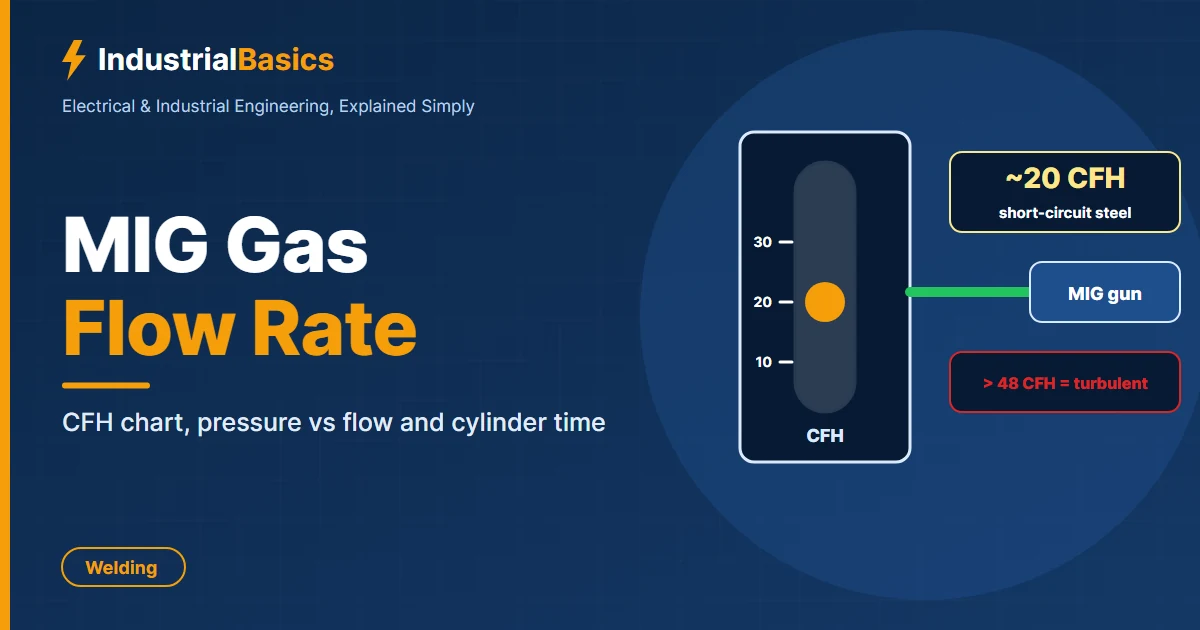
A typical MIG welding gas flow rate is about 20 CFH (10 L/min) for short-circuit welding on steel, about 30 CFH (15 L/min) for globular transfer and 40–50 CFH (20–25 L/min) for spray transfer. Set the flow in cubic feet per hour on the flowmeter, not by pressure: the regulator delivers a fixed 25–80 psi and only a few psi reach the gun. Going above about 48 CFH makes the shielding turbulent and can cause porosity.
MIG Gas Flow Rate Chart
| Transfer mode | Typical use | Flow (CFH) | Flow (L/min) |
|---|---|---|---|
| Short-circuit | Thin steel, out of position, C25 or CO2 | about 20 | about 10 |
| Pulsed spray | Thin to medium metal, aluminum, stainless | about 20 | about 10 |
| Globular | Thicker steel, CO2, flat and horizontal | about 30 | about 15 |
| Spray transfer | Thick metal, high current, argon-rich gas | 40–50 | 20–25 |
Wikipedia notes that the right flow depends on weld geometry, travel speed, current, the gas type and the transfer mode. Flat surfaces need more gas than grooves because the gas spreads faster. Faster travel and higher current need more flow. Helium mixes need more flow than argon because helium is lighter than air and does not blanket the weld as well. The top of the spray range sits close to the 48 CFH turbulence limit measured for a 5/8 in nozzle. High-current spray work uses larger nozzles, which Wikipedia notes carry more shielding gas flow.
MIG Gas Pressure vs Flow
Searches for “MIG gas pressure” usually come from regulators with two gauges. The high-pressure gauge shows what is left in the cylinder. The second gauge or flow tube shows the delivery setting. On a flowmeter, a float ball rises in a tube and you read CFH directly. A regulator in front of it holds a fixed 25–80 psi (50–80 psi for CO2 service). On a regulator/flowgauge, the dial measures the pressure behind a tiny orifice (about 0.025 in) but is printed in CFH for a specific gas. Pressures for typical flows run 40–80 psi.
Only about 3–7 psi is needed at the wire feeder to push normal MIG flow through the gun. Regulators deliver at least 25 psi so the flow stays constant as spatter builds in the nozzle or the gun cable bends (Uttrachi, NetWelding). A flowmeter calibrated for 25 psi but run on a 50 psi pipeline reads low: set to 35 CFH, it actually passes about 45 CFH. For gauge vs absolute pressure, see psig vs psia.
Choosing a Shielding Gas
| Gas | Used for | Notes (Wikipedia) |
|---|---|---|
| C25 (75% Ar / 25% CO2) | Mild steel, short-circuit | Common for hobbyists and small shops; limited to short-circuit and globular |
| Argon + 10–20% CO2 (90/10 etc.) | Steel, spray and pulsed spray | Spray transfer gets harder above about 20% CO2 |
| 100% CO2 | Steel, short-circuit and globular | Cheapest, deep penetration, more spatter, hard on thin metal |
| 100% argon | Aluminum and other nonferrous | Not used alone on steel (poor penetration) |
| Argon-helium (A-25, A-50, A-75) | Thick aluminum, copper | Hotter arc; needs higher flow |
| Argon + 1–5% O2 or CO2, or He/Ar/CO2 tri-mix | Stainless steel | Up to 5% oxygen can help on stainless |
Gas Flow and Cylinder Time Calculator
Cylinder capacity is the volume of gas at atmospheric pressure printed on the label or invoice, not the size of the steel bottle. Uttrachi’s example is a cylinder with 1.8 ft³ of internal volume holding about 310 ft³ of gas at 2,500 psi. Gas flow units are explained in SCFM vs CFM.
Why More Gas Is Not Better
- Turbulence: TWI found flow from a common 5/8 in nozzle turns from laminar to turbulent at about 48 CFH. Turbulent gas pulls in air.
- Field data: a Praxair (now Linde) welding R&D manager reported that shops typically set more than 50 CFH, which can hurt weld quality.
- Start surge: gas stored in the hose at regulator pressure blasts out at each trigger pull. Uttrachi measured peaks over 200 CFH, wasting gas and drawing in moist air.
- Waste: Uttrachi estimates the average MIG welder uses about 30 ft³ of gas per pound of wire when 5–6 ft³/lb is enough.
Troubleshooting Porosity
- Drafts: fans, open doors and wind blow the shield away. Wikipedia advises avoiding welding in moving air; screen the work first, then add a little flow.
- Too much flow: above about 48 CFH, turn it down rather than up.
- Spatter in the nozzle: it blocks and deflects the gas. Clean the nozzle and diffuser.
- Leaks: leaking fittings waste gas and let moist air into the line. Check them with leak-detection solution.
- Dirty metal: oxides and contamination cause dross and porosity, especially on aluminum. Brush or clean the joint.
- Gun angle: Wikipedia notes the best travel angle varies with the gas type and how it disperses, so an awkward angle can leave the puddle uncovered.
For structural joints, the weld type matters as much as the gas; see CJP weld vs PJP for complete joint penetration requirements.
Frequently Asked Questions
What should my MIG gas flow rate be?
For short-circuit MIG on steel, about 20 CFH (10 L/min) is the usual starting point; globular transfer needs about 30 CFH and spray transfer 40–50 CFH (Wikipedia). Raise it a little for drafts or porosity, but stay below roughly 48 CFH.
What PSI should MIG gas be set at?
MIG gas is set by flow (CFH), not by psi. Most regulator/flowmeters deliver a fixed 25–80 psi to the flow valve, and only about 3–7 psi is needed at the wire feeder. On a regulator/flowgauge the dial measures pressure behind an orifice but is printed in CFH, so set the CFH number.
What flow rate for 75/25 argon CO2?
C25 is used mainly for short-circuit MIG on mild steel, so about 20 CFH. It is limited to short-circuit and globular transfer (Wikipedia).
What argon flow rate for MIG aluminum?
Aluminum is MIG welded with pure argon (or argon-helium), usually in spray or pulsed spray. Use about 20 CFH for pulsed spray and 40–50 CFH for spray transfer. Argon-helium mixes need more flow because helium is lighter than air.
Can too much shielding gas cause porosity?
Yes. Above about 48 CFH from a 5/8 in nozzle the flow turns turbulent and pulls air into the arc (TWI research cited by NetWelding). A Praxair survey found many shops set more than 50 CFH and got poorer welds.
Why does gas blast out when I pull the trigger?
Gas stored in the hose at regulator pressure rushes out at the start. NetWelding measured peaks over 200 CFH. That surge wastes gas and can draw in air; surge-limiting devices reduce it.
How long will an 80 cubic foot cylinder last?
At 20 CFH, 80 ft³ gives about 4 hours of arc-on time. At a 40% arc-on time that is about 10 hours of shop time, before start-surge losses.
How do I convert CFH to L/min?
Multiply CFH by 0.472. 20 CFH ≈ 9.4 L/min, 30 CFH ≈ 14.2 L/min and 40 CFH ≈ 18.9 L/min. To go from L/min to CFH, multiply by 2.12.
Why does my CO2 tank gauge not drop?
CO2 is stored as a liquid. The gauge reads its vapor pressure, about 816 psig at 68 °F (Wikipedia: 5.73 MPa absolute at 20 °C), until the liquid is gone, then falls quickly. Weigh the cylinder to know how much is left.
Is 100% CO2 or 75/25 better for MIG?
Pure CO2 is cheapest and penetrates deeply but gives more spatter and is harder on thin metal. Argon-CO2 blends from 75/25 to 90/10 give a smoother arc (Wikipedia). Many hobby and shop welders use C25 on mild steel.
Sources and Further Reading
- Wikipedia: Gas metal arc welding: shielding gas mixtures, flow by transfer mode, porosity causes.
- Wikipedia: Shielding gas: gas properties, C25 and argon-helium blends, flow rates.
- Jerry Uttrachi, NetWelding: MIG Shielding Gas Control and Optimization (PDF): flowmeters, regulator pressures, the 48 CFH turbulence limit, start surge and gas waste.
- Wikipedia: Carbon dioxide: vapor pressure 5.73 MPa at 20 °C.



