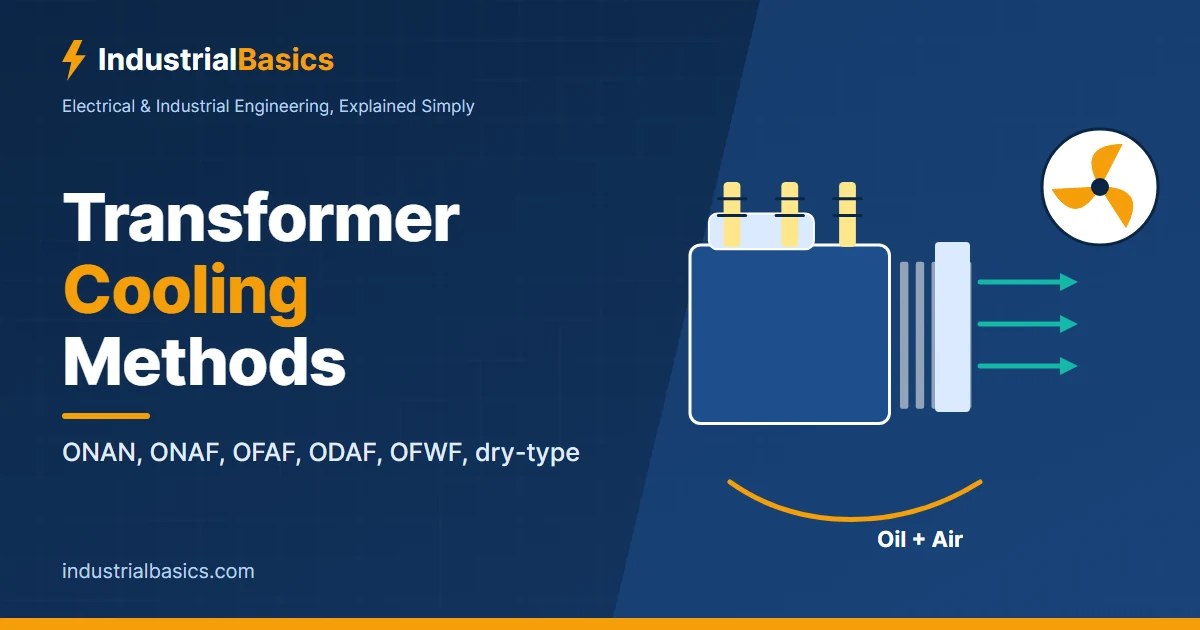
Transformer cooling methods are the ways a transformer removes the heat made in its core and windings, so the insulation does not overheat and age too quickly. Oil-immersed transformers use ONAN, ONAF, OFAF, ODAF, OFWF or ODWF cooling, while dry-type transformers use AN or AF air cooling. The letters tell you what carries the heat (oil, air or water) and whether it moves naturally or is pushed by fans and pumps.
Quick answer
- ONAN: oil and air both move naturally. Simple and silent, used on distribution and smaller power transformers.
- ONAF: same as ONAN, but fans blow air over the radiators for a higher rating.
- OFAF / ODAF: pumps move the oil and fans move the air. In ODAF the oil is also directed into the winding ducts.
- OFWF / ODWF: pumps move the oil through a water-cooled heat exchanger.
- AN / AF: dry-type transformers cooled by natural or fan-forced air.
This guide explains each method in plain language, shows how to read the IEC and IEEE cooling codes, and covers temperature limits, insulation ageing, fluids, failures and selection. If you are new to the subject, our guide to the types of transformers gives useful background first.
Why Transformers Need Cooling
A transformer is very efficient, but the small share of power it loses turns into heat. That heat has three main sources:
- Core (no-load) losses: hysteresis and eddy currents in the steel core. They are present whenever the transformer is energised.
- Winding (load) losses: I²R heating in the copper or aluminium conductors. They rise with the square of the load current.
- Stray losses: extra eddy currents in the tank, clamps and winding conductors caused by leakage flux.
If this heat is not removed, the winding temperature climbs. The paper or resin insulation around the conductors slowly breaks down, and once it has aged, the transformer is much more likely to fail. In short, transformer life is mostly a question of insulation temperature, which is why cooling is a design priority rather than an accessory.
How Heat Leaves an Oil-Immersed Transformer
Heat travels by conduction, convection and radiation. In an oil-immersed unit, the oil does two jobs: it insulates electrically and it carries heat away.
- The core and windings heat the oil around them.
- Hot oil becomes lighter and rises to the top of the tank.
- It flows into the radiators or coolers, where air or water takes the heat away.
- The cooled oil is heavier, sinks and returns to the windings.
Every cooling method below is a different way of speeding up steps 3 and 4. Some add fans, some add pumps, and some use water instead of air.
Oil-Immersed Transformer Cooling Methods
1. ONAN: Oil Natural Air Natural
In ONAN cooling, oil circulates by itself through thermosiphon action (hot oil rises, cool oil sinks), and ambient air cools the tank and radiators without any help. There are no fans or pumps.
- Advantages: no auxiliary power, silent, very little maintenance.
- Disadvantages: the lowest heat removal, so larger tanks or radiators are needed for a given rating.
- Typical use: distribution transformers and smaller power transformers.
2. ONAF: Oil Natural Air Forced
ONAF keeps the natural oil circulation of ONAN but fits fans that blow air across the radiators. Moving air removes heat faster, so the same transformer can carry a higher load.
- Advantages: more capacity without oil pumps; fans can be switched on in stages.
- Disadvantages: fans need power, control gear and maintenance, and they add noise.
- Typical use: medium power transformers that need extra capacity at peak load.
3. OFAF: Oil Forced Air Forced
OFAF uses pumps to push the oil through the coolers and fans to push air over them. Circulation no longer depends on buoyancy, so far more heat can be removed from a compact unit. Inside the windings, however, the oil still finds its own path.
- Advantages: high heat removal and more compact coolers.
- Disadvantages: pumps and fans use power and add more things that can fail.
- Typical use: large substation power transformers.
4. ODAF: Oil Directed Air Forced
ODAF is OFAF with one important addition: the pumped oil is guided through the winding ducts instead of being left to find its own way. This cools the windings, and the hot-spot in particular, more effectively.
OFAF vs ODAF in one line: in OFAF the pump moves oil through the coolers; in ODAF the pump also forces that oil into the main windings.
- Advantages: better winding cooling, suited to highly loaded designs.
- Disadvantages: more complex oil-flow design; pump reliability is critical.
- Typical use: large and extra-high-voltage power transformers.
5. OFWF: Oil Forced Water Forced
Here the oil is pumped through an oil-to-water heat exchanger, and cooling water is pumped through the other side. Water takes heat away far better than air, so the cooler can be small.
- Advantages: very high heat removal in a compact footprint.
- Disadvantages: needs a reliable water supply, water treatment and protection against leaks and freezing.
- Typical use: power stations and industrial sites with cooling water.
6. ODWF: Oil Directed Water Forced
ODWF works like OFWF, but the oil is directed into the main windings, as in ODAF. It gives the strongest winding cooling of the water-cooled options, with the extra complexity of both directed flow and a water system.
Dry-Type Transformer Cooling Methods
Dry-type transformers have no insulating liquid, so air is the only cooling medium. They are common indoors, in commercial buildings, infrastructure and industrial plants, where fire safety matters. They are usually cast resin or vacuum-pressure-impregnated (VPI) designs.
| Method | How it works | Advantages | Limits |
|---|---|---|---|
| AN (Air Natural) | Air flows by natural convection around the windings and through the ventilation ducts. | Silent, no auxiliary power, minimal maintenance. | Lower rating; very sensitive to poor room ventilation and dust. |
| AF (Air Forced) | Fans push air through the winding ducts. | Higher rating from the same transformer. | Fan noise, power use and maintenance; depends on fan reliability. |
| AN/AF | Two ratings: a lower one on natural air and a higher one when the fans run. | Extra capacity for peak or emergency loading. | Must not be loaded to the AF rating if the fans are off. |
With dry-type units, the room matters as much as the transformer. Blocked vents, a small enclosure or a hot, dusty room will raise winding temperatures even if the cooling method is correct.
How to Read Transformer Cooling Codes
The IEC four-letter code
IEC 60076-2 describes liquid-immersed cooling with four letters, always in this order: internal coolant, internal circulation, external coolant, external circulation. Take ONAF as an example.
| Position | Meaning | Letters |
|---|---|---|
| 1st | Internal cooling liquid | O = mineral oil or other liquid with a fire point of 300 °C or below K = liquid with a fire point above 300 °C (for example, esters) L = liquid with no measurable fire point |
| 2nd | Internal circulation | N = natural thermosiphon flow F = forced through the coolers, with natural flow in the windings D = forced and directed into at least the main windings |
| 3rd | External cooling medium | A = air W = water |
| 4th | External circulation | N = natural convection F = forced (fans for air, pumps for water) |
So KNAN is an ester-filled transformer with natural oil and natural air cooling. Gas (G) also exists as a coolant letter, but it is rare and outside the scope of this guide.
IEEE and older US codes
Older US nameplates use short codes such as OA, FA and FOA. IEEE C57.12.00 now uses the same four-letter structure as IEC, so modern IEEE nameplates may show ONAN or ONAF too. The table shows the usual legacy mapping.
| Legacy IEEE code | Meaning | Approximate IEC equivalent |
|---|---|---|
| OA | Oil-immersed, self-cooled | ONAN |
| FA | Forced-air cooled | ONAF |
| FOA | Forced-oil, forced-air cooled | OFAF |
| FOW | Forced-oil, water cooled | OFWF |
| AA (dry-type) | Self-cooled, ventilated | AN |
Treat this as an approximate guide, not an exact conversion. The two systems differ in fluid classes and scope, and FOA does not by itself tell you whether the winding flow is directed. Always trust the actual nameplate.
Comparison of Transformer Cooling Methods
| Method | Oil or air movement | External cooling | Auxiliaries | Relative cooling | Typical use |
|---|---|---|---|---|---|
| ONAN | Natural | Air, natural | None | Baseline | Distribution, smaller power units |
| ONAF | Natural oil | Air, fans | Fans | Higher than ONAN | Medium power units |
| OFAF | Pumped oil, non-directed in windings | Air, fans | Pumps, fans | Higher than ONAF | Large power units |
| ODAF | Pumped oil, directed into windings | Air, fans | Pumps, fans | High, better winding cooling | Large and EHV units |
| OFWF | Pumped oil | Water, pumped | Oil and water pumps | Very high | Power stations, industrial sites |
| ODWF | Pumped oil, directed | Water, pumped | Oil and water pumps | Very high | Large water-cooled units |
| AN | Natural air | Air | None | Baseline (dry-type) | Indoor distribution |
| AF | Fan-forced air | Air | Fans | Higher than AN | Higher-load dry-type |
Real ratings differ from one design to another, so this table only ranks the methods. It does not give MVA limits, because no fixed value applies to every transformer.
Multi-Stage Cooling Ratings (ONAN/ONAF)
Many nameplates show two or three cooling codes, for example ONAN/ONAF or ONAN/ONAF1/ONAF2. This is one transformer with several ratings, not several transformers. Each rating applies only while that cooling stage is working.
| Stage (illustrative example) | Cooling in service | Rating on nameplate |
|---|---|---|
| ONAN | No fans | 20 MVA |
| ONAF1 | First fan group | 26.7 MVA |
| ONAF2 | Both fan groups | 33.3 MVA |
These figures are an example only. Actual ratios are set by the designer and shown on the nameplate. If a fan group or pump fails, the usable rating falls back to the stage that is still working, so the load must come down too.
A common myth: that fans always add a fixed percentage, such as 33%, to the rating. They do not. The increase depends on radiator area, cooler design, ambient temperature and the manufacturer’s tested guarantees.
Temperature Rise, Hot-Spot and Insulation Ageing
Cooling is judged by three temperatures:
- Top-oil temperature: the oil at the top of the tank.
- Average winding temperature: found from the change in winding resistance.
- Hot-spot temperature: the hottest point in the winding, which controls insulation life.
For mineral-oil transformers with 105 °C insulation, IEC 60076-2:2011 sets these limits for natural or forced (non-directed) oil circulation, based on a yearly average ambient of 20 °C:
Limits change with the edition, insulation system, cooling mode and ambient conditions. IEEE sets its own values, usually based on a 65 °C average winding rise and a 30 °C ambient, so never mix IEC and IEEE figures in one calculation. Dry-type limits depend on the insulation class and are set in IEC 60076-11 and IEEE C57.12.01.
Altitude also matters. Thinner air cools less effectively, and the standards require the temperature-rise limits to be reduced for sites above 1,000 m, so check this for installations in hilly regions.
How to calculate hot-spot temperature
A simple form of the calculation is:
Hot-spot = ambient + top-oil rise + (H × winding gradient)
where H is the hot-spot factor. Illustrative example (not real data): ambient 30 °C, top-oil rise 50 K, gradient 15 K, H = 1.1.
Hot-spot = 30 + 50 + (1.1 × 15) = 96.5 °C
Real calculations must follow the thermal model, load cycle and cooling mode in IEC 60076-7 or IEEE C57.91. This example only shows the idea.
The 6 K rule and the 8 K rule
Insulation ageing speeds up sharply as the hot-spot rises. The two standards describe this slightly differently:
- IEC 60076-7 (6 K rule): for non-upgraded paper, the ageing rate doubles for every 6 K rise above the 98 °C reference hot-spot.
- IEEE C57.91 (8 K rule of thumb): insulation life roughly halves for every 8 to 10 K rise. IEEE uses an Arrhenius-type equation with a 110 °C reference for thermally upgraded paper.
The two rules do not contradict each other. They use different reference temperatures, insulation assumptions and equations, so use the one that belongs to the standard you are working with.
Using this model, our worked example of 96.5 °C gives a relative ageing rate of 2^((96.5 − 98) / 6), which is about 0.84. That means the insulation ages slightly slower than at the reference temperature.
Transformer Cooling Fluids
Mineral oil is the standard liquid, but esters and silicone are used where fire safety or the environment matters. These fluids are why the IEC code has the letters K and L.
| Property | Mineral oil | Natural ester | Synthetic ester | Silicone fluid |
|---|---|---|---|---|
| Fire point | About 160–165 °C | About 360 °C | Above 315 °C | About 343 °C |
| Viscosity at 40 °C | 8–9 mm²/s | 32–34 mm²/s | About 34 mm²/s | About 45 mm²/s |
| IEC code letter | O | K | K | K |
| Main benefit | Low viscosity, easy circulation | High fire point, biodegradable | High fire point | High fire point |
Esters are more viscous, so they circulate less easily. That is why they do not automatically allow a higher load. A purpose-designed ester transformer with high-temperature insulation can be loaded differently, but a mineral-oil design simply filled with ester should not be assumed to gain capacity.
Cooling Monitoring and Control
- Oil temperature indicator (OTI): reads top-oil temperature and gives alarms, fan starts and trips.
- Winding temperature indicator (WTI): estimates the winding hot-spot using top-oil temperature plus a heating element fed by load current (the thermal-image method). It usually controls fan and pump stages.
- Fibre-optic sensors: sit inside the winding and measure hot-spot temperature directly.
- Cooler control panel: starts fans and pumps in stages as temperature or load rises, and raises an alarm if a stage fails.
Temperature trips are part of a wider protection scheme. See our guides on relay testing and protection coordination for how these alarms fit in. Settings are project-specific, so use the manufacturer’s values.
Common Transformer Cooling Problems
| Problem | Typical cause | What to check |
|---|---|---|
| Fan or pump failure | Motor fault, tripped supply, wrong control settings | Cooler panel status, running current, rotation |
| Blocked radiators or vents | Dirt, debris, vegetation, covered dry-type enclosure | Visual inspection, airflow, room ventilation |
| Low oil level | Leaks | Oil level gauge, tank and gasket leaks |
| Poor oil circulation | Closed valves, pump fault, sludge | Radiator valve positions, pump flow indicators |
| High ambient temperature | Hot climate, poor ventilation, solar heating | Room or site temperature against design ambient |
| Overload or harmonics | Load growth, non-linear loads | Load current records, harmonic levels |
| Control failure | Faulty thermostat or incorrect settings | OTI and WTI contacts, alarm tests |
The usual result is higher oil and hot-spot temperatures, faster insulation ageing and, in severe cases, failure. Routine tests such as the insulation resistance (Megger) test help show whether overheating has already damaged the insulation.
How to Choose a Transformer Cooling Method
| Situation | Methods usually considered | Why |
|---|---|---|
| Small distribution transformer, outdoors | ONAN | Passive, silent, low maintenance |
| Medium unit needing extra peak capacity | ONAN/ONAF or ONAN/ONAF1/ONAF2 | Fans add capacity only when needed |
| Large, heavily loaded power transformer | OFAF or ODAF | Pumps and fans give high heat removal |
| Large unit with a reliable water supply | OFWF or ODWF | Compact, high-capacity cooling |
| Indoor, fire-sensitive location | Dry-type AN or AN/AF, or ester-filled (KNAN) | Lower fire risk; ventilation must be planned |
Besides rating, consider ambient temperature and altitude, noise limits, fire and environmental rules, water availability, the load profile, maintenance capability and running cost. Cooling must also suit the surrounding electrical equipment, such as the switchgear and switchgear panels in the same substation. This is a decision guide, not sizing advice.
Key Standards
| Standard | What it covers |
|---|---|
| IEC 60076-2 | Temperature rise and cooling designation for liquid-immersed transformers |
| IEC 60076-7 | Loading guide for mineral-oil-immersed transformers (2018 edition) |
| IEC 60076-11 | Dry-type transformers |
| IEEE C57.12.00 | General requirements for liquid-immersed transformers |
| IEEE C57.12.01 | General requirements for dry-type transformers |
| IEEE C57.91 | Loading guide for mineral-oil-immersed transformers (2025 edition listed by IEEE) |
| IS 2026 | Indian power transformer standard series |
Editions and amendments change, so confirm the current versions with IEC, IEEE and BIS before relying on any limit. Sound earthing also supports safe transformer installations, as explained in our guide to the types of earthing systems.
Frequently Asked Questions
What are the main types of transformer cooling methods?
Oil-immersed transformers use ONAN, ONAF, OFAF, ODAF, OFWF and ODWF. Dry-type transformers use AN and AF.
What does ONAN mean?
ONAN means Oil Natural, Air Natural. The oil circulates by thermosiphon and the air cools the radiators naturally, with no fans or pumps.
What is the difference between ONAN and ONAF?
ONAF adds fans to blow air over the radiators. The oil still circulates naturally. The fans allow a higher rating than ONAN.
What is the difference between OFAF and ODAF?
Both use oil pumps and fans. In ODAF, the pumped oil is directed into the main windings, which gives better winding cooling. In OFAF, flow inside the windings is not directed.
What are AN and AF in dry-type transformers?
AN is Air Natural, where air moves by convection. AF is Air Forced, where fans push air through the windings.
What happens if the cooling fans stop working?
Heat removal drops, so the transformer should only carry the rating of the cooling stage still working, within the manufacturer’s instructions and the applicable loading guide.
Which cooling method is the most efficient?
No single method is best. Water-cooled and directed-oil methods remove the most heat, but they are also the most complex. The right choice depends on rating, site and maintenance capability.
Is OA the same as ONAN?
OA is the older US code and is approximately equal to ONAN. The match is not exact, so check the nameplate and standard.
Why do transformers have radiators?
Radiators increase the surface area through which hot oil gives up heat to the surrounding air.
How does cooling affect transformer life?
Better cooling keeps the winding hot-spot lower, which slows insulation ageing. Life also depends on the load history, moisture and oxygen, not temperature alone.
Conclusion
Transformer cooling methods all do one job: move heat from the windings to the air or water around the transformer. Natural methods (ONAN, AN) are simple and quiet, forced methods (ONAF, OFAF, AF) add capacity with fans and pumps, directed methods (ODAF, ODWF) cool the windings most effectively, and water cooling suits sites with a reliable supply. Read the four-letter code on the nameplate, respect the rating of each cooling stage, and keep radiators, vents, fans and pumps in good order.
Sources
- IEC 60076-7:2018, Loading guide for mineral-oil-immersed power transformers
- IEEE SA, IEEE C57.91 loading guide
- IEEE Transformers Committee, IEEE and IEC loading guide comparison
- Cargill, transformer dielectric fluid comparison
- ABB, ester-liquid transformer design paper
Disclaimer: transformer selection, loading, testing and maintenance must be carried out by qualified electrical professionals in line with local regulations, applicable standards and manufacturer instructions. Worked examples are for education only.