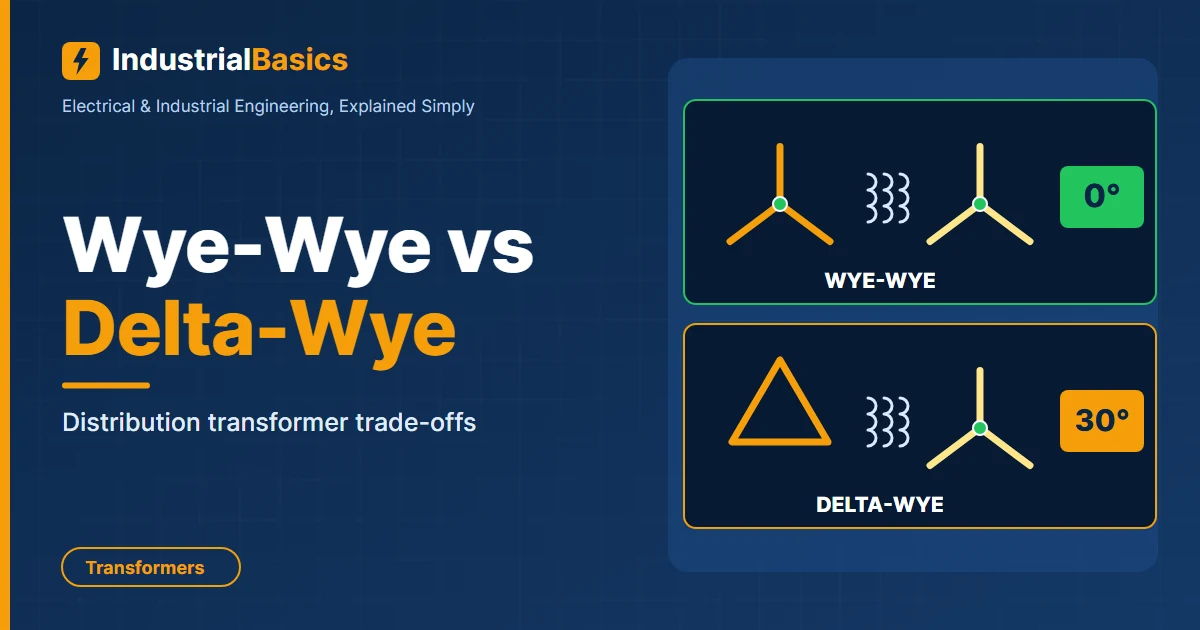
A wye-wye transformer has both windings connected in wye, with no phase shift and a neutral on each side, while a delta-wye transformer has a delta primary and a 30° phase shift. Delta-wye is the usual choice for building and plant distribution because its delta winding gives triplen harmonic current a closed path. Wye-wye can work well, but it normally needs a solidly grounded primary neutral or a tertiary delta winding.
| Factor | Wye-wye | Delta-wye |
|---|---|---|
| Phase shift | 0° (Yy0) | 30° |
| Primary neutral | Available, normally grounded | None |
| Secondary neutral | Available | Available |
| Triplen current | Needs a grounded neutral path or tertiary | Circulates in the delta |
| Primary winding voltage | Line voltage ÷ √3 | Full line voltage |
| Typical use | Utility, solar and battery step-up | Commercial and industrial supply |
How the Two Connections Differ
In a wye-wye transformer, each winding is connected from a line to a neutral point on both sides. Because the windings see the same phase relationship, there is no angular displacement in a standard Yy0 unit. In a delta-wye transformer, each primary coil connects line to line, which creates a 30° shift. Our guide to transformer vector groups explains the notation.
Worked Example: 225 kVA, 12.47 kV to 480Y/277 V
| Quantity | Wye-wye | Delta-wye |
|---|---|---|
| HV line current | 10.4 A | 10.4 A |
| HV coil voltage | 7,200 V | 12,470 V |
| HV coil current | 10.4 A | 6.0 A |
| LV coil voltage | 277 V | 277 V |
| LV line current | 270.6 A | 270.6 A |
| Turns ratio per phase | 26.0:1 | 45.0:1 |
The line currents match, but the coils do not. A wye primary coil sees 7,200 V, about 57.7% of line voltage, while a delta coil sees the full 12,470 V. That lower coil voltage is a key attraction of wye windings at high voltage. The delta coil carries less current, at 6.0 A instead of 10.4 A. For the formulas, see our guide to electrical 3 phase calculations.
Third Harmonics: The Main Trade-Off
A transformer’s magnetizing current is not a pure sine wave. It includes triplen harmonics, which are in phase across all three phases and so need a path that a normal three-phase line does not offer.
| Connection | Triplen path | Result |
|---|---|---|
| Delta-wye | Circulates in the closed delta | Contained in the transformer |
| Wye-wye with grounded source neutral | Through the neutral | Current can flow, but it enters the supply system |
| Wye-wye with tertiary delta | Circulates in the tertiary | Contained in the transformer |
| Wye-wye with no neutral path | Blocked | Third-harmonic voltage can appear phase to neutral |
Core construction also matters. Voltage Disturbance notes that three-leg cores tend to have lower third-harmonic voltage than shell and four- or five-limb cores. For the wider effects of distortion, see our guide to power quality problems.
Grounding and Fault Behavior
| Issue | Wye-wye | Delta-wye |
|---|---|---|
| Zero-sequence current | Can pass through when both neutrals are grounded | Blocked from the primary lines |
| Secondary ground faults | Can be seen by upstream ground relays | Not seen as ground current upstream |
| Unbalanced line-to-neutral load | Needs a stable neutral reference | Delta supports the unbalance |
| Primary neutral | Grounding must be coordinated with the utility | Not applicable |
If a wye-wye secondary neutral floats on a system with mixed loads, the neutral can shift and put damaging voltage on some loads. Follow the required system grounding, and review protection coordination whenever the transformer connection changes.
Which Should You Choose?
| Wye-wye is suited to | Delta-wye is suited to |
|---|---|
| Utility systems with a grounded-wye source | Commercial and industrial building supply |
| Some solar and battery step-up designs | Loads with line-to-neutral circuits |
| Applications needing no phase shift | Sites without a grounded primary neutral |
| High-voltage winding insulation savings | Non-linear loads with triplen harmonics |
If you are replacing a unit, match its vector group unless an engineer has reviewed the change. A mismatch can prevent paralleling and upset protection. See our overview of types of transformers for other options.
Frequently Asked Questions
What is a wye-wye transformer?
It is a three-phase transformer with both its high-voltage and low-voltage windings connected in wye. Each side has a neutral point.
Does a wye-wye transformer have a phase shift?
A standard Yy0 connection has no phase shift between the primary and secondary. A delta-wye transformer has a 30° shift.
Why is delta-wye more common than wye-wye?
The delta winding gives triplen harmonic current a closed path and helps stabilize the secondary neutral, without relying on a grounded primary neutral.
What is the main problem with a wye-wye transformer?
Without a suitable path for triplen current, such as a grounded primary neutral or tertiary delta, it can have third-harmonic voltage and neutral instability.
Should the primary neutral of a wye-wye be grounded?
Wye-wye units normally rely on a solidly grounded source neutral. Follow the utility requirements and the transformer manufacturer’s instructions.
What is a tertiary winding?
It is a third winding, commonly connected in delta, that provides a path for triplen currents in a transformer that would otherwise lack one.
Can wye-wye and delta-wye transformers be paralleled?
No. They have different phase shifts, so paralleling them would drive large circulating currents.
Where are wye-wye transformers used?
They are used in utility systems and some solar and battery step-up applications where a grounded source is available and the design calls for it.
Sources and Further Reading
- ElectricalFlux: When to Specify Wye-Wye vs Delta-Wye: phase shift, grounding and selection.
- Voltage Disturbance: Transformer Connections and Third Harmonics: harmonic paths and core types.
- Maddox: Guide to Delta and Wye Transformer Connections: uses, insulation and paralleling.