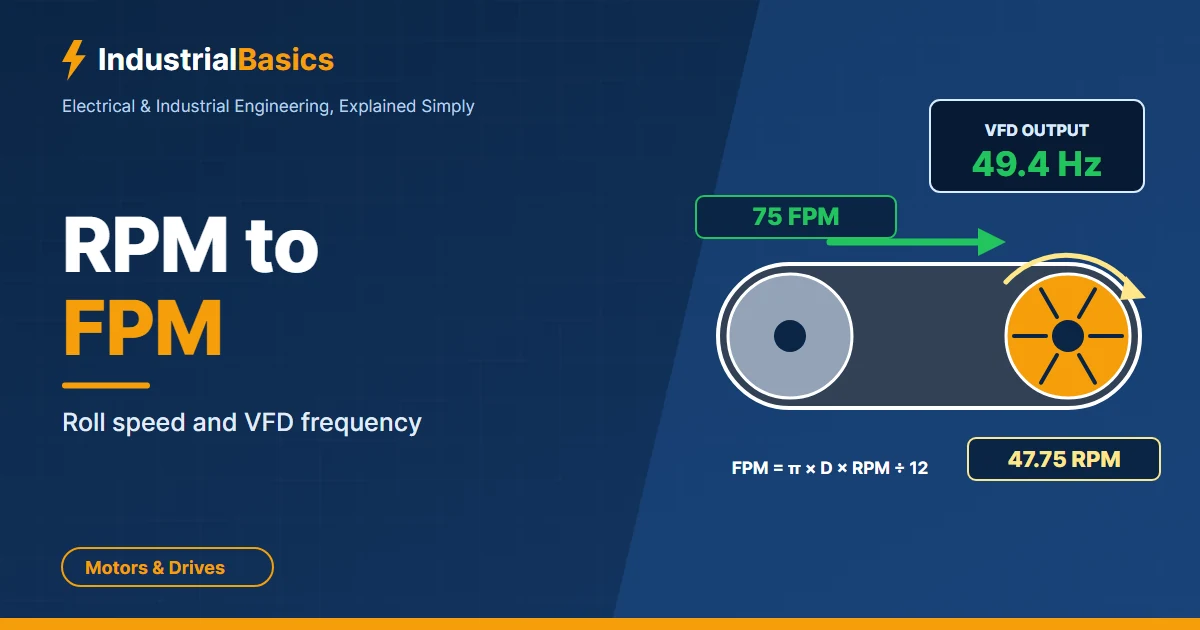
To convert RPM to FPM, use FPM = π × diameter (in) × RPM ÷ 12, or about RPM × diameter × 0.2618. A 6 inch roller at 80 RPM has a surface speed of about 125.7 FPM. To set a VFD for a required line speed, work backward through the roll, gearbox and motor slip, then use f = RPM × poles ÷ 120.
| Convert | Formula | Units |
|---|---|---|
| RPM to FPM | FPM = π × D × RPM ÷ 12 | D in inches |
| FPM to RPM | RPM = FPM × 12 ÷ (π × D) | D in inches |
| Roll to motor RPM | Motor RPM = roll RPM × gear ratio | Ratio is input over output |
| RPM to frequency | f = synchronous RPM × poles ÷ 120 | f in Hz |
Line Speed to VFD Frequency Calculator
Enter the required line speed and your drive details. The result is a starting estimate for commissioning.
How to Convert RPM to FPM
Each revolution moves a point on the roll surface one circumference, which is π × diameter. Multiply that by revolutions per minute to get distance per minute. Because roller diameters are usually in inches, divide by 12 to get feet.
Example: π × 6 in × 80 RPM ÷ 12 = 125.7 FPM.
| RPM | 2 in | 4 in | 6 in | 8 in | 12 in | 24 in |
|---|---|---|---|---|---|---|
| 10 | 5.2 | 10.5 | 15.7 | 20.9 | 31.4 | 62.8 |
| 50 | 26.2 | 52.4 | 78.5 | 104.7 | 157.1 | 314.2 |
| 100 | 52.4 | 104.7 | 157.1 | 209.4 | 314.2 | 628.3 |
| 500 | 261.8 | 523.6 | 785.4 | 1,047.2 | 1,570.8 | 3,141.6 |
| 1,750 | 916.3 | 1,832.6 | 2,748.9 | 3,665.2 | 5,497.8 | 10,995.6 |
How to Convert FPM to RPM
For a 75 FPM line on a 6 inch roll: 75 × 12 ÷ (π × 6) = 47.75 RPM. This is the speed the roll must turn, not the motor.
Include the Gearbox or Belt Ratio
Motors usually turn faster than the roll. With gear ratio G as input speed over output speed:
For a belt drive, the ratio is the driven sheave diameter divided by the driver sheave diameter. Using the motor speed by mistake is one of the biggest errors in this calculation. A 1,750 RPM motor through a 30:1 reducer turns a 6 inch roller at 58.3 RPM, for about 91.6 FPM, not the 2,749 FPM you would get from the motor speed.
Find the VFD Frequency
An induction motor’s synchronous speed depends on frequency and pole count:
| Poles | Synchronous RPM at 60 Hz | Synchronous RPM at 50 Hz |
|---|---|---|
| 2 | 3,600 | 3,000 |
| 4 | 1,800 | 1,500 |
| 6 | 1,200 | 1,000 |
| 8 | 900 | 750 |
The shaft runs slightly below synchronous speed. That difference is slip. A 4-pole, 60 Hz motor with a 1,750 RPM nameplate has 1,800 − 1,750 = 50 RPM of slip at rated load. For a given load torque, slip in RPM stays roughly constant as frequency changes, so add it to the required motor speed before calculating frequency.
Worked Example: 75 FPM Line
A conveyor needs 75 FPM. It has a 6 inch drive roll, a 30:1 gearbox and a 4-pole, 60 Hz, 1,750 RPM motor at rated load.
| Step | Calculation | Result |
|---|---|---|
| Roll speed | 75 × 12 ÷ (π × 6) | 47.75 RPM |
| Motor speed | 47.75 × 30 | 1432.4 RPM |
| Rated slip | 1,800 − 1,750 | 50 RPM |
| Synchronous speed needed | 1432.4 + 50 | 1482.4 RPM |
| VFD frequency | 1482.4 × 4 ÷ 120 | 49.4 Hz |
Set the drive to about 49.4 Hz, then measure the real line speed and trim it. Slip at the actual load will differ from the rated value. On a pump or fan, torque falls as speed falls, so the slip also becomes smaller.
Check the Motor at That Speed
| Operating point | What changes | What to check |
|---|---|---|
| Below base frequency | Drive lowers voltage with frequency | Motor cooling on constant-torque loads |
| At base frequency | Rated voltage and speed | Nameplate conditions |
| Above base frequency | Voltage is at maximum and flux falls | Reduced torque and mechanical speed limit |
Conveyors are usually constant-torque loads. A shaft-mounted motor fan moves less air at low speed, so long operation at low frequency may need extra cooling. Above base frequency, the motor has less torque available, so a conveyor that runs fine at 60 Hz may not hold its load at a higher speed.
For more on drive selection, see VFD vs soft starter. To set speed manually, see potentiometer speed control. To hold line speed automatically from a sensor, see our guide to PID tuning. Also confirm the running current against the motor’s full load amps.
If you program CNC lathes, our guide to Fusion turning canned cycles and long hand output explains how to post and test the G-code safely.
Drilling and tapping small threads? Our 4-40 tap drill size guide gives the drill for cutting and forming taps, thread dimensions and clearance holes.
Frequently Asked Questions
How do you convert RPM to FPM?
Multiply π by the diameter in inches and by RPM, then divide by 12. A shortcut is FPM = RPM × diameter in inches × 0.2618.
How do you convert FPM to RPM?
Use RPM = FPM × 12 ÷ (π × diameter in inches).
What is 1750 RPM in FPM?
It depends on the diameter. On a 6 inch roll driven directly at 1750 RPM, the surface speed is about 2,749 FPM.
Should I use radius or diameter?
Use diameter in this formula. Entering the radius by mistake halves the answer.
Do I use motor RPM or roll RPM?
Use the roll RPM after any gearbox or belt reduction. A 1750 RPM motor through a 30:1 reducer turns the roll at about 58.3 RPM.
How do I calculate VFD frequency for a line speed?
Convert line speed to roll RPM, multiply by the gear ratio, add the motor slip in RPM, then use f = RPM × poles ÷ 120.
Why is the actual line speed different from the calculation?
Motor slip changes with load, belts can slip, and the effective roll diameter may differ. Measure the real speed and trim the drive setting.
Can I run a motor above 60 Hz to get more line speed?
Sometimes, but available torque falls above base frequency and the motor and driven equipment must be rated for the speed. Check the manufacturer limits first.
Sources and Further Reading
- Calculator Academy: RPM to Feet Per Minute: formula, 0.2618 constant and conveyor example.
- Calculator Academy: Surface Speed Calculator: reverse formula.
- MechCodex: VFD Output Frequency to Motor Speed: frequency, slip and torque limits.
- IAEI: Speed Control of Motors: synchronous speed and slip.