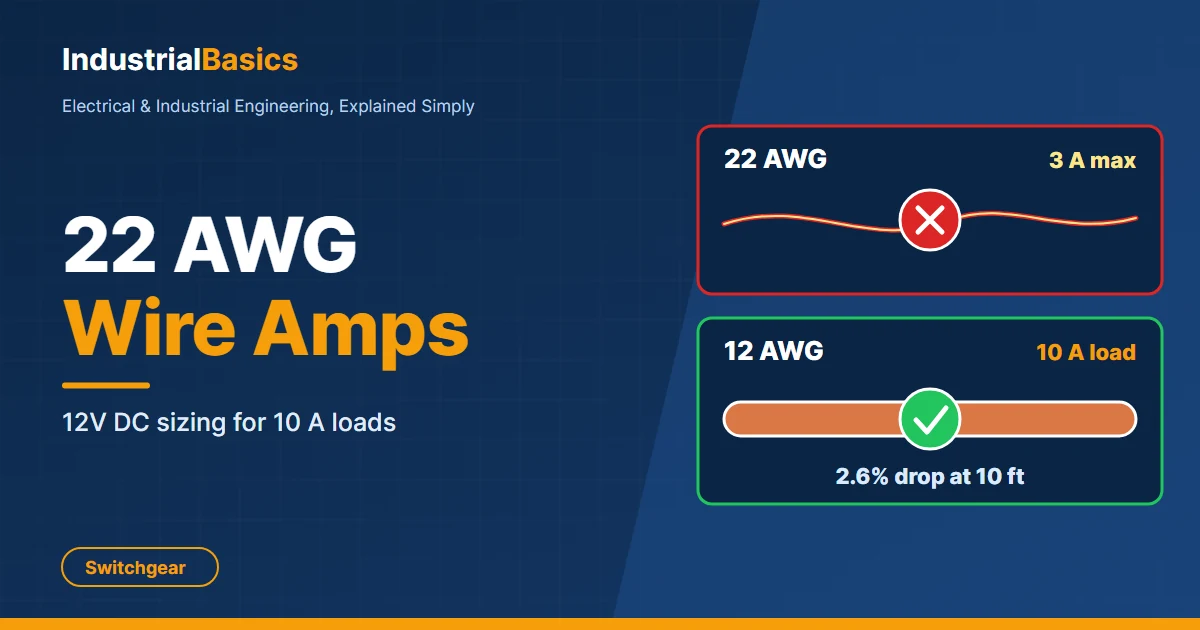
22 AWG copper wire is rated for 3 amps under NFPA 79 at 30 °C, so it should not carry a 10 A load at 12 V DC. A 10 A load on a 10 ft run needs about 12 AWG to stay within a 3% voltage drop. Very short runs could use 16 AWG on ampacity alone, but that leaves no margin. The calculator below checks both limits.
22 AWG Wire Calculator
22 AWG Ampacity
| AWG | NFPA 79 ampacity (75 °C) | Resistance (Ω/1000 ft) | Drop at 10 A, 10 ft | Carries 10 A? |
|---|---|---|---|---|
| 22 | 3 A | 16.14 | 3.23 V (26.9%) | No |
| 20 | 5 A | 10.15 | 2.03 V (16.9%) | No |
| 18 | 7 A | 6.385 | 1.28 V (10.6%) | No |
| 16 | 10 A | 4.016 | 0.80 V (6.7%) | Yes |
| 14 | 20 A | 2.525 | 0.51 V (4.2%) | Yes |
| 12 | 25 A | 1.588 | 0.32 V (2.6%) | Yes |
| 10 | 35 A | 0.999 | 0.20 V (1.7%) | Yes |
You will see other numbers online, including 7 A for 22 AWG. That figure is usually given for short chassis wiring with no stated ambient, insulation or test method, so we do not use it as a design limit. NFPA 79 applies to industrial machinery, so check the standard for your application. Vehicles, boats and consumer products have their own rules.
Derating 22 AWG
The 3 A value applies at a 30 °C ambient. NFPA 79’s correction factors reduce it in hotter conditions or when conductors are grouped:
| Condition | Factor | 22 AWG ampacity |
|---|---|---|
| 30 °C ambient | 1.00 | 3.00 A |
| 40 °C, 75 °C insulation | 0.88 | 2.64 A |
| 40 °C and 4 to 6 conductors | 0.88 × 0.80 | 2.11 A |
Why 12V Circuits Need Thicker Wire
L is the one-way length in feet, I is the current and R is the resistance in ohms per 1000 ft. The factor of 2 covers the return conductor. A 3% limit on a 12 V system is only 0.36 V, so low-voltage circuits run out of allowable drop quickly.
Worked Example: 10 A at 12 V Over 10 ft
- Try 22 AWG: 2 × 10 × 10 × 16.14 ÷ 1000 = 3.23 V, or 26.9%. It also exceeds the 3 A ampacity.
- Heat in the wire: 3.23 V × 10 A ≈ 32 W, concentrated in a very thin conductor.
- Try 16 AWG: ampacity is exactly 10 A, but the drop is 0.80 V, or 6.7%.
- Try 14 AWG: the drop is 0.51 V, or 4.2%, which is still above 3%.
- Try 12 AWG: the drop is 0.32 V, or 2.6%. This meets both limits.
How Far Can You Run 22 AWG at 12V?
| Current | Maximum one-way length at 3% drop |
|---|---|
| 0.5 A | 22.3 ft |
| 1 A | 11.2 ft |
| 2 A | 5.6 ft |
| 3 A | 3.7 ft |
22 AWG is a good fit for signals, sensors, relay coils and other small loads. Our dry contact guide and interposing relay guide show typical low-current circuits. For larger cables, use the AWG ampacity chart or the 12V wire size calculator.
Frequently Asked Questions
How many amps can 22 AWG wire carry?
NFPA 79 lists 22 AWG copper at 3 A in a 30 °C ambient for industrial machinery. Higher figures online usually refer to short chassis wiring and are not a code rating.
Can 22 AWG handle 10 amps at 12V?
No. A 10 A load is more than three times the 3 A NFPA 79 value, and a 10 ft run would lose about 3.2 V.
What size wire do I need for 10 amps at 12V?
It depends on length. For a 10 ft one-way run and a 3% drop, 12 AWG works. Very short runs can use 16 AWG on ampacity alone, with no margin.
Why do some charts say 22 AWG can carry 7 amps?
That number is commonly quoted for chassis wiring, with no stated temperature or insulation. Do not use it for a machine or vehicle design without a recognized standard behind it.
Does voltage matter for wire ampacity?
Heating depends on current, not voltage. Voltage matters because the same drop is a much larger percentage of 12 V than of 120 V.
What is the resistance of 22 AWG wire?
About 16.14 ohms per 1000 ft for solid copper at 20 °C. Stranded wire and hotter wire are slightly higher.
How far can I run 22 AWG at 12V?
For a 3% drop, about 11 ft one way at 1 A and only about 3.7 ft at 3 A.
What fuse should I use with 22 AWG wire?
The fuse must protect the wire, so it should not exceed the wire’s rating after correction factors. Follow the standard that applies to your equipment.
Sources and Further Reading
- Lutze: Ampacity per NFPA 79 (2018 Edition): ampacity and correction factors.
- HyperPhysics, Georgia State University: Electrical Wire Gauges: copper wire resistance.