
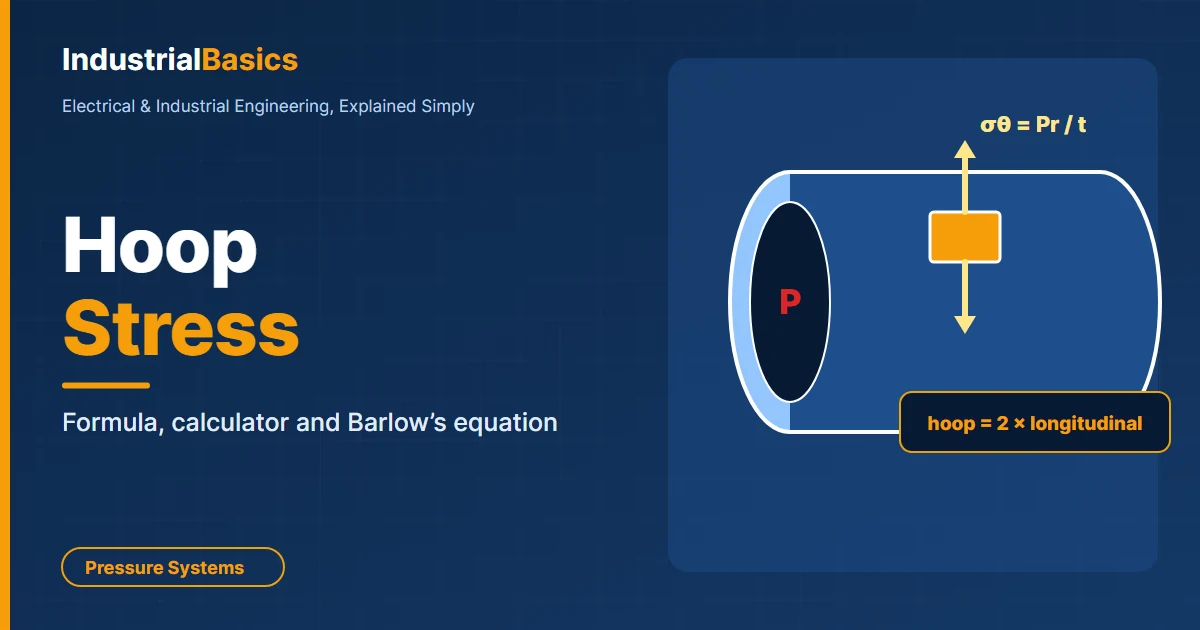
Hoop stress is the circumferential stress in the wall of a pressurized cylinder. For a thin-walled cylinder it is σθ = P r / t, where P is internal pressure, r the mean radius and t the wall thickness. The longitudinal (axial) stress is half of that, σL = P r / 2t, which is why pipes and tanks split lengthwise. Rearranged for pressure, the hoop formula becomes Barlow’s formula, P = 2 S t / D. Example: 8 in Schedule 40 steel pipe (8.625 in OD, 0.322 in wall) at 300 psi has a hoop stress of about 3,868 psi.
What Is Hoop Stress?
Wikipedia defines hoop stress as the force over area exerted circumferentially, perpendicular to the axis and the radius, on every particle in the cylinder wall. Together with axial (longitudinal) stress and radial stress it makes up the three principal stresses in a cylinder. Internal pressure pushes outward on the wall; the hoop stress is the tension that holds the two halves of the cylinder together along every lengthwise section.
Hoop Stress Equation (Thin-Walled Cylinder)
Wikipedia gives the thin-wall result from the Young–Laplace equation: σθ = P r / t for a cylinder and σθ = P r / 2t for a sphere. In US customary units P is in psi and r and t in inches, giving stress in psi. With closed ends, the pressure on the end caps adds an axial stress of about σz = P r / 2t, and the radial stress at the inner surface is about −P, small enough to ignore in thin walls.
| Stress | Thin-wall formula | Direction |
|---|---|---|
| Hoop (circumferential) | σθ = P r / t | Around the circumference |
| Longitudinal (axial), closed ends | σL = P r / 2t | Along the axis |
| Radial | σr ≈ −P inside, 0 outside | Through the wall |
| Sphere (all directions) | σ = P r / 2t | Tangential |
Worked example: 8 in Schedule 40 pipe at 300 psi
- Wikipedia’s nominal pipe size table gives 8 in Schedule 40 as 8.625 in OD with a 0.322 in wall. D/t = 26.8, above 20, so thin-wall formulas apply.
- Mean radius r = (8.625 − 0.322) ÷ 2 = 4.1515 in.
- Hoop stress σθ = 300 × 4.1515 ÷ 0.322 = 3,868 psi.
- Longitudinal stress σL = 3,868 ÷ 2 = 1,934 psi.
- Barlow, using the outside diameter: 300 × 8.625 ÷ (2 × 0.322) = 4,018 psi, slightly conservative.
Hoop Stress Calculator
Barlow’s Formula for Pipe Pressure
Wikipedia notes that “in practical engineering applications for cylinders (pipes and tubes), hoop stress is often re-arranged for pressure, and is called Barlow’s formula”: P = 2 σθ s / D, with s the wall thickness and D the outside diameter. Using the outside diameter instead of the mean diameter makes it slightly conservative. It is common in the pipeline industry, where the result is multiplied by a design factor to set the maximum allowable operating pressure (MAOP).
| US pipeline class location | Description (summary) | Design factor |
|---|---|---|
| Class 1 | 10 or fewer buildings for human occupancy (or offshore) | 0.72 |
| Class 2 | More than 10 but fewer than 46 buildings | 0.60 |
| Class 3 | 46 or more buildings, or near occupied outdoor areas | 0.50 |
| Class 4 | Buildings of four or more stories prevalent | 0.40 |
Wikipedia also stresses that designing a pressure system “involves much more than the application of Barlow’s formula”: the ASME Boiler and Pressure Vessel Code governs pressure vessel design and testing, and piping codes add corrosion allowance, weld joint efficiency, temperature derating and mill tolerance.
Thick-Walled Cylinders: The Lamé Equations
Wikipedia states that when radius/thickness falls below 10 (diameter/thickness below 20), the thin-wall equations no longer hold, because stresses vary significantly between the inner and outer surfaces. The Lamé equations give the hoop and radial stress at any radius r for inner radius a, outer radius b and internal pressure Pa:
The hoop stress is highest at the bore. Wikipedia explains this is why cracks in pipes should theoretically start from the inside, and why inspection focuses there. The maximum shear stress, half the difference between hoop and radial stress, also peaks at the inner surface.
Hoop Strain
The circumferential strain follows from Hooke’s law for three-dimensional stress, which Wikipedia gives as ε₁ = [σ₁ − ν(σ₂ + σ₃)] / E. For the hoop direction: εθ = [σθ − ν(σL + σr)] / E. Engineering ToolBox lists Young’s modulus for ASTM A36 structural steel as 200 GPa (about 29,000 ksi), and Wikipedia gives Poisson’s ratio for steel as 0.27–0.30.
For the 8 in pipe example, using the average radial stress of −P/2 across the wall: εθ = [3,868 − 0.29 × (1,934 − 150)] ÷ 29,000,000 ≈ 116 microstrain, a diameter growth of about 1.0 thousandths of an inch.
Where Hoop Stress Matters in a Plant
- Piping and tubing: wall thickness and schedule selection; pressure-rating checks after corrosion has thinned the wall.
- Pressure vessels and air receivers: shell thickness is driven by hoop stress, heads by the spherical or dished-head equations.
- Hydraulic cylinders: thick walls and high pressures, so the Lamé equations apply.
- Storage tanks: liquid head creates hoop stress that grows with depth, which is why tank shells are thicker at the bottom. Our psi to feet of head guide converts liquid depth to pressure.
- Gauge vs absolute pressure: the formulas use the pressure difference across the wall, which for a vessel open to atmosphere outside is the gauge pressure; see psig vs psia.
Checking an aluminum tube or vessel? Compare the stress with the material’s strength; our 6061 aluminum yield strength guide gives T6, T4 and welded values in ksi and MPa.
Pressure vessel shells are designed under ASME Section VIII; our ASME Section VIII guide explains Divisions 1, 2 and 3 and MAWP vs design pressure.
Frequently Asked Questions
What is hoop stress?
Hoop stress is the circumferential (tangential) stress in the wall of a cylinder or sphere, acting around the circumference. Internal pressure tries to burst the cylinder open along its length, and the hoop stress is the wall’s resistance to that.
What is the hoop stress formula?
For a thin-walled cylinder, σθ = P r / t, where P is internal pressure, r the mean radius and t the wall thickness. For a sphere it is P r / 2t.
What is the difference between hoop stress and longitudinal stress?
Hoop stress acts around the circumference (σθ = Pr/t); longitudinal or axial stress acts along the axis of a closed cylinder (σL = Pr/2t). In a thin-walled cylinder the hoop stress is twice the longitudinal stress.
Why do pipes split lengthwise?
Because the hoop stress is twice the longitudinal stress, the wall fails first in the hoop direction, so the crack runs along the length of the pipe or tank.
What is Barlow’s formula?
P = 2 S t / D, which rearranges the hoop stress equation to give the pressure a pipe can hold, using the allowable stress S, wall thickness t and outside diameter D. It is widely used in the pipeline industry.
When is the thin-walled formula valid?
When the wall thickness is no more than about one tenth of the radius, often stated as diameter/thickness above 20. Below that, use the Lamé equations.
What is hoop tension?
Another name for the circumferential force or stress in a ring or cylinder wall. Wikipedia also uses wall tension for the total circumferential force per unit length.
What is hoop strain?
The circumferential strain of the wall. From Hooke’s law, εθ = [σθ − ν(σL + σr)] / E. For thin walls the radial term is small.
Is hoop stress tensile or compressive?
Tensile for internal pressure. External pressure (vacuum, deep water) makes it compressive, and thin vessels can then fail by buckling rather than yielding.
Where is hoop stress highest in a thick-walled pipe?
At the inside surface. The Lamé equations show the hoop stress falls from a maximum at the bore to a minimum at the outer surface, which is why cracks tend to start from the inside.
Sources and Further Reading
- Wikipedia: Cylinder stress: hoop, axial and radial stress, thin-wall limits and Lamé equations.
- Wikipedia: Barlow’s formula: pipe pressure formula and pipeline design factors.
- Wikipedia: Pressure vessel: design context and codes.
- Wikipedia: Hooke’s law: three-dimensional strain relations.
- Wikipedia: Poisson’s ratio: values for steel.
- Engineering ToolBox: Young’s modulus: elastic modulus of structural steel.
- Wikipedia: Nominal Pipe Size: 8 in Schedule 40 dimensions.



