
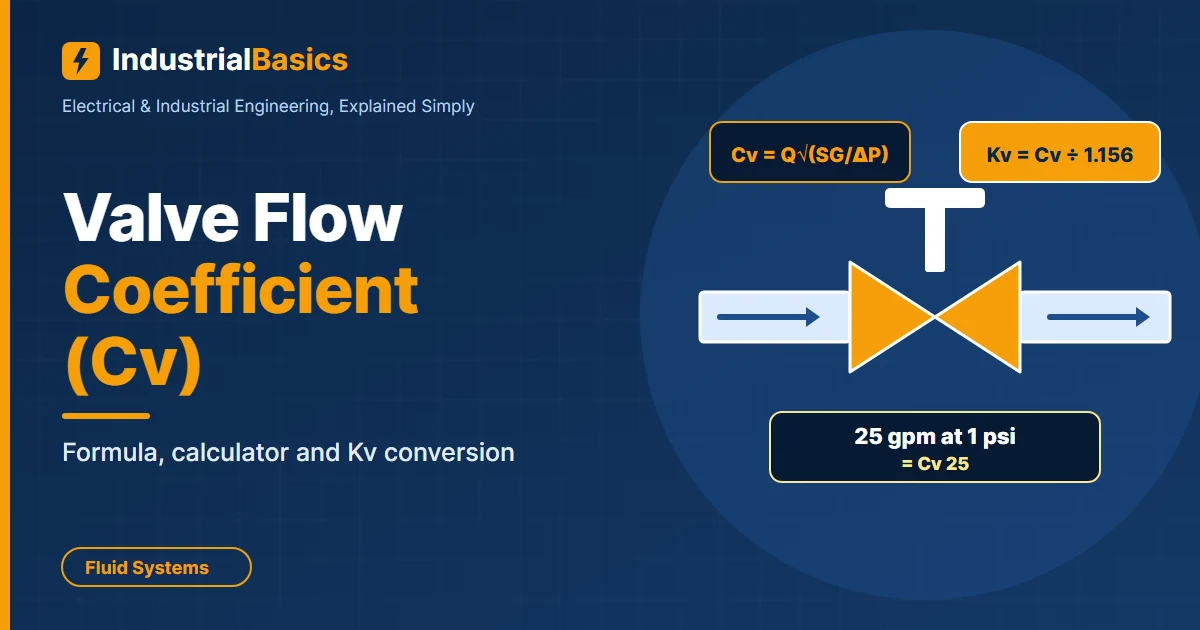
The flow coefficient Cv of a valve is the flow of 60 °F water, in US gallons per minute, that passes through it with a 1 psi pressure drop. For liquids, Cv = Q × √(SG / ΔP) and Q = Cv × √(ΔP / SG). For example, 50 gpm of water at a 25 psi drop needs Cv = 50 × √(1/25) = 10. The metric equivalent Kv (m³/h at 1 bar) equals Cv ÷ 1.156. Gases need a different equation that uses absolute pressures and temperature, and flow chokes once the outlet pressure falls below about half of the inlet.
What Is Cv?
Wikipedia describes the flow coefficient as a relative measure of a device’s efficiency at allowing fluid flow, relating the pressure drop across it to the flow rate. In practical terms, Cv “is the volume (in US gallons) of water at 60 °F (16 °C) that will flow per minute through a valve with a pressure drop of 1 psi”. A larger restriction gives a smaller Cv. Because it is a single number, Cv lets you compare valves of different sizes, types and makers on equal terms.
Swagelok’s valve sizing bulletin notes that manufacturers determine flow coefficients by testing the valve with water using a standard ISA test method. Engineering ToolBox gives a simple example: a control valve that passes 25 gpm of water at a 1 psi drop when fully open has Cv = 25.
Cv Formula for Liquids
Engineering ToolBox gives Cv = q (SG / dp)½ for liquids, with q in US gpm, SG the specific gravity and dp the pressure drop in psi; Swagelok writes the same as q = N₁ Cv √(Δp / Gf) with N₁ = 1.0 for gpm and psi. In metric units ToolBox gives Cv = 11.6 q (SG / dp)½ with q in m³/h and dp in kPa.
| Find | Formula | Example |
|---|---|---|
| Cv required | Cv = Q √(SG / ΔP) | 50 gpm water at 25 psi → Cv = 10 |
| Flow through a valve | Q = Cv √(ΔP / SG) | Cv 10 at 16 psi → 40 gpm |
| Pressure drop | ΔP = SG (Q / Cv)² | 40 gpm through Cv 10 → 16 psi |
| Flow by weight (water) | Cv = w / (500 √(ΔP SG)), w in lb/h | 20,000 lb/h at 16 psi → Cv 10 |
| Kv from Cv | Kv = Cv ÷ 1.156 | Cv 10 → Kv 8.65 |
Swagelok points out that the effect of a pressure change on liquid flow is diminished by taking its square root: doubling the flow needs four times the pressure drop. Its liquid formulas apply to ordinary liquids, not to liquids that are boiling or flashing, slurries or very viscous liquids.
Valve Cv Calculator
Cv for Gases and Air
Gases are compressible, so Swagelok’s equations use absolute pressures (psia), absolute temperature (°R = °F + 460) and the gas specific gravity Gg (air = 1.0), with N₂ = 22.67 for flow in standard cubic feet per minute:
| Condition | Equation (Swagelok) |
|---|---|
| Low pressure drop: p₂ > ½ p₁ | q = 22.67 Cv p₁ (1 − 2Δp / 3p₁) √(Δp / (p₁ Gg T₁)) |
| High pressure drop (choked): p₂ ≤ ½ p₁ | q = 0.471 × 22.67 Cv p₁ √(1 / (Gg T₁)) |
In low pressure drop flow, lowering the outlet pressure increases the flow. Once the outlet pressure reaches half the inlet pressure, Swagelok explains, the gas leaves the orifice at the velocity of sound and “cannot break that sound barrier”, so this becomes the maximum (choked or critical) flow. Example: a valve with Cv = 1.0 and 200 psia inlet on air at 60 °F, choked, passes about 94 scfm. Wikipedia quotes roughly 100 scfm for the same case, a reminder that these are sizing estimates.
Steam
Engineering ToolBox gives simplified steam formulas: for choked (critical) flow, with outlet pressure below about 58% of inlet, Cv = m / (1.61 pi), where m is steam flow in lb/h and pi the inlet pressure in psia; for non-critical flow, Cv = m / (2.1 √((pi + po) Δp)). Superheated steam is corrected by (1 + 0.00065 Δt), with Δt the superheat in °F.
Valves in Series and Parallel
Because ΔP = SG (Q/Cv)² for each valve and the same flow passes through valves in series, their pressure drops add. That gives 1/Cvtotal² = 1/Cv₁² + 1/Cv₂² + … Two Cv 10 valves in series behave like one valve of Cv 7.07. In parallel, each valve sees the same pressure drop, so the flows add and Cvtotal = Cv₁ + Cv₂ + …. The same reasoning applies to strainers, check valves and orifices in the line.
Sizing a Control Valve with Cv
- Set the flow range: minimum, normal and maximum flow the process needs.
- Allocate pressure drop to the valve at maximum flow, after pipe, fitting and equipment losses.
- Calculate the required Cv at maximum flow with the formula for your fluid.
- Pick a valve whose rated Cv covers that value without being excessively large; Engineering ToolBox warns that an oversized valve runs at small openings with more dead band and hurts control.
- Check the low end: the valve must still control at minimum flow.
For how a control valve receives its position signal from a PLC or controller, see our 4-20 mA flow control valve guide; for converting pressure to head on the pump side, see psi to feet of head.
Measuring flow with a restriction instead of a valve? See the orifice flow equation for discharge coefficients, beta ratio and a flow calculator.
Frequently Asked Questions
What is the flow coefficient Cv of a valve?
Cv is the number of US gallons per minute of 60 °F water that flow through the valve with a 1 psi pressure drop across it. A valve with Cv = 25 passes 25 gpm of water at 1 psi drop.
What is the Cv formula?
For liquids: Cv = Q × √(SG / ΔP), where Q is flow in gpm, SG the specific gravity (water = 1) and ΔP the pressure drop in psi. Rearranged: Q = Cv × √(ΔP / SG).
How do you calculate Cv for a valve?
Divide the required flow by the square root of the pressure drop, and multiply by the square root of the specific gravity. 50 gpm of water at 25 psi drop: Cv = 50 × √(1/25) = 10.
What is the difference between Cv and Kv?
Cv is in US gpm at 1 psi; Kv is in m³/h at 1 bar. Wikipedia gives Cv = 1.156 × Kv, so Kv = Cv ÷ 1.156 (about 0.865 Cv).
How do you convert Cv to gpm?
Q (gpm) = Cv × √(ΔP / SG). A Cv of 10 at 16 psi drop on water passes 10 × 4 = 40 gpm.
How is Cv used for gas?
Gas flow needs absolute pressures and temperature. Swagelok’s equations use q = 22.67 Cv p1 (1 − 2Δp/3p1) √(Δp/(p1 Gg T1)) when outlet pressure is above half of inlet, and q = 0.471 × 22.67 Cv p1 √(1/(Gg T1)) when the flow is choked.
What is choked flow in a valve?
When the outlet pressure falls to about half the inlet absolute pressure, gas reaches sonic velocity in the valve and flow stops increasing even if outlet pressure drops further. Swagelok calls this maximum, choked or critical flow.
What is the Cv of valves in series?
For liquids, pressure drops add, so 1/Cv_total² = 1/Cv₁² + 1/Cv₂² + … Two valves of Cv 10 in series act like one valve of Cv 7.07. Valves in parallel simply add their Cv values.
Is a bigger Cv always better?
No. Engineering ToolBox warns that an oversized control valve adds too much gain, runs at small openings with more dead band, and can hurt process control. Size for the required flow at a sensible pressure drop.
How do manufacturers determine Cv?
By testing with water to a standard ISA test method, measuring flow and pressure drop across the valve, as Swagelok describes. Published Cv values are usually for the fully open valve.
Sources and Further Reading
- Wikipedia: Flow coefficient: Cv definition, Kv and the 1.156 conversion.
- Engineering ToolBox: Flow coefficients Cv and Kv: liquid, steam and gas formulas and oversizing.
- Swagelok: Valve Sizing technical bulletin (PDF): liquid and gas flow equations, choked flow and testing.



