
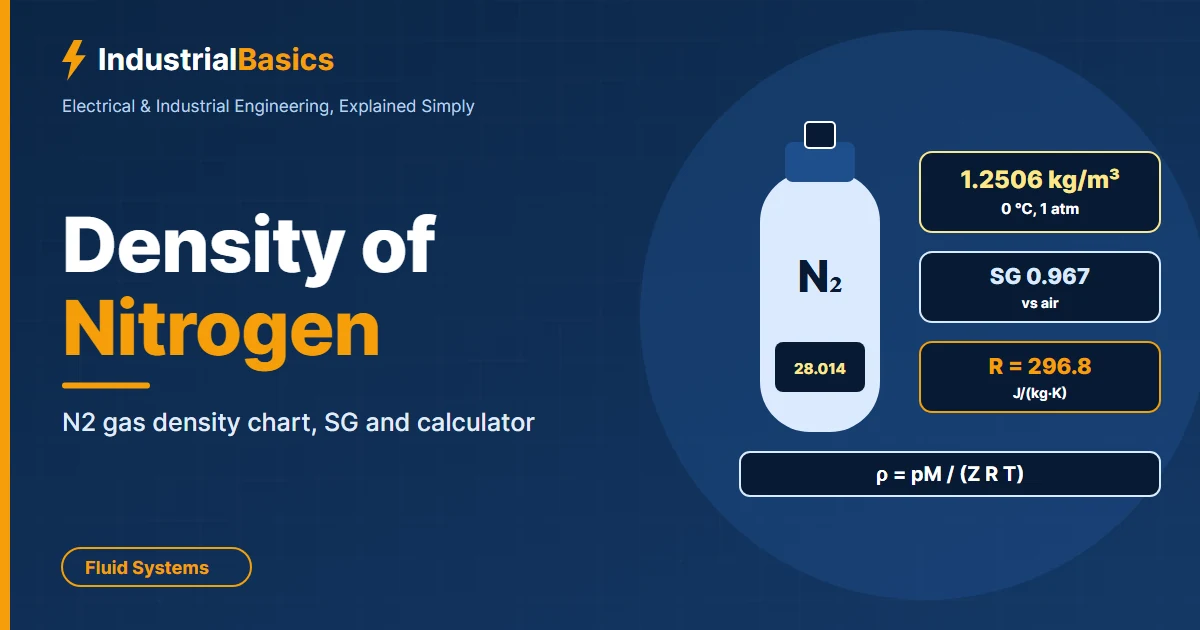
The density of nitrogen gas is 1.2506 kg/m³ (g/L) at 0 °C and 1 atm, and about 1.165 kg/m³ (0.0727 lb/ft³) at 20 °C (68 °F). Its specific gravity relative to air is 0.967, and its specific gas constant is 296.8 J/(kg·K). Density rises in proportion to absolute pressure and falls with absolute temperature: ρ = pM/(ZRT), with M = 28.014 g/mol. Liquid nitrogen is about 800 kg/m³ near its boiling point.
Nitrogen Density at Standard Conditions
| Condition | kg/m³ | lb/ft³ | Source |
|---|---|---|---|
| 0 °C (32 °F), 1 atm | 1.2506 | 0.07807 | Wikipedia (measured) |
| 0 °C, 1 atm, ideal gas | 1.2498 | 0.07803 | Calculated |
| 15.6 °C (60 °F), 1 atm | 1.1825 | 0.07382 | Calculated |
| 20 °C (68 °F), 1 atm | 1.1646 | 0.07270 | Calculated |
| 27 °C (300 K), 1 bar | 1.126 | 0.07029 | Engineering ToolBox |
Nitrogen Gas Pressure-Temperature Density Chart
| Temperature | 1 bar | 10 bar | 50 bar | 100 bar |
|---|---|---|---|---|
| 200 K (-73 °C) | 1.689 | 16.84 | 84.2 | 168.4 |
| 300 K (27 °C) | 1.126 | 11.23 | 56.13 | 112.3 |
| 400 K (127 °C) | 0.845 | 8.42 | 42.1 | 84.2 |
| 500 K (227 °C) | 0.676 | 6.736 | 33.68 | 67.36 |
The ToolBox values follow the ideal-gas law closely at these conditions: ten times the absolute pressure gives ten times the density. Real nitrogen departs from ideal behavior at high pressure or near its critical temperature (−147 °C). The compressibility factor Z expresses that departure, and Wikipedia notes Z generally increases with pressure and decreases with temperature. At 100 K (−173 °C) and 1 bar, for example, the ToolBox density of 3.437 kg/m³ is already about 2% above the ideal-gas value.
Density vs Temperature at 1 bar
| K | °C | °F | kg/m³ | lb/ft³ |
|---|---|---|---|---|
| 100 | -173 | -280 | 3.437 | 0.2146 |
| 150 | -123 | -190 | 2.252 | 0.1406 |
| 200 | -73 | -100 | 1.689 | 0.1054 |
| 300 | 27 | 80 | 1.126 | 0.0703 |
| 400 | 127 | 260 | 0.845 | 0.0528 |
| 500 | 227 | 440 | 0.676 | 0.0422 |
| 600 | 327 | 620 | 0.561 | 0.0350 |
| 800 | 527 | 980 | 0.422 | 0.0263 |
| 1100 | 827 | 1520 | 0.306 | 0.0191 |
| 1600 | 1327 | 2420 | 0.211 | 0.0132 |
Nitrogen Density Calculator
Formula and Constants
- Molar mass: N₂ = 2 × 14.007 = 28.014 g/mol (Wikipedia standard atomic weight).
- Specific gas constant: RN2 = 8.314 / 0.028014 = 296.8 J/(kg·K).
- Specific gravity: 28.014 / 28.965 = 0.9672 relative to dry air (air M = 0.0289652 kg/mol, Wikipedia).
- Pressure must be absolute: add atmospheric pressure to gauge readings; see psig vs psia.
Example: a nitrogen line at 100 psig and 68 °F has an absolute pressure of 114.7 psia (790.8 kPa). The density is 790,800 / (296.8 × 293.15) = 9.09 kg/m³, about 7.8 times the density at atmospheric pressure. For gas volume units, see SCFM vs CFM; for gas mixtures, see partial pressure.
Liquid Nitrogen
At atmospheric pressure nitrogen boils at 77 K (−195.8 °C). Engineering ToolBox lists the saturated liquid at 816.7 kg/m³ at 75 K and 798.6 kg/m³ at 79 K, roughly 690 times the density of the gas at room temperature. Wikipedia gives the liquid-to-gas expansion ratio as 1:694 at 20 °C.
Frequently Asked Questions
What is the density of nitrogen?
Nitrogen gas has a density of 1.2506 g/L (kg/m³) at 0 °C and 1 atm (Wikipedia). At 20 °C (68 °F) and 1 atm it is about 1.165 kg/m³, or 0.0727 lb/ft³.
What is the density of nitrogen at STP?
About 1.25 kg/m³: Wikipedia gives 1.2506 g/L at 0 °C and 1013 mbar. The ideal-gas value is 1.2498 kg/m³, within 0.1%.
What is the specific gravity of nitrogen gas?
About 0.967 relative to air, the ratio of the molar masses (28.014 vs 28.965 g/mol), so nitrogen is slightly lighter than air.
What is the specific gas constant of nitrogen?
About 296.8 J/(kg·K), the universal gas constant 8.314 J/(mol·K) divided by nitrogen’s molar mass of 0.028014 kg/mol. In US units that is about 55.2 ft·lbf/(lb·°R).
How does nitrogen density change with pressure?
In proportion to absolute pressure at a fixed temperature. At 27 °C the Engineering ToolBox table gives 1.126 kg/m³ at 1 bar, 11.23 at 10 bar and 112.3 at 100 bar.
How does nitrogen density change with temperature?
Inversely with absolute temperature: at 1 bar density falls from 1.689 kg/m³ at −73 °C to 1.126 at 27 °C and 0.676 at 227 °C (Engineering ToolBox).
What is the density of liquid nitrogen?
About 800 kg/m³ near its boiling point: Engineering ToolBox lists 816.7 kg/m³ at 75 K and 798.6 kg/m³ at 79 K. Nitrogen boils at 77 K (−195.8 °C) at atmospheric pressure.
How much gas does liquid nitrogen make?
The liquid-to-gas expansion ratio is about 1:694 at 20 °C (Wikipedia), which is why liquid nitrogen must never be sealed in a closed container.
What is the molar mass of nitrogen gas?
About 28.014 g/mol for N₂ (two atoms at a standard atomic weight of 14.007).
Is nitrogen heavier than air?
No, slightly lighter (specific gravity 0.967), but cold nitrogen from liquid boil-off is denser than room air and can pool in low areas.
Sources and Further Reading
- Wikipedia: Nitrogen: density at STP, atomic weight, boiling point.
- Engineering ToolBox: Nitrogen density and specific weight: density vs temperature and pressure, liquid density.
- Wikipedia: Density of air: molar mass of dry air.
- Wikipedia: Compressibility factor: real-gas correction Z.
- Wikipedia: Liquid nitrogen: expansion ratio and asphyxiation hazard.



