
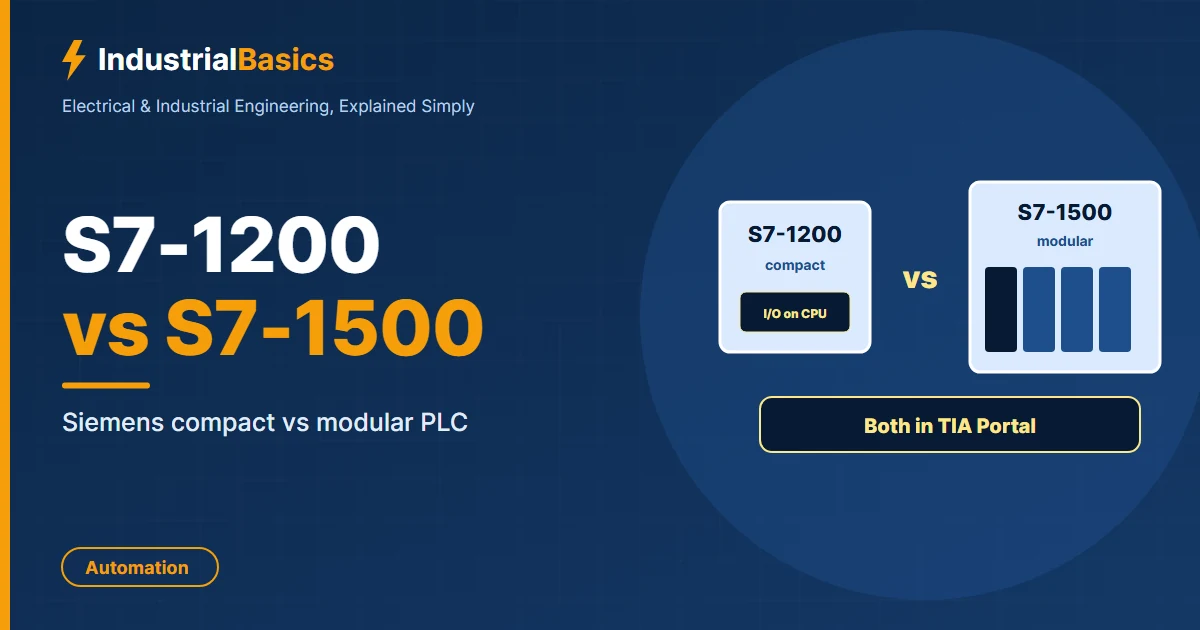
The S7-1200 is Siemens’ compact PLC for basic automation, and the S7-1500 is its modular high-performance PLC for complex machines and plants. The S7-1200 has I/O built into the CPU, takes up to 8 expansion modules and up to about 250 kB of program memory (G2). The S7-1500 takes up to 32 modules centrally and up to 6 MB of program memory. It adds integrated motion in every CPU, a display, SIL 3 fail-safe versions and redundant R/H CPUs. Both are programmed in TIA Portal, and the S7-1500 replaces the older S7-300 and S7-400.
S7-1200 vs S7-1500 Comparison
| Feature | S7-1200 / S7-1200 G2 | S7-1500 |
|---|---|---|
| Class | Compact; low to medium complexity | Modular; medium to high complexity |
| Launched | 2009 (G1); December 2024 (G2) | Presented 2012 |
| Replaces | S7-200 | S7-300 and S7-400 |
| On-board I/O | Yes, digital and analog in the CPU | No; I/O on signal modules (ET 200MP) |
| Expansion | Signal board + up to 8 I/O modules (1214C and up) | Up to 32 modules in the central rack |
| Memory | 50–150 kB working (G1); 150–250 kB program (G2) | 150 kB – 6 MB program; up to 60 MB data |
| Motion | Simple axes; G2 adds sync axes, cams, kinematics | Every CPU; T-CPUs for advanced motion |
| Safety | FC fail-safe CPUs | F-CPUs up to SIL 3 / PL e |
| Redundancy | No | R and H CPUs |
| Display, web | G2: integrated web server, Web API, NFC | Color display and web server on CPU |
| Communication | PROFINET/Ethernet; CM modules; G2 adds IRT, MRP/MRPD | PROFINET, Industrial Ethernet, OPC UA; CP modules |
| Program memory card | Internal or SIMATIC Memory Card | SIMATIC Memory Card required |
| Software | STEP 7 in TIA Portal | STEP 7 in TIA Portal |
Memory and CPU Range
First-generation S7-1200 CPUs run from the 1211C (50 kB working memory, 6 inputs, 4 outputs, 2 analog inputs) to the 1217C (150 kB). Bit instructions execute in about 0.1 μs. The G2 CPU 1212C G2 has 150 kB program and 500 kB data memory, and the 1214C G2 has 250 kB program and 750 kB data. S7-1500 CPUs span the 1511-1PN (from 150 kB program, 1 MB data) to the 1518-4PN/DP (6 MB program, 60 MB data). F, T, TF, R and H versions are available (Wikipedia).
Which Should You Choose?
- Choose the S7-1200 for small to medium standalone machines, such as packaging, pumps, HVAC and conveyors, where on-board I/O and a compact footprint keep cost down. Use G2 for new designs.
- Choose the S7-1500 for large I/O counts, many networked devices, coordinated motion, SIL 3 safety in the controller, redundancy or very large programs, and when replacing an S7-300 or S7-400.
- Keep the S7-300/400 only to maintain existing plants; Siemens positions the S7-1500 as the successor.
For general PLC selection steps, see how to select a PLC. For the Rockwell side of the market, see I/O tags in Studio 5000.
S7-1200 G2: What Changed
Siemens lists higher processing power, more memory and faster communication for the S7-1200 G2. It adds motion control for single axes, coordinated axes and simple kinematics, plus cost-optimized fail-safe hardware, NFC wireless access and an integrated web server with Web API. Wikipedia adds PROFINET IRT, MRP/MRPD media redundancy, user and role management, and an event log. It also reports that NFC was deactivated in a firmware release a few months after launch, so check the current firmware notes.
S7 Family History
| Year | Event |
|---|---|
| 1994 | SIMATIC S7 launched: S7-200, S7-300, S7-400 |
| 1996 | Totally Integrated Automation concept |
| 2009 | S7-1200 launched, replacing the S7-200 |
| 2011 | TIA Portal software launched |
| 2012 | S7-1500 presented, to replace S7-300/400 over time |
| 2024 | S7-1200 G2 launched (with TIA Portal V20) |
For PROFINET basics used by both families, see what is PROFINET. For control-system architecture, see PLC vs DCS vs SCADA.
Frequently Asked Questions
What is the difference between S7-1200 and S7-1500?
The S7-1200 is Siemens’ compact PLC for basic, low-to-medium complexity automation, with I/O built into the CPU and up to 8 expansion modules. The S7-1500 is the modular high-performance PLC for medium to high complexity, with up to 32 modules in the central rack, more memory, a display, integrated motion in every CPU, SIL 3 fail-safe and redundant versions.
What is the Siemens SIMATIC S7-1200?
A family of small (about 100 × 75 mm) compact PLCs launched in 2009 to replace the S7-200. Each CPU includes PROFINET and on-board digital and analog I/O, and is programmed with STEP 7 in TIA Portal (Wikipedia).
What is the S7-1200 G2?
The second generation of the S7-1200, launched in December 2024 with TIA Portal V20. Siemens lists higher processing power, more memory, motion control including simple kinematics, cost-optimized fail-safe CPUs, NFC access and an integrated web server and Web API.
Is the S7-1200 G2 compatible with the old S7-1200?
Not in hardware: Siemens says G2 controllers are not hardware-compatible with the previous S7-1200 modules, although existing programs can usually be converted with minor changes.
What replaced the S7-300 and S7-400?
The S7-1500, presented in 2012, is intended to replace the S7-300 and S7-400 over time (Wikipedia).
Which software programs the S7-1200 and S7-1500?
Both use STEP 7 in TIA Portal (Totally Integrated Automation Portal), launched in 2011. The older S7-300/400 use classic STEP 7, and the S7-200 used STEP 7-Micro/WIN.
Does the S7-1500 support safety?
Yes. Fail-safe S7-1500F CPUs reach up to SIL 3 to IEC 62061 and PL e to ISO 13849, and TF variants add technology functions (Wikipedia).
Does the S7-1200 support motion control?
Yes, for single and simple axes; the G2 generation supports SIMATIC Motion technology objects including synchronous axes, cams and kinematics. Every S7-1500 CPU has motion control, and S7-1500T CPUs add extended synchronization and kinematics.
Which communication does each support?
Both have integrated PROFINET/Industrial Ethernet. The S7-1500 supports OPC UA and adds communication modules; the S7-1200 uses CM modules for RS-232, Modbus and other buses. The G2 adds PROFINET IRT and MRP/MRPD redundancy.
Is the S7-1200 cheaper than the S7-1500?
Generally yes. It is a compact controller for smaller machines, so for small I/O counts it usually costs less than an S7-1500 CPU plus rack modules. Check current pricing with a Siemens distributor.
Sources and Further Reading
- Siemens: SIMATIC S7-1200 G2: G2 features and compatibility.
- Siemens: SIMATIC S7-1500: modularity, motion, communication, TIA Portal.
- Wikipedia: SIMATIC S7: history, CPU ranges and memory.



