
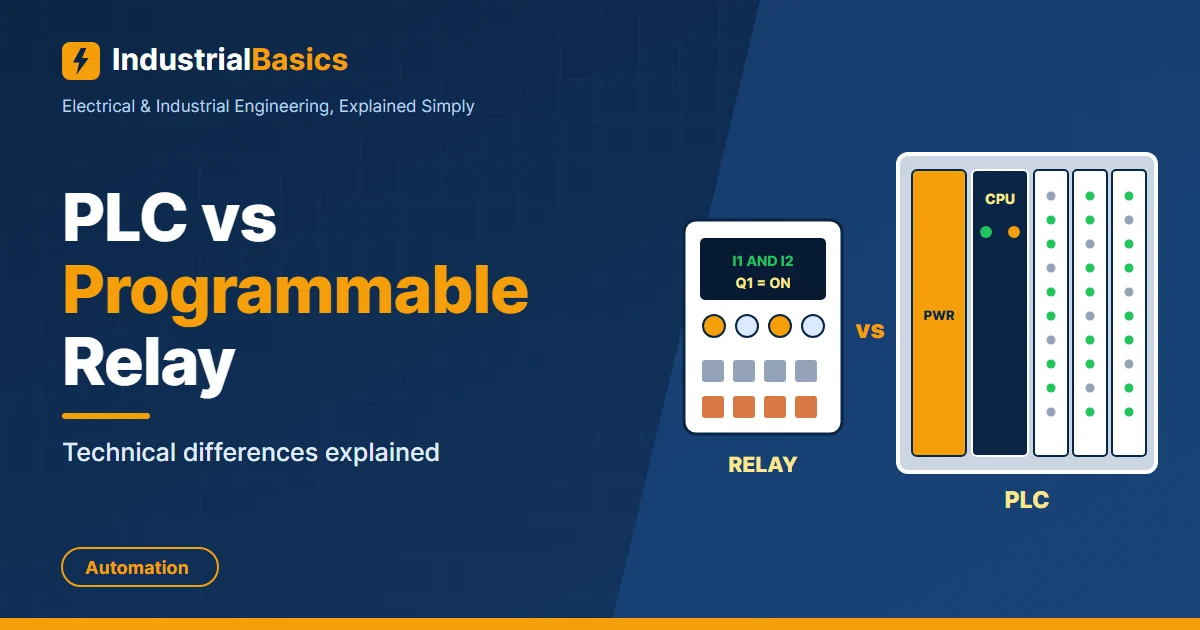
A programmable relay is a compact controller for small automation jobs, while a PLC is built for larger or more demanding control. Choose a programmable relay for a simple panel or machine with a modest, fixed I/O count. Choose a PLC when you need more I/O, faster or more complex control, wider networking, stronger diagnostics or room to grow. The line is not fixed, because large programmable relays can overlap with small PLCs.
| Factor | Programmable relay | PLC |
|---|---|---|
| Typical job | Lighting, pumps, fans, small machines | Machines, lines and process systems |
| I/O capacity | Tens of points, up to 188 on easyE4 | Scales with modules and racks |
| Programming | Simple software, often FBD or ladder | Full engineering software and languages |
| Networking | Often Ethernet or Modbus options | Broader industrial network options |
| Diagnostics | Basic to moderate | More detailed |
| Best when | The task is small and well defined | The system is large or will grow |
What Is a Programmable Relay?
A programmable relay, also called a smart relay or control relay, combines inputs, outputs, timers, counters and logic in one small device. It can replace a group of hard-wired relays and timers, so a logic change becomes a program change instead of a wiring change.
A programmable logic controller follows the same input, logic and output idea, but is designed to scale further. If you are replacing discrete relays, our comparison of contactors and relays explains what still needs to stay in the panel.
Real Programmable Relay Specifications
| Specification | Siemens LOGO! 8 | Schneider Zelio Logic | Eaton easyE4 |
|---|---|---|---|
| Maximum I/O | 24 DI, 20 DQ, 8 AI, 8 AQ | 40 I/O | 188 I/O |
| Expansion | Expansion modules | Modular models: 6, 10 or 14 I/O extensions | Up to 11 expansions |
| Languages | FBD and ladder in LOGO! Soft Comfort | FBD or ladder | ST, FBD, LD and EDP |
| Communication | Integrated Ethernet | Modbus or Ethernet Modbus/TCP extensions | Ethernet |
| Program limit | 400 blocks, 8,500 bytes | See model data | See model data |
PLC vs Programmable Relay: Key Differences
I/O and expansion
Programmable relays have a defined ceiling. A PLC family usually grows through more modules, racks or networked I/O. As one example, Rockwell’s 1769 Compact I/O allows up to 16 modules in a bank. With 32-point modules, that is up to 512 points on one bank before controller, power and distance limits are applied.
Programming
Programmable relays are designed for quick setup, and some can be edited from the front panel. PLCs usually have fuller engineering tools and support the languages described in IEC 61131-3. Note that some advanced relays, such as easyE4, now offer structured text as well.
Communication and diagnostics
Modern relays are not isolated devices. LOGO! 8 has integrated Ethernet, and Zelio has Modbus and Ethernet extensions. A PLC is still the safer choice when a system needs several industrial networks, many remote devices or detailed fault information. For tag-based PLC programming, see our guide to the I/O tag in Studio 5000.
Which Should You Choose?
| Choose a programmable relay for | Choose a PLC for |
|---|---|
| Lighting or time-based control | Production lines |
| Pump alternation or level control | Multi-axis or high-speed control |
| Small fans and ventilation | Large I/O counts |
| Replacing a few relays and timers | Plant network integration |
| Standard machine with fixed scope | Systems likely to expand |
Worked Selection Examples
These examples use the 25% I/O margin explained in our guide on how to select a PLC.
| Application | Counted I/O | With 25% margin | Result |
|---|---|---|---|
| Duplex pump panel | 12 DI, 6 DO, 2 AI | 15 DI, 8 DO, 3 AI | Within LOGO! 8 limits |
| Packaging machine | 60 DI, 40 DO | 75 DI, 50 DO | 125 points: beyond LOGO! 8 and Zelio, within the easyE4 total |
| Plant line with several networks | Hundreds of points | More with margin | Use a PLC |
The packaging machine shows why I/O alone does not settle the decision. It might fit a large relay, but if it needs fast motion, recipes or plant data, a PLC is the better long-term choice.
Frequently Asked Questions
What is a programmable relay?
It is a compact controller with built-in inputs, outputs and logic functions. It is used for small automation tasks such as lighting, pumps, fans and simple machines. It is also called a smart relay or control relay.
What is the difference between a PLC and a programmable relay?
A programmable relay is designed for smaller, simpler tasks, while a PLC is designed for larger or more demanding control, with wider I/O, communication and diagnostic options. The boundary varies by product.
Is a programmable relay a PLC?
It works on the same basic idea, but it is usually a smaller and simpler class of controller. Some larger models overlap with small PLCs.
How many I/O can a programmable relay handle?
It depends on the model. Schneider Zelio Logic reaches 40 I/O, a Siemens LOGO! 8 setup supports 24 DI, 20 DQ, 8 AI and 8 AQ, and Eaton easyE4 reaches 188 I/O.
Can programmable relays be expanded?
Many can. Siemens LOGO! 8, modular Zelio Logic and Eaton easyE4 all accept expansion modules. Compact fixed models may not.
What languages do programmable relays use?
It varies. Zelio Logic uses FBD or ladder, and Eaton easyE4 offers ST, FBD, LD and EDP. LOGO! Soft Comfort supports ladder and function block diagrams.
When should I choose a PLC instead?
Choose a PLC when you need more I/O, fast or complex control, wider networking, stronger diagnostics or a clear path for future expansion.
Can a programmable relay be used for safety?
A standard programmable relay should not perform an emergency stop or other safety function. Use devices rated for the required safety function.
Sources and Further Reading
- Siemens: LOGO! System Manual: maximum I/O, memory and block limits.
- Siemens: LOGO! 8 Brochure: configuration and Ethernet.
- Schneider Electric: Zelio Logic Catalog: I/O, extensions and languages.
- Eaton: easyE4 Control Relay Brochure: I/O capacity and programming languages.
- Rockwell Automation: Compact I/O Selection Guide: PLC module and bank limits.



