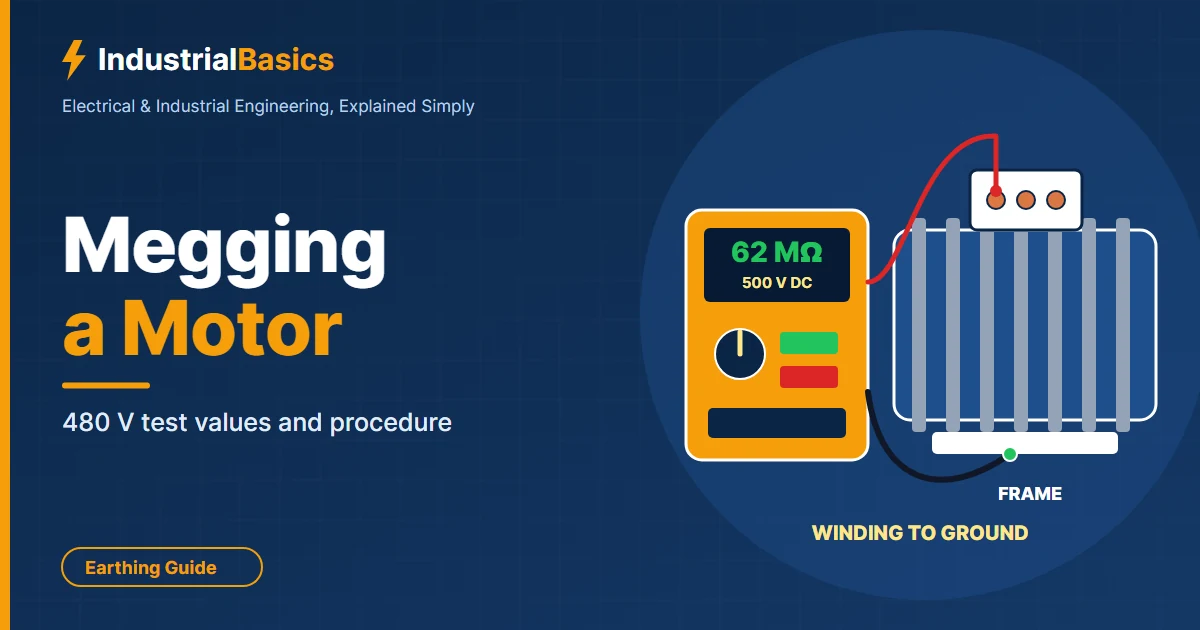
To meg a 480V motor, isolate it, apply 500 V DC between the winding and ground for 1 minute, then correct the reading to 40 °C. For a typical random-wound motor, guidance based on IEEE 43-2013 gives a minimum of 5 MΩ at 40 °C. A single pass is not the whole story: compare the result with earlier readings and check the polarization index when you can.
| Item | Typical value for a 480 V random-wound motor |
|---|---|
| Test voltage | 500 V DC |
| Reading time | 1 minute (IR1) |
| Minimum IR at 40 °C | 5 MΩ |
| PI time | 10 minutes ÷ 1 minute |
| Minimum PI | 1.5 Class A, 2.0 Class B and above |
| Discharge | At least 4 times the test duration |
Motor Megger Result Calculator
How to Meg a 3 Phase Motor
- Isolate the motor. Apply lockout/tagout and prove it dead.
- Disconnect the leads from any VFD, soft starter, capacitor or surge device.
- Record conditions: winding temperature, ambient, humidity and time out of service.
- Connect the tester. Put the line lead on one phase and ground the other phases and frame.
- Apply 500 V DC for 1 minute and record IR1.
- Continue to 10 minutes if you need a PI.
- Discharge the winding through a suitable grounding path for at least four times the test time.
- Repeat for each phase, then correct and compare the results.
For the basics of the instrument, see our guide to insulation resistance testing.
Minimum Insulation Resistance Values
| Minimum IR1 at 40 °C | Applies to |
|---|---|
| 5 MΩ | Random-wound stator coils, form-wound coils below 1 kV, and DC armatures |
| 100 MΩ | AC form-wound windings built after about 1970 |
| kV + 1 MΩ | Windings made before about 1970, field windings and others not listed above |
Most 480 V motors are random-wound, so 5 MΩ is usually the relevant value. For an older winding in the kV + 1 category, a 480 V motor works out to 0.48 + 1 = 1.48 MΩ. These are minimums for deciding whether to proceed, not a sign that the motor is in good condition.
Correct the Reading to 40 °C
Insulation resistance changes strongly with temperature, so compare readings at the same reference. Multiply the measured value by the correction factor KT.
| Winding temp | KT thermoplastic | KT thermosetting |
|---|---|---|
| 10 °C | 0.125 | 0.7 |
| 20 °C | 0.25 | 0.8 |
| 30 °C | 0.5 | 0.9 |
| 40 °C | 1.0 | 1.0 |
| 50 °C | 2.0 | 1.5 |
| 60 °C | 4.0 | 2.3 |
| 70 °C | 8.0 | 3.3 |
| 80 °C | 16.0 | 4.6 |
Example: a winding reads 12 MΩ at 20 °C. If it is thermosetting, R40 = 0.8 × 12 = 9.6 MΩ, which meets 5 MΩ. If it is thermoplastic, R40 = 0.25 × 12 = 3 MΩ, which does not. Knowing the insulation type can change the decision.
Polarization Index
A clean, dry winding usually keeps absorbing charge, so its resistance rises during the test. For example, 50 MΩ at 1 minute and 130 MΩ at 10 minutes gives a PI of 2.6, which is above the 2.0 minimum for Class B and higher.
PI does not need temperature correction because the factor cancels. It need not be calculated when IR1 is above 5,000 MΩ. Small random-wound motors may finish absorbing within a few minutes, so PI is less useful there, and the trend matters more.
What to Do With the Result
| Result | Likely meaning | Action |
|---|---|---|
| IR and PI pass, stable trend | Insulation looks healthy | Record and return to service |
| Passes, but sharply lower than last time | Developing problem | Investigate before it fails |
| Low IR, PI near 1.0 | Moisture or contamination | Clean, dry and retest |
| Still low after drying | Insulation damage | Further diagnosis or repair |
| One phase is much lower | Local fault | Check leads, then the winding |
Do not high-potential test a wet or contaminated winding. Insulation resistance also cannot see every fault, so pair it with motor phase angle testing when you suspect shorted turns. Moisture in the connection area is covered in our motor terminal box guide, and other problems are in motor failure causes.
Frequently Asked Questions
What voltage should I use to meg a 480V motor?
Guidance summarizing IEEE 43-2013 lists 500 V DC for windings rated below 1000 V.
What is a good megger reading on a 480V motor?
For a typical random-wound 480 V motor, the IEEE 43-2013 minimum commonly cited is 5 MΩ at 40 °C. Healthy motors often read far higher, so compare with the motor’s trend.
Is kV + 1 still the minimum for motors?
It remains in the table for windings made before about 1970, field windings and others not otherwise described. Modern random-wound stators use 5 MΩ.
How long should you meg a motor?
Take the insulation resistance at 1 minute. For a polarization index, continue to 10 minutes.
What is a good polarization index?
The cited minimums are 1.5 for Class A and 2.0 for Class B and higher. PI need not be calculated when the 1-minute reading is above 5,000 MΩ.
How do you meg a three-phase motor?
Isolate it, disconnect drives and sensitive devices, then test each phase to ground with the other phases grounded, or test all phases together for a simple phase-to-ground check.
Can you meg a motor connected to a VFD?
Do not apply test voltage to a VFD. Disconnect the motor leads from the drive first and follow the drive maker’s instructions.
How long should a winding be discharged after testing?
Ground it for at least four times the test duration: 4 minutes after a 1-minute test and 40 minutes after a 10-minute test.
Sources and Further Reading
- InsulationTesting.com: Insulation Resistance Testing of Motors, IEEE 43: minimums, correction, PI and discharge.
- InsulationTesting.com: Motor Megger Value: test voltage and acceptable readings.
- The Pump & Motor Works: Understanding IEEE 43: test practice and trending.