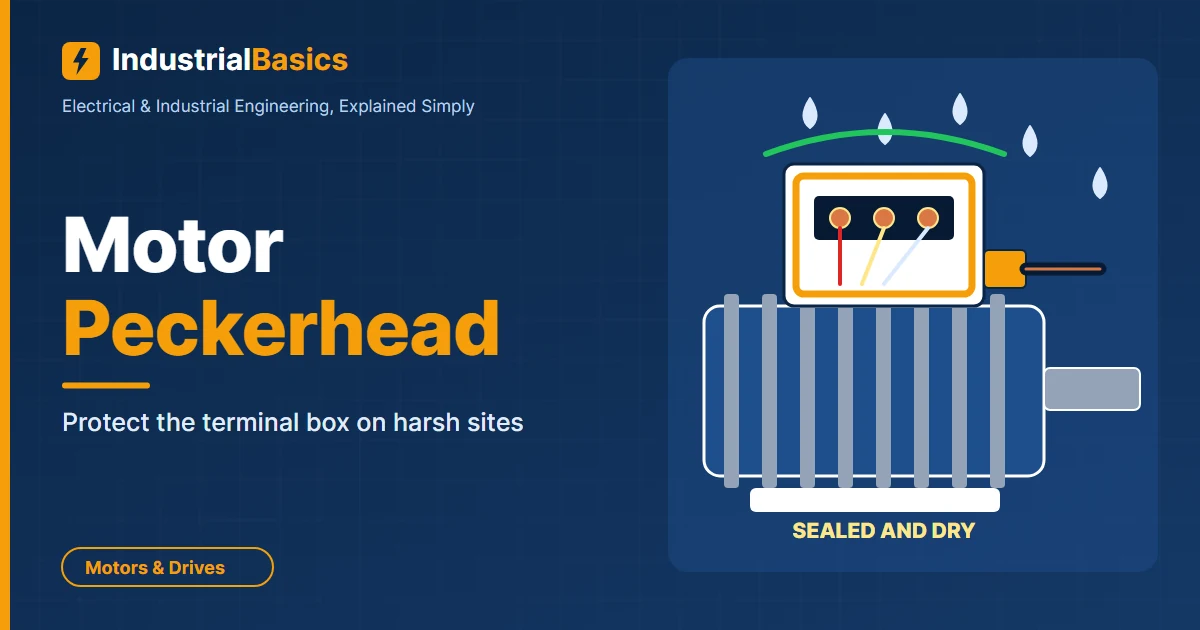
A motor peckerhead is the terminal box (or conduit box) on an electric motor, where the motor leads connect to the supply cable. To protect it in a harsh environment, keep the cover gasket in good condition, use correctly sealed cable entries, plug every unused opening, control condensation and check the connections regularly. One failed seal can let in the dust or water that causes a terminal fault.
| Threat | How it gets in or causes damage | Best protection |
|---|---|---|
| Water | Gasket, gland or open entry | Sealed entries and suitable IP rating |
| Condensation | Temperature changes while stopped | Breathing element or heater |
| Dust | Unsealed joints and openings | Good gasket and plugged entries |
| Corrosion | Chemicals, salt or washdown | Coated or stainless materials |
| Vibration | Terminals loosen over time | Correct torque and periodic checks |
What the Peckerhead Does
“Peckerhead” is shop-floor slang. Manufacturers normally call this part the terminal box or conduit box, so use those terms when ordering parts. The box holds the terminal block, connection links and earth terminal, and it protects the joints between the winding leads and the supply cable.
Because it contains every power connection to the motor, a small problem here can stop the whole machine. Moisture and loose terminals are among the issues covered in our guide to motor failure causes.
Seal the Cover and Cable Entries
DRG Motor describes the cover gasket as the main element that sets the box’s IP protection. A worn, missing or badly seated gasket cancels that protection, even on a well-rated motor.
- Replace damaged gaskets instead of reusing them.
- Use the correct gland for the cable, so it grips the cable and seals out dust and moisture.
- Use a suitable threaded adapter and seal for conduit entries.
- Plug every unused entry with a suitable plug.
- Keep auxiliary cables separate from the power cable where the box has several entries.
Choosing an IP or NEMA Rating
| IP code | Water protection | Typical exposure |
|---|---|---|
| IP54 | Splashing from any direction | General indoor industry |
| IP55 | Low-pressure jets | Dusty or damp areas |
| IP65 | Low-pressure jets, dust-tight | Heavy dust |
| IP66 | Powerful water jets, dust-tight | Outdoor and harsh areas |
Do not treat IP and NEMA ratings as interchangeable. Teyconn’s engineering guide notes that they cannot be converted exactly, and that IP66 alone does not establish NEMA Type 4 compliance. NEMA 4X also includes corrosion requirements that an IP code does not cover. If a specification calls for a NEMA Type, confirm that exact rating with the manufacturer.
In corrosive areas, choose the box and gland materials for the environment. A suitable coating or stainless material can extend service life.
Control Condensation
A perfectly sealed box can still get wet inside. When a warm motor stops and cools, moisture can condense on the terminals and windings. DRG Motor lists a sealed box, suitable breathing elements or a heater as ways to reduce this risk.
| Method | How it works | Watch out for |
|---|---|---|
| Breathing element | Lets the enclosure equalize with outside air | Must suit the IP rating |
| Terminal box heater | Keeps the box above ambient while stopped | Separate supply to isolate |
| Winding space heater | Strip heaters on the end turns | Leads are brought to the conduit box |
| Trickle heating | Low voltage on two motor leads while stopped | Winding is energized when the motor is off |
Worked example: trickle heating range
Nidec describes trickle heating as 10 to 20 percent of nameplate voltage, with current of about 25 to 35 percent of nameplate amps, for a rise of about 10 °C above ambient. For an example 460 V, 20 A motor:
Current: 20 A × 0.25 to 0.35 = 5 to 7 A
Treat that as a planning range only. The transformer and setup should come from the motor manufacturer, and the arrangement must comply with your local electrical code.
Keep the Connections Tight
Vibration can loosen terminal connections over time. A loose joint runs hot, and that heat damages insulation and nearby parts. Tighten connections to the supplier’s torque value, then recheck them after first commissioning and during periodic maintenance. We have not listed generic torque figures because the correct value depends on the terminal.
If a motor repeatedly trips, check for a poor connection along with its full load amps and overload setting. An insulation resistance test can confirm the condition of the winding and connections, and motor phase angle testing can help find developing winding faults.
Terminal Box Inspection Checklist
| Check | Look for | Action |
|---|---|---|
| Cover and gasket | Cracks, flattening, poor seating | Replace and reseat |
| Cable gland | Loose grip, damaged seal | Tighten or replace |
| Unused entries | Missing or wrong plugs | Fit a suitable plug |
| Inside the box | Water, staining, dust | Find and fix the entry path |
| Terminals | Looseness, discoloration | Clean and torque as specified |
| Metalwork | Rust or chemical attack | Repair or upgrade material |
| Drain provisions | Blocked or wrongly positioned | Follow the motor manual |
| Heater | No operation | Test after safe isolation |
Frequently Asked Questions
What is a motor peckerhead?
It is trade slang for the terminal box, also called a conduit box, on an electric motor. It is the enclosure where the motor leads connect to the supply cable.
Why is it called a peckerhead?
The origin is uncertain, and explanations differ. In manuals and purchase orders, use terminal box or conduit box instead.
How does water get into a motor terminal box?
Common paths are a worn or badly seated cover gasket, a poor cable gland, an open unused entry, or condensation forming inside the box.
What IP rating does a motor terminal box need?
It depends on the site. Match the rating to the dust and water exposure, and remember that glands, plugs and gaskets must maintain that rating after installation.
Is IP66 the same as NEMA 4?
No. NEMA and IP ratings use different requirements and cannot be converted exactly. If a specification requires a NEMA Type, confirm that the product carries that rating.
How do you stop condensation in a motor terminal box?
Use a sealed box, suitable breathing elements or an anti-condensation heater. Keeping the motor warm while stopped also helps reduce condensation.
What is trickle heating on a motor?
It applies a reduced voltage to the winding while the motor is stopped. Nidec describes 10 to 20 percent of nameplate voltage, giving about a 10 °C rise above ambient.
How often should a motor terminal box be inspected?
Set the interval by the environment and your maintenance plan. Check after first commissioning and then periodically for tightness, gasket condition, moisture and corrosion.
Sources and Further Reading
- DRG Motor: Motor Terminal Box, IP Protection and Cable Entry: gaskets, entries, condensation and maintenance.
- Nidec Motor Corporation: Heaters and Trickle Voltage: space heaters and trickle heating.
- Teyconn: NEMA vs IP Rating: limits of comparing ratings.