
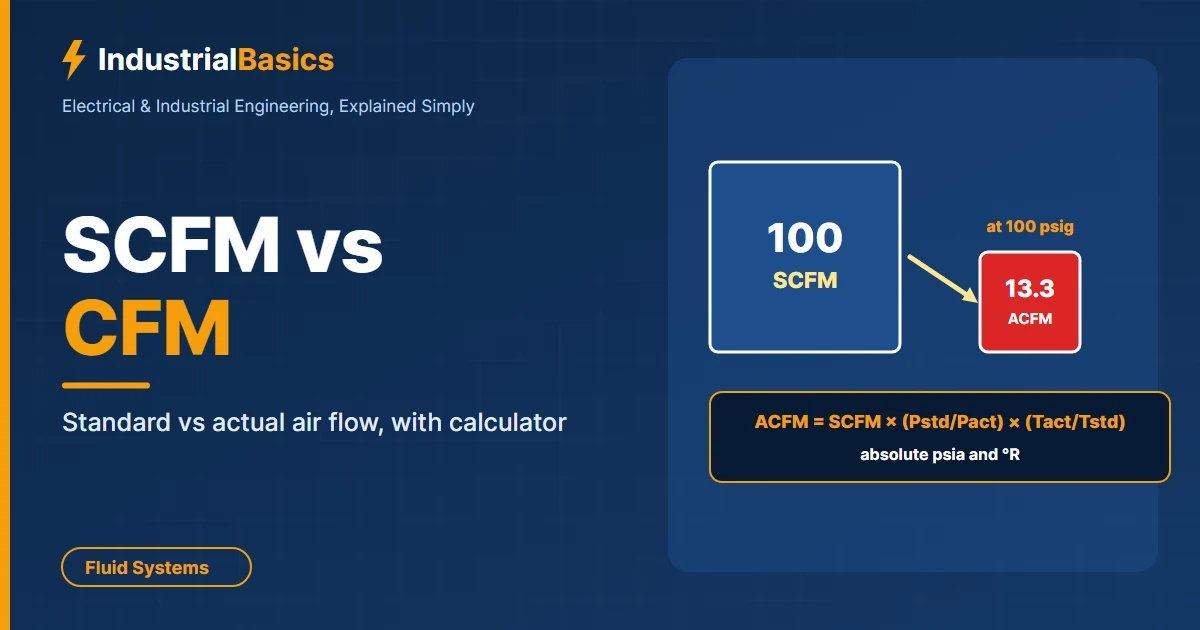
SCFM (standard cubic feet per minute) is air flow converted to standard conditions, typically 14.696 psia and 60 °F in the US, so it measures a fixed amount of air. ACFM (actual cubic feet per minute), often just called CFM, is the volume that air actually occupies at the real pressure and temperature. Convert with ACFM = SCFM × (Pstd ÷ Pactual) × (Tactual ÷ Tstd), using absolute pressures and °R. Inside a 100 psig air line at 80 °F, 100 SCFM is only about 13.3 ACFM; at a 5,000 ft site it is about 129 ACFM.
SCFM vs CFM vs ACFM vs ICFM
| Term | Meaning | Changes with pressure/temperature? |
|---|---|---|
| SCFM | Flow corrected to stated standard conditions; a fixed mass of air | No (that is the point) |
| ACFM | Actual volume flowing at real pressure, temperature and humidity | Yes |
| ICFM | Actual flow at the compressor inlet after filters or blowers | Yes |
| CFM | Ambiguous; usually ACFM, sometimes loosely used for SCFM | Depends on what is meant |
| SCFH | Standard cubic feet per hour (SCFM × 60) | No |
Wikipedia describes SCFM as “the molar flow rate of a gas expressed as a volumetric flow at a standardized temperature and pressure”, representing a fixed number of moles regardless of actual conditions. ACFM is the volume at the actual point in the system; if the gas were exactly at standard conditions, ACFM would equal SCFM, but the biggest difference in practice is pressure.
What Are “Standard” Conditions?
| Standard | Pressure | Temperature | Humidity |
|---|---|---|---|
| Common US definition (Engineering ToolBox) | 14.696 psia | 60 °F (520 °R) | 0% RH |
| US EPA (Wikipedia) | 101.3 kPa (29.92 inHg) | 68 °F (293 K) | — |
| CAGI / PNEUROP, per ISO (Engineering ToolBox) | 14.5 psia (1 bar) | 68 °F (20 °C) | Dry |
| Petroleum gas SCF (Wikipedia) | About 14.696–14.73 psia | 60 °F | — |
| European “normal” (Nm³) | 1.01325 bar abs | 0 °C | — |
Wikipedia’s warning example: 1,000 kg/h of air is 455 SCFM if “standard” means 32 °F, but 481 SCFM if it means 60 °F. Because of that ambiguity, it calls stating the standard conditions “best engineering practice” whenever you quote a standard flow.
SCFM to ACFM Calculator
How to Convert SCFM to ACFM
Engineering ToolBox gives the full conversion including humidity:
where Psat is the water vapor saturation pressure at the actual temperature and Φ the relative humidity. Its worked example: a compressor at 5,000 ft (12.23 psia), 80 °F (540 °R) and 80% RH, with Psat = 0.5069 psia, needs to deliver 100 SCFM. ACFM = 100 × [14.7 ÷ (12.23 − 0.5069 × 0.80)] × (540 ÷ 520) = 129.1 ACFM. Water vapor takes up part of each cubic foot, so humid air needs more actual volume for the same dry air. For the humidity physics, see our partial pressure guide.
Example: flow inside a compressed air line
At 100 psig with sea-level atmosphere (114.7 psia) and 80 °F: ACFM = 100 × (14.7 ÷ 114.7) × (540 ÷ 520) = 13.3 ACFM. That small actual volume is what sets velocity and pressure drop in the pipe, which is why pipe sizing uses ACFM, while compressor capacity and tool consumption are quoted in SCFM.
Why It Matters for Air Compressors and Tools
- Compare compressors on the same basis. Check whether capacity is quoted in SCFM (and which standard) or in ACFM/ICFM at the inlet.
- Size for site conditions. At high elevations or high inlet temperatures, a compressor rated in ACFM delivers fewer SCFM.
- Tool and process demand is normally given in SCFM at a stated pressure; add up SCFM, not line volumes.
- Pipe and valve sizing use actual flow at line pressure; see valve flow coefficient Cv for gas flow through valves.
- Compression ratio and power depend on absolute pressures; see psig vs psia.
Unit Conversions: SCFH, SCCM and m³/h
| From | To | Multiply by |
|---|---|---|
| SCFH | SCFM | 1/60 (0.01667) |
| SCFM | SCFH | 60 |
| SCFM | standard liters per minute (SLPM) | 28.317 |
| SCFM | SCCM (standard cm³/min) | 28,317 |
| SCFM | standard m³/h | 1.699 |
Welding shielding gas is a common shop example of low-pressure flow in CFH: see the MIG welding gas flow rate chart for typical settings.
Natural gas is billed with the same standard-volume idea in larger units: see what CCF means on a gas bill, and how Ccf, Mcf and therms relate.
Frequently Asked Questions
What is the difference between SCFM and CFM?
SCFM (standard cubic feet per minute) is air flow corrected to standard pressure and temperature, so it represents a fixed amount (mass) of air. CFM by itself is ambiguous; it often means ACFM, the actual volume at the real pressure and temperature. At standard conditions they are equal; anywhere else they differ.
How do you convert SCFM to ACFM?
ACFM = SCFM × (P_std ÷ P_actual) × (T_actual ÷ T_std), using absolute pressure and absolute temperature (°R = °F + 460). Engineering ToolBox also subtracts the water vapor partial pressure from P_actual for humid air.
How do you convert ACFM to SCFM?
SCFM = ACFM × (P_actual ÷ P_std) × (T_std ÷ T_actual), with absolute values.
What are standard conditions for SCFM?
There is no single standard. Engineering ToolBox gives 14.696 psia, 60 °F and 0% RH as the most common US definition; CAGI and PNEUROP use the ISO definition of 14.5 psia (1 bar), 68 °F and dry air; the EPA uses 68 °F and 29.92 inHg. Always state the standard.
Is SCFM the same as CFM on an air compressor?
Compressor ratings are usually given as free air delivered in SCFM or ACFM at the inlet, not as volume at the discharge pressure. A compressor delivering 100 SCFM moves the same amount of air whether it is measured at the inlet or in the line, but the line volume is much smaller.
How do you convert SCFH to CFM?
Divide standard cubic feet per hour by 60 to get SCFM: 600 SCFH = 10 SCFM. Then convert to ACFM if you need actual volume.
What is ICFM?
Inlet cubic feet per minute: the actual flow at the compressor inlet after filters or other inlet equipment. Engineering ToolBox: ICFM = ACFM × (P_act ÷ P_filter) × (T_filter ÷ T_act).
Why does altitude change ACFM?
Air is thinner at altitude, so the same mass of air takes up more volume. Engineering ToolBox’s example: 100 SCFM at 5,000 ft and 80 °F with 80% humidity is about 129 ACFM.
Can SCFM be converted to psi?
No. SCFM is a flow rate and psi is pressure; they are related only through a device’s flow characteristic, such as a valve’s Cv or a nozzle’s curve.
How much does the definition of “standard” matter?
Wikipedia gives an example: 1,000 kg/h of air is 455 SCFM if standard is 32 °F but 481 SCFM if standard is 60 °F, a difference of nearly 6%.
Sources and Further Reading
- Engineering ToolBox: SCFM, ACFM and ICFM: definitions, standards and the humidity-corrected conversion.
- Wikipedia: Standard cubic feet per minute: definition, standard condition variations and ACFM.
- Wikipedia: Standard cubic foot: SCF in the petroleum industry.



