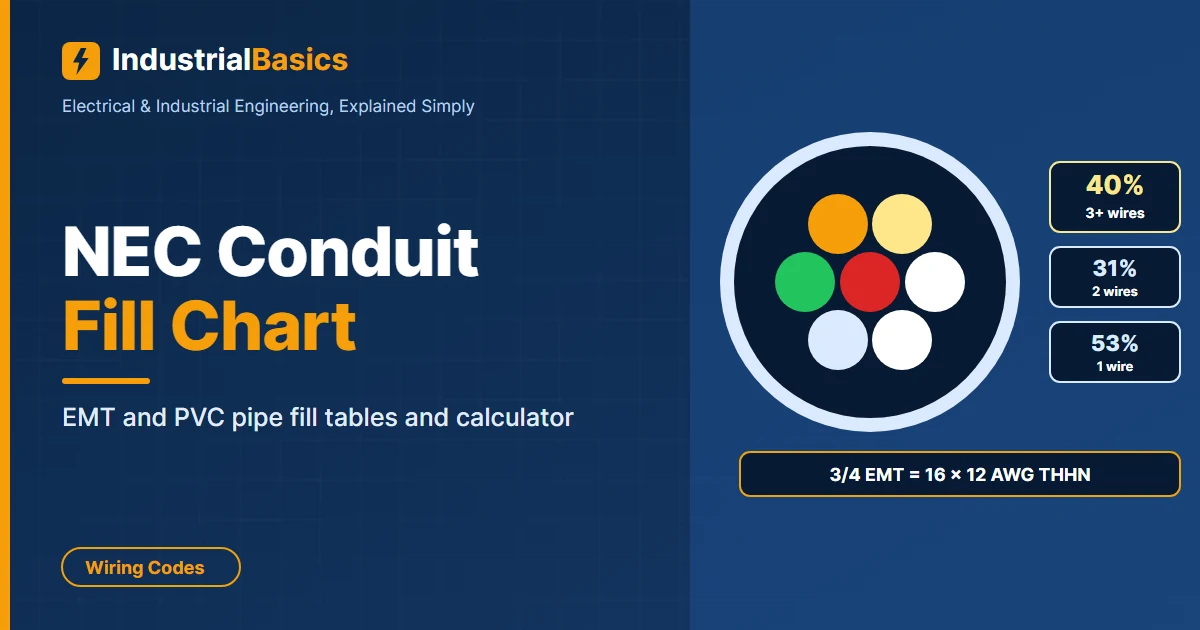
NEC conduit fill is limited by Chapter 9 Table 1: conductors may fill no more than 40% of a raceway’s internal area when there are three or more, 31% for two and 53% for one. Nipples 24 in or shorter may be filled to 60%. To check a run, add the Table 5 areas of every insulated conductor (including grounds) and compare the total with the raceway area in Table 4. For example, 3/4 in EMT holds sixteen 12 AWG THHN conductors.
NEC Conduit Fill Percentages (Chapter 9 Table 1)
| Number of conductors or cables | Maximum fill of raceway area |
|---|---|
| 1 | 53% |
| 2 | 31% |
| More than 2 | 40% |
| Nipple 24 in or less between enclosures (Note 4) | 60% |
EMT Conduit Fill Chart (THHN/THWN-2)
Maximum number of same-size THHN/THWN-2 copper or aluminum conductors per EMT trade size. This is what most people mean by a “pipe fill chart”.
| Trade size | 14 AWG | 12 AWG | 10 AWG | 8 AWG | 6 AWG | 4 AWG | 2 AWG | 1/0 AWG |
|---|---|---|---|---|---|---|---|---|
| 1/2 in | 12 | 9 | 5 | 3 | 1 | 1 | 1 | 0 |
| 3/4 in | 22 | 16 | 10 | 6 | 4 | 2 | 1 | 1 |
| 1 in | 35 | 26 | 16 | 9 | 7 | 4 | 3 | 1 |
| 1-1/4 in | 61 | 45 | 28 | 16 | 12 | 7 | 5 | 3 |
| 1-1/2 in | 84 | 61 | 38 | 22 | 16 | 10 | 7 | 4 |
| 2 in | 138 | 101 | 63 | 36 | 26 | 16 | 11 | 7 |
PVC Schedule 40 Conduit Fill Chart (THHN/THWN-2)
| Trade size | 14 AWG | 12 AWG | 10 AWG | 8 AWG | 6 AWG | 4 AWG | 2 AWG | 1/0 AWG |
|---|---|---|---|---|---|---|---|---|
| 1/2 in | 11 | 8 | 5 | 3 | 1 | 1 | 1 | 0 |
| 3/4 in | 21 | 15 | 9 | 5 | 4 | 1 | 1 | 1 |
| 1 in | 34 | 25 | 15 | 9 | 6 | 4 | 3 | 1 |
| 1-1/4 in | 60 | 43 | 27 | 16 | 11 | 7 | 5 | 3 |
| 1-1/2 in | 82 | 59 | 37 | 21 | 15 | 9 | 7 | 4 |
| 2 in | 135 | 99 | 62 | 36 | 26 | 16 | 11 | 7 |
These charts apply only when every conductor is the same size and insulation. For XHHW, THW or mixed sizes, calculate by area (below) or use the calculator. For conductors in the same raceway, NEC Annex C tables give the same counts for each raceway type.
Raceway Internal Area (Chapter 9 Table 4)
| Trade size (in) | EMT 100% / 40% (in²) | PVC Schedule 40 100% / 40% (in²) | PVC Schedule 80 100% / 40% (in²) | RMC (rigid metal) 100% / 40% (in²) |
|---|---|---|---|---|
| 1/2 | 0.304 / 0.122 | 0.285 / 0.114 | 0.217 / 0.087 | 0.314 / 0.126 |
| 3/4 | 0.533 / 0.213 | 0.508 / 0.203 | 0.409 / 0.164 | 0.549 / 0.220 |
| 1 | 0.864 / 0.346 | 0.832 / 0.333 | 0.688 / 0.275 | 0.887 / 0.355 |
| 1-1/4 | 1.496 / 0.598 | 1.453 / 0.581 | 1.237 / 0.495 | 1.526 / 0.610 |
| 1-1/2 | 2.036 / 0.814 | 1.986 / 0.794 | 1.711 / 0.684 | 2.071 / 0.828 |
| 2 | 3.356 / 1.342 | 3.291 / 1.316 | 2.874 / 1.150 | 3.408 / 1.363 |
| 2-1/2 | 5.858 / 2.343 | 4.695 / 1.878 | 4.119 / 1.648 | 4.866 / 1.946 |
| 3 | 8.846 / 3.538 | 7.268 / 2.907 | 6.442 / 2.577 | 7.499 / 3.000 |
| 3-1/2 | 11.545 / 4.618 | 9.737 / 3.895 | 8.688 / 3.475 | 10.010 / 4.004 |
| 4 | 14.753 / 5.901 | 12.554 / 5.022 | 11.258 / 4.503 | 12.882 / 5.153 |
Trade size is not the inside diameter, and PVC Schedule 80 has a thicker wall, so it leaves less room than Schedule 40 of the same size.
Conductor Area (Chapter 9 Table 5)
| Size | THHN/THWN-2 (in²) | XHHW/XHHW-2 (in²) | THW/THHW (in²) |
|---|---|---|---|
| 14 AWG | 0.0097 | 0.0139 | 0.0139 |
| 12 AWG | 0.0133 | 0.0181 | 0.0181 |
| 10 AWG | 0.0211 | 0.0243 | 0.0243 |
| 8 AWG | 0.0366 | 0.0437 | 0.0437 |
| 6 AWG | 0.0507 | 0.0590 | 0.0726 |
| 4 AWG | 0.0824 | 0.0814 | 0.0973 |
| 3 AWG | 0.0973 | 0.0962 | 0.1134 |
| 2 AWG | 0.1158 | 0.1146 | 0.1333 |
| 1 AWG | 0.1562 | 0.1534 | 0.1901 |
| 1/0 AWG | 0.1855 | 0.1825 | 0.2223 |
| 2/0 AWG | 0.2223 | 0.2190 | 0.2624 |
| 3/0 AWG | 0.2679 | 0.2642 | 0.3117 |
| 4/0 AWG | 0.3237 | 0.3197 | 0.3718 |
| 250 kcmil | 0.3970 | 0.3904 | 0.4596 |
| 350 kcmil | 0.5242 | 0.5166 | 0.5958 |
| 500 kcmil | 0.7073 | 0.6984 | 0.7901 |
How to Calculate Conduit Fill
- Step 1: find the area of each insulated conductor in Table 5 (Table 8 for bare conductors) and multiply by the quantity.
- Step 2: add the areas to get the total conductor area.
- Step 3: choose the raceway whose allowable area (40% for three or more conductors, 60% for a nipple) in Table 4 equals or exceeds the total.
Example 1: 400 A feeder in PVC
From EC&M (Mike Holt): three 500 kcmil THHN, one 250 kcmil THHN and one 3 AWG THHN in Schedule 40 PVC.
| Conductor | Area each (in²) | Qty | Subtotal (in²) |
|---|---|---|---|
| 500 kcmil THHN | 0.7073 | 3 | 2.1219 |
| 250 kcmil THHN | 0.3970 | 1 | 0.3970 |
| 3 AWG THHN | 0.0973 | 1 | 0.0973 |
| Total | 5 | 2.6162 |
At 40%, 2-1/2 in PVC Schedule 40 allows only 1.878 in², so it fails. A 3 in PVC Schedule 40 allows 2.907 in² and passes (36.0% fill).
Example 2: Rigid metal nipple
Also from EC&M: three 3/0 THHN, one 1 AWG THHN and one 6 AWG THHN in a rigid metal nipple 24 in or shorter.
Total area is 0.8037 + 0.1562 + 0.0507 = 1.0106 in². At the 60% nipple limit, a 1-1/4 in RMC nipple allows 0.916 in² (fails), while a 1-1/2 in nipple allows 1.243 in² and passes. The same conductors in a longer run would need 2 in RMC (1.363 in² at 40%).
Example 3: Branch circuits in 3/4 EMT
Nine 12 AWG THHN circuit conductors plus one 12 AWG THHN ground in 3/4 in EMT: 10 × 0.0133 = 0.1330 in², or 25.0% of 0.533 in². That passes the 40% limit with room to spare, but nine current-carrying conductors in one raceway also trigger ampacity adjustment, which is checked separately.
Conduit Fill Calculator
Rules That Change the Answer
- Grounds count (Note 3): include equipment grounding and bonding conductors at their actual size.
- Cables count as one (Note 9): a multiconductor cable counts as a single conductor; an elliptical cable uses its major diameter as a circle.
- Note 7 rounding: for same-size conductors, a result of 0.8 or more rounds up to the next whole conductor. Mixed sizes get no rounding.
- Nipples (Note 4): 60% applies only to a nipple of 24 in or less (excluding connectors) between boxes, cabinets or similar enclosures. The ampacity adjustment factors of 310.15(C)(1) need not apply to that nipple.
- Compact conductors: use Table 5A, not Table 5.
- Bends: a run may not have more than 360° of total bends between pull points (Wikipedia, Electrical conduit). A full raceway with many bends is hard to pull even when the fill passes.
Frequently Asked Questions
What is the NEC conduit fill rule?
NEC Chapter 9 Table 1 limits the total cross-sectional area of the conductors to 53% of the raceway’s internal area for one conductor, 31% for two and 40% for three or more. A nipple 24 in or shorter between enclosures may be filled to 60%.
How many 12 AWG wires can go in 3/4 EMT?
16 THHN/THWN-2 conductors: 40% of 3/4 in EMT is 0.213 in² and each 12 AWG THHN is 0.0133 in² (Tables 4 and 5).
How many 12 AWG wires can go in 1/2 EMT?
9 THHN/THWN-2 conductors (0.122 in² ÷ 0.0133 in² = 9.1).
How many 14 AWG wires in 1/2 EMT?
12 THHN/THWN-2 conductors, since 0.122 in² ÷ 0.0097 in² = 12.5.
How many 10 AWG wires in 3/4 EMT?
10 THHN/THWN-2 conductors (0.213 ÷ 0.0211 = 10.1).
Why is two-wire fill only 31%?
Two round conductors in a round raceway can wedge side by side and jam during the pull, so Table 1 allows less fill for two conductors than for three or more.
Do ground wires count in conduit fill?
Yes. Chapter 9 Note 3 includes equipment grounding and bonding conductors at their actual dimensions: Table 5 for insulated, Table 8 for bare.
How do I calculate conduit fill with different wire sizes?
Look up each conductor’s area in Table 5, multiply by quantity and add the totals. Then pick the smallest raceway in Table 4 whose 40% column (for three or more wires) equals or exceeds that total.
What is the 0.8 rounding rule?
Chapter 9 Note 7: when all conductors are the same size and insulation, and the calculation gives a fractional conductor of 0.8 or more, you may round up to the next whole number. That is why 1 in EMT holds 26 (25.98) 12 AWG THHN.
Is PVC fill the same as EMT?
No. PVC Schedule 40 has a slightly smaller internal area than EMT of the same trade size, and Schedule 80 is smaller still. For example, 1 in PVC Schedule 40 holds 25 12 AWG THHN versus 26 in 1 in EMT.
Sources and Further Reading
- Conduit Fill Calculator: NEC Chapter 9 Tables 1, 4, 5 and 8: Table 1 limits and notes, Table 4 raceway areas, Table 5 conductor areas.
- EC&M: Code Calculations (Mike Holt): three-step method and Examples 1 and 2.
- Portlandia Electric Supply: Conduit Fill Chart: EMT max THHN counts used as a cross-check.
- Wikipedia: Electrical conduit: conduit types, derating and the 360° bend limit.