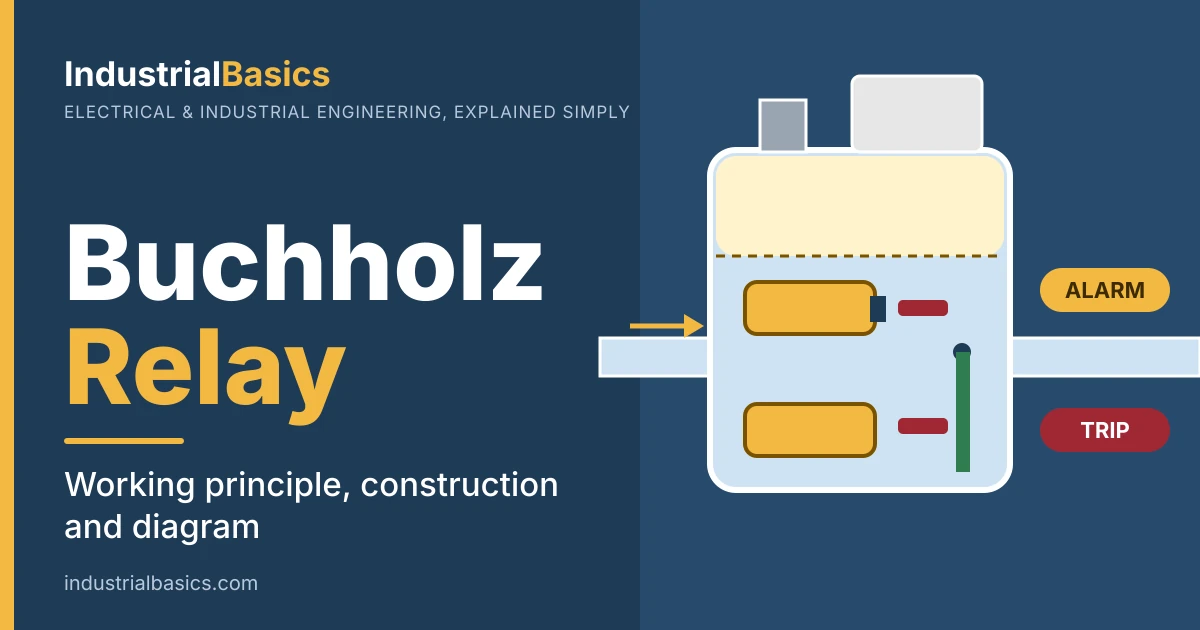
A Buchholz relay is a gas- and oil-flow-operated protective device fitted in the pipe between the main tank and the conservator of an oil-filled transformer. It gives an alarm when gas slowly collects inside the transformer, and it trips the transformer when oil surges violently or the oil level falls too far.
That is the short answer. The rest of this guide shows where the relay sits, how it is built and how it works, which faults it detects and misses, and how it is wired, tested and set. It also explains why it sometimes operates when nothing is wrong.
Quick Summary
- Where: in the pipe from the transformer tank to the conservator.
- Alarm: slow gas build-up lowers the upper float.
- Trip: a sudden oil surge moves the flap, or the lower float drops after serious oil loss.
- Works on: oil-filled transformers and reactors with a conservator, not dry-type or sealed units.
- Cannot replace: differential and other electrical protection.
- Origin: developed by Max Buchholz, with a patent filed in 1921.
What Is a Buchholz Relay and Why Is It Used?
Faults inside an oil-filled transformer, such as overheating, a poor joint, damaged core insulation or arcing, break down the oil and paper insulation and release gas. A small, slow fault may not change the line current enough for electrical protection to react quickly. The gas, however, rises towards the conservator and is caught by the relay. A severe fault makes gas so fast that it pushes oil along the pipe, and the relay senses that too.
The IEC calls it a gas and liquid actuated relay, which is why people also say gas and oil actuated. It is a mechanical device. Floats and a flap move, and sealed switches turn that movement into an electrical signal.
This is why it is used alongside electrical protection, not instead of it. Reinhausen states that other protection does not remove the need for a Buchholz relay, because the relay is specifically effective for early-stage faults. For the wider picture, see our guide to types of protection relays.
Max Buchholz, a German engineer at the Prussian electricity company in Kassel, developed the relay. His patent was filed in 1921 and the relay was tested extensively in the mid-1920s. It is still fitted to conservator-type transformers a century later.
Where Is a Buchholz Relay Located in a Transformer?
The relay is mounted in the connecting pipe between the main tank and the conservator, the expansion tank above it. The conservator gives the oil room to expand as it heats and keeps the pipe full of oil. Because the pipe is full, any gas leaving the tank, and any oil pushed towards the conservator, must pass through the relay.
Installation Requirements
Poor installation is a common reason for nuisance operation. The values below come from the Reinhausen CEDASPE EB catalogue and the IEC 60076-22-1 preview. Always follow the manual for your own relay.
| Requirement | Reference value |
|---|---|
| Relay position | Essentially horizontal; up to 5° rise towards the conservator is admissible (IEC 60076-22-1) |
| Pipe slope | About 2° to 4°, maximum 5° (CEDASPE EB); the pipe rises so gas can reach the relay instead of sitting in a low point |
| Pipe start | From the highest point of the tank cover; it must not protrude into the tank |
| Straight pipe | At least 5 pipe diameters before the relay and 3 after it |
| Bends | Avoid right-angle elbows near the relay |
| Flow arrow | Must point from the tank to the conservator |
Do not treat one slope as universal. Makers quote different values, so use the figure in your relay’s data sheet. Straight pipe runs matter because they keep the oil flow smooth where the flap sits. For how oil moves inside the tank, see our guide to transformer cooling methods.
Which Transformers Use a Buchholz Relay?
| Transformer type | Buchholz relay? | Reason |
|---|---|---|
| Oil-immersed with conservator | Yes | Has the tank-to-conservator pipe the relay needs |
| Oil-filled reactor with conservator | Yes | Same oil and gas path as a transformer |
| Sealed or nitrogen-cushioned oil type | Not normally | No conservator pipe; pressure-rise protection is more relevant |
| Hermetic conservator with rubber bag | Sometimes | EMB notes it can monitor air-cell failure in some designs |
| Dry-type | No | No insulating oil, gas path or conservator |
You will often read that a relay is required above 500 kVA or 750 kVA. Those figures appear in study notes, but not in the standards or maker data reviewed for this guide. The rating at which a relay is fitted depends on the utility and the contract, so check the project specification. To see how these units differ, read our guide to the main types of transformers and the comparison of power and distribution transformers.
Construction of a Buchholz Relay
A Buchholz relay is a small oil-tight housing with a few moving parts. The housing is normally cast aluminium, with inspection windows and a scale so you can read the oil level and the volume of collected gas.
| Part | What it does |
|---|---|
| Relay housing | Holds the oil and the moving parts; sits in the pipe and carries the flow arrow |
| Gas collection chamber | The top of the housing; traps free gas rising from the tank |
| Inspection window and oil level scale | Lets you read the oil level and the volume of gas collected |
| Upper float | Drops as gas pushes oil out of the chamber; operates the alarm contact |
| Lower float | Drops if oil loss continues; operates the trip contact |
| Flap (baffle or damper) | Pushed towards the conservator by a fast oil surge; operates the trip contact |
| Reed switches | A magnet on each float or the flap closes a sealed reed contact |
| Gas release and sampling valve | Releases or draws off gas; a test cock allows air-injection testing where fitted |
| Test button | Moves the floats mechanically to prove the alarm and trip circuits |
| Terminal box | Houses the cable connections for the alarm and trip contacts |
Types of Buchholz Relay
| Type | How it differs | Typical use |
|---|---|---|
| Double-float | Upper float for alarm, lower float for oil loss, plus a flap for surges | Standard choice for power transformers |
| Single-float | One float plus a flow damper; alarm and trip functions are combined | Smaller or specific designs (listed by EMB) |
| Reed-switch | Sealed reed contacts operated by magnets | Current mainstream design |
| Mercury-switch | Tilting glass tubes of mercury close the contacts | Older installations |
| Smart relay | Adds gas-volume, temperature and moisture sensors | Online monitoring; does not replace the mechanical function |
Reed switches have largely replaced mercury switches. Their contacts are hermetically sealed, so the relay copes better with vibration and avoids handling mercury. Check that the contact rating suits your trip circuit.
Buchholz Relay Working Principle
The relay reacts to three different conditions: slow gas build-up, a sudden oil surge and loss of oil. The diagram shows what each one does inside the housing.
1. Normal Operating Condition
The housing is full of oil and both floats sit at the top. The flap hangs at rest across the oil path, and no contact is closed. Slow oil movement from heating and cooling passes the flap without moving it.
2. Alarm Operation: Slow Gas Build-Up
A minor fault, such as local overheating, produces small gas bubbles. They rise through the oil and collect at the top of the relay. As the gas builds up it pushes oil downwards, the upper float sinks and its magnet closes the alarm contact. The transformer stays in service while someone investigates.
3. Trip Operation: Sudden Oil Surge
A severe fault, such as a winding short circuit, creates gas so quickly that oil is thrown through the pipe towards the conservator. The surge pushes the flap, which closes the trip contact. The trip signal then opens the breakers. Quick isolation keeps damage to the unit as small as possible.
4. Trip Operation: Loss of Oil
If oil leaks out, the level falls in the conservator, then the pipe and finally the relay. The upper float drops first and gives the alarm. If the level keeps falling, the lower float drops and trips the transformer. A transformer running low on oil can lose insulation and cooling, so this protects it from damage that follows. Air entering the oil system behaves in a similar way: it can raise an alarm and, if enough collects, a trip.
Do not mix up the two trip elements
The flap responds to oil flow and trips on a surge. The lower float responds to the oil level and trips on loss of oil. Some study notes describe only two floats, which hides the flap.
Buchholz Relay Alarm vs Trip: Key Differences
| Comparison | Alarm | Trip |
|---|---|---|
| Main purpose | Early fault warning | Transformer protection |
| Main trigger | Gas accumulation or first drop in oil level | Oil surge or continued oil loss |
| Operating element | Upper float | Flap or lower float, depending on the trigger |
| Contact | Alarm contact closes | Trip contact closes |
| Response | Warning to annunciator or SCADA | Circuit breakers open, transformer isolated |
| Fault condition | Often a developing fault, or trapped air | Severe fault or serious oil loss |
An alarm does not always mean a severe fault. The gas may be air from filling or maintenance. A trip does not always mean an internal short circuit either, because loss of oil trips the relay too. Treat both as real until the cause is proved.
| After an alarm | After a trip |
|---|---|
| Log the time, and check the gas volume and oil level on the relay window | Do not re-energise until the cause is found; Reinhausen warns against immediate re-energisation |
| Check loading and the oil and winding temperature readings | Check which other protection operated, such as differential, and read the relay flags |
| Have qualified staff take a gas sample and an oil sample for analysis | Inspect for leaks, a low oil level and any pressure relief device operation |
| Remove the transformer from service if the gas proves to be fault gas | Test the unit before return to service, for example insulation resistance and oil analysis |
What Faults Does a Buchholz Relay Detect?
The relay responds when a fault produces enough free gas, moves the oil, or lets oil escape. Reinhausen lists poor contacts, core and winding faults, phase, turn and earth faults, and internal bushing puncture as detectable.
| Condition | What happens inside | Buchholz response | Other protection that also helps |
|---|---|---|---|
| Inter-turn short circuit | Heat or arcing between turns breaks down the oil and paper | Alarm; trip if severe | Differential protection |
| Winding overheating | Hot winding or poor joint decomposes insulation | Alarm; trip if severe | Winding temperature indicator |
| Core overheating | Local hot spots in the core heat the oil | Alarm; trip if severe | Oil testing and DGA |
| Core insulation failure | Short-circuited laminations or failed core-bolt insulation | Alarm; trip if severe | Oil testing and DGA |
| Internal arcing | An arc makes gas very quickly and throws oil | Trip (oil surge) | Differential and overcurrent protection |
| Insulation breakdown | Paper or oil insulation fails and releases gas | Alarm; trip if severe | Differential protection |
| Internal bushing puncture | Breakdown of a bushing inside the tank | Alarm or trip | Differential protection |
| Partial discharge | Small discharges make gas, mostly dissolved in the oil | Alarm only if enough free gas forms | DGA, which usually sees it first |
| Oil leak or loss of oil | The oil level falls in the relay | Alarm, then trip | Oil level indicator |
| Air ingress | Air enters through a defect or after filling | Alarm; trip if a lot of air collects | Correct filling and venting |
What Faults Does a Buchholz Relay Not Detect?
- External short circuits: faults on the network outside the tank do not make gas or move oil.
- External bushing flashovers: a flashover outside the tank is outside the oil system. Surge protection such as a lightning arrester or surge arrester deals with the cause, not this relay.
- Faults that produce neither enough gas nor oil movement: the relay has nothing to sense.
- Faults outside the protected oil system: for example the tap-changer compartment, which has its own relay.
This is why the relay cannot replace other transformer protection. It senses gas and oil movement, while differential protection senses a difference in current, and overcurrent protection covers external faults and backup. How the devices work together is covered in protection coordination.
Buchholz Relay Connection and Wiring Diagram
The relay has separate potential-free contacts for alarm and trip. Both end in the terminal box on the relay housing, and cables run from there to the transformer control and protection circuits. The two circuits stay separate so that an alarm can never be confused with a trip.
Alarm and Trip Connections
The alarm contact feeds a local alarm, an annunciator or a SCADA input. The trip contact feeds the breaker trip circuit, usually through a master trip (lockout) relay, which is ANSI device 86. That relay then trips the high-voltage and low-voltage breakers. See our ANSI device numbers list to decode the numbers, and types of circuit breakers for the devices that clear the trip. Buchholz protection is usually grouped under the pressure and gas-type devices numbered 63, but check the exact wording in IEEE C37.2 before quoting it.
Normally Open and Changeover Contacts
Makers supply normally open and changeover contact options, and some relays have more than one contact per function. A magnet moving towards a reed switch closes it, and moving away opens it. Confirm which type your scheme expects, and check the contact rating against the trip circuit voltage and current. Actual wiring, ratings and terminal layout depend on the relay maker and the protection design, so follow the project drawings.
Buchholz Relay Testing and Maintenance
A Buchholz relay may sit unmoved for years, so you need proof that its contacts and floats will work when needed. These are the common checks:
- Visual check: oil level, gas volume on the scale, leaks and window condition.
- Alarm and trip contact test: a self-resetting test button moves the floats mechanically, and a multimeter shows whether each circuit closes.
- Pneumatic test: where a test cock is fitted, air tests the alarm float, and a sudden air application can test the flap. Bleed the relay and refill it with oil afterwards.
- Gas collection and sampling: gas is drawn off through the sampling valve for laboratory analysis, never vented casually.
- Float and flap inspection: a mechanical check that nothing sticks or is damaged, done as the maker’s manual describes.
- Wiring and contacts: continuity and insulation checks, as in any relay testing programme, plus an insulation resistance test of the cables.
Reinhausen states that the CEDASPE relay needs no periodic maintenance but recommends regular checks. How often you test depends on the maker’s guidance and your utility’s rules. Factory tests by makers such as EMB include dielectric, leakage, functional and flow tests.
Safety
Testing, gas sampling and maintenance must be done only by qualified, authorised people following the maker’s instructions, local regulations and site permits. Collected gas can be explosive or toxic, so keep ignition sources away and use a safe isolation method such as the lockout tagout procedure and suitable electrical safety PPE.
Gas Analysis in a Buchholz Relay: What Does Gas Colour Indicate?
When the alarm operates, the collected gas may be harmless air from filling or maintenance, or fault gas from decomposing oil and insulation. Older guides link the colour of the gas to the cause. Reinhausen’s catalogue lists the traditional associations below, but also advises taking a sample for analysis.
| Gas colour | Traditional indication |
|---|---|
| Whitish | Paper or cotton insulation involved |
| Yellowish | Wood or cardboard decomposition |
| Greyish | Magnetic circuit breakdown |
| Black | Free arcing in oil |
Treat colour as a rough clue only. It cannot confirm the exact fault type. Older practice also used flammability to separate fault gas from air, but never ignite the gas as a field test, because it is dangerous and does not identify the fault.
Free-Gas Analysis and Dissolved Gas Analysis (DGA)
Free-gas analysis tests the gas collected in the relay. Dissolved gas analysis (DGA) tests the gases dissolved in an oil sample, and repeated samples show a trend over time. Both are done in a laboratory, and the results are read using IEC 60599 and IEEE C57.104. Our guide to transformer oil testing explains DGA in detail.
| Gas | Often linked with (indicative only) |
|---|---|
| Hydrogen | Partial discharge, and most fault types at low level |
| Acetylene | Arcing |
| Ethylene | High-temperature overheating of oil |
| Methane and ethane | Lower-temperature overheating of oil |
| Carbon monoxide and carbon dioxide | Overheating of paper insulation |
Specialists read gas ratios and amounts together, not single gases, so use the table as background and not as a diagnosis.
Common Causes of Buchholz Relay False Alarms and Trips
| Cause | Why it happens | What to do |
|---|---|---|
| Air trapped after oil filling | Air rises and collects like fault gas | Fill and bleed properly; let gas settle before resetting |
| Air entering the oil circuit | A defect in the oil circulation system draws in air | Find and repair the air path; confirm with oil tests |
| Improper filling or refilling | Oil level or venting is not right after maintenance | Follow the maker’s filling procedure |
| Vibration or external disturbance | Strong vibration can move a contact | Use vibration-resistant reed designs and correct mounting |
| Incorrect installation | Wrong pipe slope, reversed flow arrow or bends near the relay | Follow the maker’s and IEC guidance |
| Setting not matched to pipe size | Flap setting is wrong for the pipe | Select from the maker’s data |
| Relay, contact or wiring fault | A damaged contact or wiring defect gives a false signal | Test the relay and supervise the trip circuit |
Only treat a cause as confirmed when you have evidence from the manufacturer or your utility. Reinhausen confirms air from filling as a cause of alarms. Vibration is a design concern, which is why reed switches are used, but it should not be assumed without evidence.
How to Tell a Real Fault from a Nuisance Operation
- Bleed the collected gas and watch whether it returns. Gas that keeps coming back points to a fault or an air leak.
- Send gas and oil samples for DGA. Fault gases such as acetylene suggest arcing, while clean air does not.
- Compare with other signs: temperatures, other relay flags, oil level and any recent oil work.
- If the signs point to nothing, test the relay and its wiring for a contact fault.
An alarm should never be assumed to be a nuisance. Repeated alarms need investigation, and a tripped transformer should not be re-energised until the cause is known.
Buchholz Relay vs Other Transformer Protection Devices
| Device | Operating principle | Condition detected | Location | Type of protection |
|---|---|---|---|---|
| Buchholz relay | Floats and flap respond to gas and oil flow | Free gas, oil surge, oil loss | Pipe between main tank and conservator | Early and severe internal faults on conservator units |
| Sudden pressure relay (SPR) | Responds to a fast rise in pressure | Rapid internal pressure rise | Tank wall or cover | Fast mechanical trip; works with or without a conservator |
| Pressure relief device (PRD) | Spring-loaded valve opens at a set pressure | Excess static pressure | Tank cover | Last mechanical defence against tank rupture |
| OLTC protective relay | Flap responds to oil surge in the tap-changer | Oil surge in the OLTC compartment | Pipe from OLTC head to its conservator | Protects the tap-changer only |
| Oil level indicator | Float or gauge reads the oil level | Oil level in the conservator | Conservator | Indication and alarm; not fault protection |
| Temperature indicator | Reads oil or winding temperature | Overheating and overload | Tank top or winding | Thermal alarm and trip |
Buchholz Relay vs Sudden Pressure Relay
- What it senses: a Buchholz relay senses gas and oil flow. A sudden pressure relay senses a rapid rise in pressure.
- Where it sits: the Buchholz relay is in the conservator pipe. The sudden pressure relay is on the tank.
- Slow faults: the Buchholz relay gives an early alarm on slow gas build-up. A sudden pressure relay ignores slow changes and reacts only to fast ones.
- Transformer type: the Buchholz relay needs a conservator. A sudden pressure relay can also be used on sealed units.
The names are sometimes mixed up. The IEEE PES Relay Committee notes that a flow-sensing sudden pressure relay is commonly called a Buchholz relay in some places, so check what the device actually senses before comparing them.
Buchholz Relay vs Pressure Relief Device, OLTC Relay, Oil Level and Temperature Indicators
A pressure relief device opens to release excess pressure and protect the tank, and it does not warn of slow gas build-up. An on-load tap changer has its own oil compartment, because switching creates arcs, and a separate oil surge relay protects it. It works on a similar surge principle but has its own pipe arrangement and settings, and it does not replace the main-tank relay. Both are used in a typical substation transformer with a tap changer. An oil level indicator only measures level, and a temperature indicator only measures heat, so neither detects gas or oil surge.
The Buchholz relay is slower than differential protection for a major fault, but it catches faults that produce gas without a large change in current.
Applications of a Buchholz Relay
- Oil-filled power transformers with a conservator.
- Distribution transformers with a conservator, where the specification calls for one.
- Oil-filled reactors with a conservator arrangement.
- On-load tap changers, using a separate protective relay for the tap-changer oil compartment.
A conventional Buchholz relay is not used on dry-type transformers, because they have no oil or gas path. It also does not normally apply to sealed transformers without a conservator pipe. You will find these transformers, and the relays that protect them, in the substation equipment list and alongside switchgear in a typical site.
Advantages and Disadvantages of a Buchholz Relay
Advantages
- Detects developing internal faults
- Gives early warning through gas accumulation
- Separate alarm and trip functions
- Responds to oil surges and oil loss
- Gas collected can be analysed to help find the fault
Disadvantages
- Needs a suitable conservator arrangement
- Cannot detect every type of fault
- Can respond to trapped air
- Needs regular inspection and testing
- Depends on correct installation and oil flow
Buchholz Relay Standards and Technical Specifications
| Standard | Relevance |
|---|---|
| IEC 60076-22-1:2019 | Protective devices for power transformers, including gas and liquid actuated (Buchholz) relays |
| IEC 60076 series | Wider guidance on power transformers and their fittings |
| EN 50216-2 | European Buchholz relay requirements (legacy reference; check current edition) |
| IS 3637 | Indian specification for gas-operated relays (confirm current edition with BIS) |
| IEC 60599 and IEEE C57.104 | Interpreting dissolved and free gases |
| IEEE C37.2 | Device function numbers |
There is no single “standard” setting. Gas volume and oil velocity depend on the maker, the relay model and the pipe size (commonly DN25, DN50 or DN80), so values differ between manufacturers. The charts plot published examples for you to compare.
The alarm volumes look similar across makers, while the trip settings vary much more. Do not mix values between manufacturers, and use the data sheet for your own relay.
Frequently Asked Questions
What is a Buchholz relay?
A Buchholz relay is a gas- and oil-flow-operated protective device fitted in the pipe between the main tank and the conservator of an oil-filled transformer.
What is the main function of a Buchholz relay?
It warns of slow internal faults when gas builds up, and it trips the transformer on a violent oil surge or serious oil loss.
What is the working principle of a Buchholz relay?
Gas lowers the upper float and gives an alarm. A fast oil surge pushes the flap and trips. A falling oil level lowers the lower float and trips.
Where is a Buchholz relay installed?
In the pipe that joins the main transformer tank to the conservator.
Why is a Buchholz relay used in transformers?
It catches gas-producing internal faults early, before electrical protection may see a clear change in current.
What are the main components of a Buchholz relay?
A housing with an inspection window, a gas chamber, an upper float, a lower float, a flap, reed switches, a gas valve, a test button and a terminal box.
What is the difference between Buchholz relay alarm and trip?
An alarm is an early warning and the transformer stays in service. A trip opens the circuit breakers and isolates the transformer.
Which faults can a Buchholz relay detect?
Overheating, core insulation failure, inter-turn faults, internal arcing, internal bushing puncture, partial discharge that produces gas, oil leaks and air ingress.
Which faults cannot be detected by a Buchholz relay?
External short circuits, external bushing flashovers, and internal faults that produce neither enough gas nor any oil movement.
Why does a Buchholz relay operate during oil leakage?
As oil is lost, the level in the relay falls. The upper float drops first and gives an alarm, then the lower float drops and trips.
Can a Buchholz relay give a false alarm?
Yes. Air trapped after filling or maintenance is the most common harmless cause, but every alarm must be investigated.
How do you test a Buchholz relay?
Qualified staff use the test button, air injection where a test cock is fitted, and contact and wiring checks, all following the maker’s manual.
Why is gas collected inside a Buchholz relay?
Gas rises through the oil and collects in the relay chamber, where it operates the upper float and can be sampled for analysis.
Is a Buchholz relay used in dry-type transformers?
No. A dry-type transformer has no insulating oil, no conservator and no oil pipe.
Is a Buchholz relay used in an OLTC?
An on-load tap changer has its own protective relay, usually called an oil surge relay, which is separate from the main-tank Buchholz relay.
What is the difference between a Buchholz relay and a sudden pressure relay?
A Buchholz relay senses gas and oil flow in the conservator pipe. A sudden pressure relay senses a rapid rise in pressure inside the tank.
Who invented the Buchholz relay?
Max Buchholz, a German engineer working in Kassel, whose patent was filed in 1921.
What is the purpose of the upper and lower floats?
The upper float gives the early alarm. The lower float gives a separate trip if oil loss continues.
Why is a Buchholz relay installed between the transformer tank and conservator?
It is the one place that all rising gas and all surging oil must pass through.
What is the role of gas analysis in Buchholz relay protection?
A laboratory analysis shows whether collected gas is air or fault gas and helps identify the type of fault. Colour alone cannot do this.
Conclusion
A Buchholz relay gives a conservator-type transformer an early mechanical warning of internal faults and a fast trip for severe ones. Gas lowers the upper float for the alarm, an oil surge moves the flap for the trip, and a falling oil level lowers the lower float. Its value depends on correct installation, settings matched to the relay model and pipe size, regular testing and proper gas analysis. Treat every alarm as a reason to investigate, and use the relay together with differential and other electrical protection, never in place of them.
Sources: Reinhausen CEDASPE EB catalogue and operating instructions, and Messko MSAFE technical data; EMB Buchholz relay catalogue; Hitachi Energy Buchholz relay page; IEC 60076-22-1:2019 preview; IEEE PES Relay Committee report on sudden pressure protection; PACW engineering history; Wikipedia, Buchholz relay.