
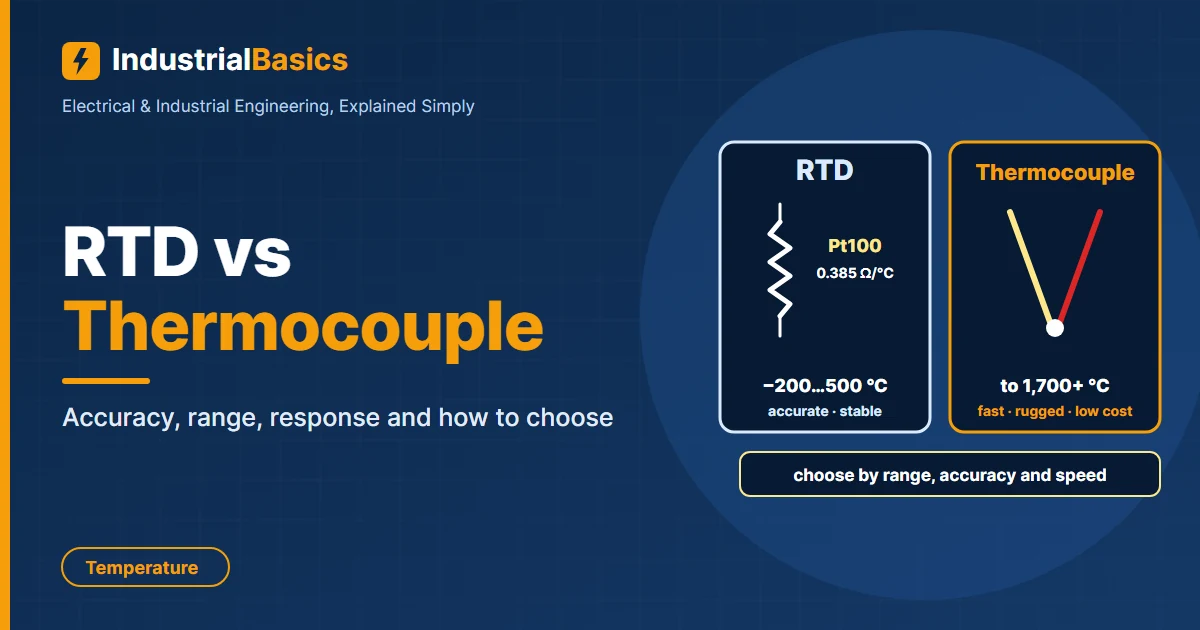
An RTD (resistance temperature detector) measures temperature from the resistance of a platinum element and is more accurate and stable. A thermocouple measures it from the small voltage at the junction of two dissimilar metals and covers a much wider range, responds faster and costs less. Use an RTD from −200 to 500 °C when accuracy matters. Use a thermocouple above about 500 °C, or when you need fast response, a very thin probe or a lower price.
RTD vs Thermocouple Comparison
| RTD (Pt100) | Thermocouple | |
|---|---|---|
| Principle | Resistance of platinum rises with temperature | Seebeck voltage from two dissimilar metals |
| Power | Needs excitation current | Self-powered |
| Range | −200 to 500 °C preferred; elements to 850 °C | −180 to 2,320 °C (by type) |
| Accuracy | Higher; e.g. tolerance class F 0.15 (−30 to 300 °C) | Type K class 1: ±1.5 °C to 375 °C, then ±0.4% of T |
| Stability | Stable for many years | Can drift within the first hours of use |
| Response | Seconds | Fractions of a second possible |
| Sheath size | Typically 3.2–6.4 mm | Can be under 1.6 mm |
| Signal | 0.385 Ω/°C (Pt100) | ≈10–50 µV/°C depending on type |
| Wiring | Copper; 3- or 4-wire to cancel lead resistance | Thermocouple/extension wire + cold-junction compensation |
| Cost | Higher | Inexpensive, interchangeable |
Temperature Range
Wikipedia’s rule of thumb: for process temperatures between −200 and 500 °C an industrial RTD is preferred. Above 500 °C the thermocouple is the usual contact sensor. RTDs are rarely used above 660 °C because the platinum becomes contaminated by impurities from the metal sheath. Because of their accuracy and repeatability, RTDs are slowly replacing thermocouples in industrial applications below 600 °C.
Accuracy and Stability
The RTD wins on accuracy. Wikipedia notes that thermocouple system errors below 1 °C are difficult to achieve. If a tolerance of about 2 °C is acceptable and top repeatability is not needed, a thermocouple will serve. RTDs keep their calibration for years, while thermocouples can drift in the first few hours of use.
| Thermocouple | Class 1 tolerance | Class 2 tolerance |
|---|---|---|
| K, N | ±1.5 °C (−40 to 375 °C); ±0.004×T to 1,000 °C | ±2.5 °C (−40 to 333 °C); ±0.0075×T to 1,200 °C |
| J | ±1.5 °C (−40 to 375 °C); ±0.004×T to 750 °C | ±2.5 °C (−40 to 333 °C); ±0.0075×T to 750 °C |
| T | ±0.5 °C (−40 to 125 °C); ±0.004×T to 350 °C | ±1.0 °C (−40 to 133 °C); ±0.0075×T to 350 °C |
| E | ±1.5 °C (−40 to 375 °C); ±0.004×T to 800 °C | ±2.5 °C (−40 to 333 °C); ±0.0075×T to 900 °C |
| R, S | ±1.0 °C (0 to 1,100 °C) | ±1.5 °C (0 to 600 °C); ±0.0025×T to 1,600 °C |
| RTD tolerance class (BS EN 60751:2008) | Valid range |
|---|---|
| F 0.3 | −50 to +500 °C |
| F 0.15 | −30 to +300 °C |
| F 0.1 | 0 to +150 °C |
Which to Choose: Calculator
At 200 °C, for example, a Pt100 reads 175.86 Ω. A Type K thermocouple there has a class 1 tolerance of ±1.5 °C and a class 2 tolerance of ±2.5 °C, before any instrument or cold-junction error.
Response Time and Size
When a process needs a response in fractions of a second rather than seconds, a thermocouple is the better choice. Response time is measured by plunging the sensor into water moving at 1 m/s and timing the 63.2% step. A standard RTD sheath is 3.175 to 6.35 mm (1/8 to 1/4 in) in diameter, while thermocouple sheaths can be less than 1.6 mm (1/16 in), so thermocouples also fit smaller spaces.
Wiring and Signal Conditioning
- RTD: needs a small excitation current. The lead resistance adds to the reading, so 2-wire connections are used only when accuracy is not critical. 3-wire and 4-wire connections cancel the leads; see 3-wire vs 4-wire RTD.
- Thermocouple: produces microvolts (about 41 µV/°C for Type K, 50 µV/°C for J, 10 µV/°C for R, S and B). It needs thermocouple or extension wire of the same type all the way to the instrument, plus cold-junction compensation.
- Transmitters: both are commonly converted to a 4–20 mA signal in or near the sensor head to reach the control system.
Thermocouple Types at a Glance
| Type | Materials | Range (°C) | Sensitivity (µV/°C) | Notes |
|---|---|---|---|---|
| K | Chromel–alumel | −200 to +1350 | ≈41 | Most common general-purpose; inexpensive; green rot in low oxygen |
| J | Iron–constantan | −40 to +1200 | ≈50 | Higher sensitivity; limited by iron Curie point (770 °C) |
| T | Copper–constantan | −200 to +350 | ≈43 | Good at low temperatures; no Curie point |
| N | Nicrosil–Nisil | −270 to +1300 | ≈39 (at 900 °C) | Stable, oxidation resistant; alternative to K |
| E | Chromel–constantan | 0 to +800 (class 1) | — | Listed in the IEC tolerance table |
| R, S | Platinum–rhodium | up to +1600 | ≈10 | Very stable, costly, low sensitivity; high temperatures |
| B | Platinum–rhodium | +200 to +1700 (class 2 from 600) | ≈10 | Highest-temperature noble-metal type |
If you choose a thermocouple, the junction matters too: see grounded vs ungrounded thermocouples.
Frequently Asked Questions
What is the difference between an RTD and a thermocouple?
An RTD measures temperature from the change in electrical resistance of a metal (usually platinum) and needs an excitation current. A thermocouple produces a small voltage from the junction of two dissimilar metals (the Seebeck effect) and needs no power. RTDs are more accurate and stable; thermocouples reach higher temperatures, respond faster and cost less.
Which is more accurate, RTD or thermocouple?
The RTD. Wikipedia notes RTDs have higher accuracy and repeatability and stay stable for years, while thermocouples can drift within the first hours of use and errors below 1 °C are hard to achieve. A Type K class 1 thermocouple is ±1.5 °C up to 375 °C.
When should I use a thermocouple instead of an RTD?
Above about 500 °C, when you need a response in fractions of a second, when the sheath must be very small (under 1.6 mm), or when low cost and ruggedness matter more than accuracy.
What is the temperature range of an RTD?
Industrial RTDs are preferred from −200 to 500 °C. Coiled elements work to 850 °C, but industrial RTDs are rarely used above 660 °C because the platinum gets contaminated by the sheath.
What is the temperature range of a thermocouple?
About −270 to 2,320 °C across all types (up to 3,000 °C briefly in inert gas). Type K covers −200 to 1,350 °C; Type T −200 to 350 °C; Types R and S to 1,600 °C.
What is a Pt100?
A platinum RTD with 100 Ω resistance at 0 °C. Its nominal sensitivity is 0.385 Ω/°C (α = 0.00385, IEC 60751 / ASTM E1137); at 100 °C it reads about 138.5 Ω.
Is an RTD faster than a thermocouple?
Generally no. A thermocouple, especially a thin exposed one, responds faster. RTD sheaths are typically 3.2 to 6.4 mm in diameter, while thermocouple sheaths can be smaller than 1.6 mm.
Do RTDs or thermocouples need special wire?
Thermocouples need matching thermocouple or extension wire all the way to the instrument, plus cold-junction compensation. RTDs use ordinary copper leads, but lead resistance must be cancelled with a 3-wire or 4-wire connection.
Why are RTDs replacing thermocouples?
Because of their accuracy and repeatability, RTDs are slowly replacing thermocouples in industrial applications below 600 °C (Wikipedia).
Are RTDs fragile?
RTD elements are more fragile than thermocouple junctions, so they are housed in sheaths and thermowells, often packed with magnesium oxide for shock and vibration resistance. Industrial PRTs can be almost as durable as thermocouples.
Sources and Further Reading
- Wikipedia: Resistance thermometer: RTDs vs thermocouples, Pt100, Callendar–Van Dusen, tolerance classes, construction.
- Wikipedia: Thermocouple: types, sensitivity, tolerance classes, accuracy limits.



