
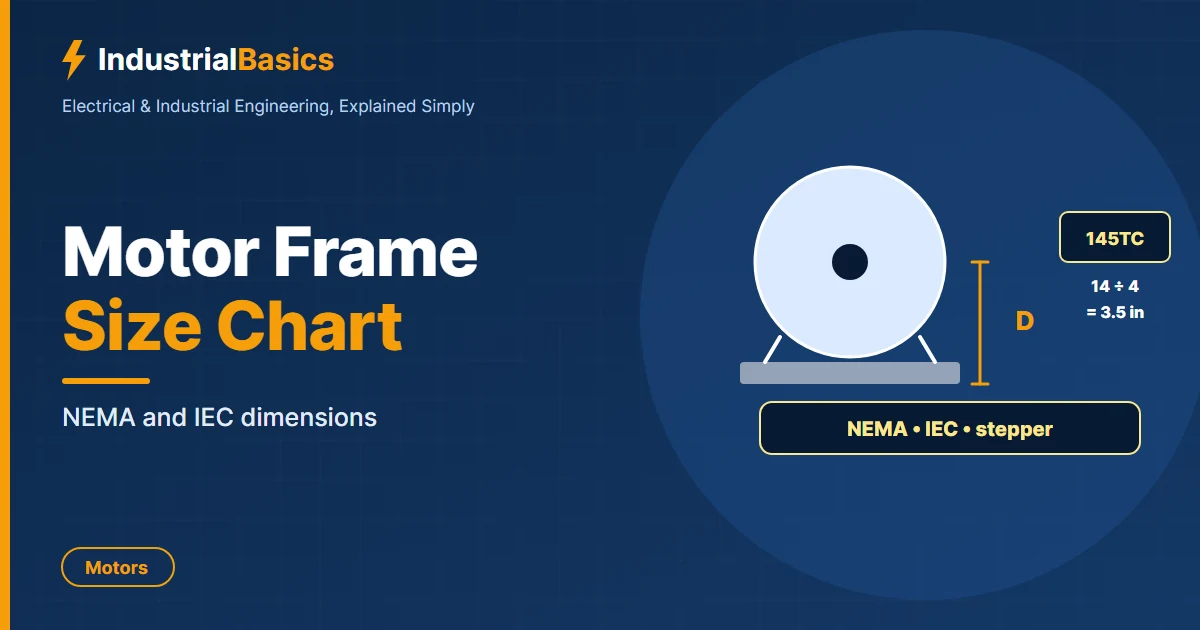
For a NEMA motor, the frame number gives the shaft height: on three-digit frames, the first two digits divided by 4 give the shaft centre height in inches. A 145T has a 3.5 in shaft height and a 256T 6.25 in. The third digit sets foot-hole spacing and length, and letters show the standard (T or U) and mounting (C-face, D flange, JM/JP pump). IEC frame numbers are simply the shaft height in millimetres: an IEC 112 has a 112 mm shaft height. NEMA stepper sizes such as NEMA 17 refer to faceplate size, not frame.
NEMA Motor Frame Size Chart
| Frame | D shaft height | E | 2F | BA | U shaft dia. |
|---|---|---|---|---|---|
| 42 | 2 5/8 in | 1 3/4 | 1 11/16 | 2 1/16 | 3/8 |
| 48 | 3 in | 2 1/8 | 2 3/4 | 2 1/2 | 1/2 |
| 56 | 3 1/2 in | 2 7/16 | 3 | 2 3/4 | 5/8 |
| 143T | 3 1/2 in | 2 3/4 | 4 | 2 1/4 | 7/8 |
| 145T | 3 1/2 in | 2 3/4 | 5 | 2 1/4 | 7/8 |
| 182T | 4 1/2 in | 3 3/4 | 4 1/2 | 2 3/4 | 1 1/8 |
| 184T | 4 1/2 in | 3 3/4 | 5 1/2 | 2 3/4 | 1 1/8 |
| 213T | 5 1/4 in | 4 1/4 | 5 1/2 | 3 1/2 | 1 3/8 |
| 215T | 5 1/4 in | 4 1/4 | 7 | 3 1/2 | 1 3/8 |
| 254T | 6 1/4 in | 5 | 8 1/4 | 4 1/4 | 1 5/8 |
| 256T | 6 1/4 in | 5 | 10 | 4 1/4 | 1 5/8 |
| 284T | 7 in | 5 1/2 | 9 1/2 | 4 3/4 | 1 7/8 |
| 286T | 7 in | 5 1/2 | 11 | 4 3/4 | 1 7/8 |
| 324T | 8 in | 6 1/4 | 10 1/2 | 5 1/4 | 2 1/8 |
| 326T | 8 in | 6 1/4 | 12 | 5 1/4 | 2 1/8 |
| 364T | 9 in | 7 | 11 1/4 | 5 7/8 | 2 3/8 |
| 365T | 9 in | 7 | 12 1/4 | 5 7/8 | 2 3/8 |
How to Read a NEMA Frame Number
| Part | Meaning | Example |
|---|---|---|
| Digits 1–2 | Shaft height = number ÷ 4 (inches) | 445T: 44 ÷ 4 = 11 in |
| Digit 3 | Foot-hole spacing and frame length | 143T vs 145T: same height, longer frame |
| T or U | T = 1964 standard, U = 1952–1964 | 256T vs 256U |
| C or D | C-face or D flange | 145TC |
| JM / JP | Close-coupled pump motor | 213JM |
NEMA introduced standard frames in 1952 and revised them in 1964, creating the T frame. Motors built before 1964 carry U frames. Small motors use two-digit frames from 42 to 56, where the shaft height is the number divided by 16: a 56 frame is 3.5 in (ATEK; Engineering ToolBox). Under NEMA MG 1, frame assignment depends on enclosure, horsepower and speed at 60 Hz (NEMA guide).
Motor Frame Decoder
IEC Frame Sizes and NEMA Equivalents
| NEMA frame | Shaft height (in) | Shaft height (mm) | Nearest IEC frame | IEC shaft height (mm) |
|---|---|---|---|---|
| 42 | 2.625 | 66.7 | 71 | 71 |
| 48 | 3 | 76.2 | 80 | 80 |
| 56 / 140T | 3.5 | 88.9 | 90 | 90 |
| 180T | 4.5 | 114.3 | 112 | 112 |
| 210T | 5.25 | 133.3 | 132 | 132 |
| 250T | 6.25 | 158.8 | 160 | 160 |
| 280T | 7 | 177.8 | 180 | 180 |
| 320T | 8 | 203.2 | 200 | 200 |
| 360T | 9 | 228.6 | 225 | 225 |
| 400T | 10 | 254.0 | 250 | 250 |
| 440T | 11 | 279.4 | 280 | 280 |
IEC 60072-1 frames run from 56 to 400. The number is the shaft height in millimetres for foot-mounted machines, and S, M or L marks the stack length on the same frame. IEC labels dimensions more logically than NEMA: shaft height is H (NEMA D), shaft diameter is D (NEMA U) and length is L (NEMA C). NEMA’s guide notes that shaft heights, foot spacing and shaft diameters are generally within 3 or 4 mm, and NEMA output shafts tend to be longer.
NEMA Stepper Motor Sizes
Stepper motors use a different NEMA naming scheme under NEMA ICS 16: the number is the faceplate size in tenths of an inch. A NEMA 17 has a 1.7 × 1.7 in (43 mm) faceplate, a NEMA 23 2.3 in and a NEMA 34 3.4 in (Wikipedia). These sizes say nothing about torque or length, which vary by model. For servo alternatives, see closed loop servo systems.
Related Motor Data
For full-load current by horsepower, see the NEC motor FLA table. For starting current, see locked rotor amps, and for speed control, VFD vs soft starter.
Frequently Asked Questions
How do you read a NEMA motor frame size?
For three-digit frames, the first two digits divided by 4 give the shaft centre height in inches: 145T → 14 ÷ 4 = 3.5 in; 256T → 6.25 in. The third digit relates to foot-hole spacing and frame length, and the letters give the standard (T or U) and mounting (C, D, JM, JP) (ATEK).
What is the difference between 143T and 145T?
Same shaft height (3.5 in) and shaft (7/8 in); the 145T has longer foot-hole spacing (2F = 5 in vs 4 in) for a longer frame (Engineering ToolBox).
What does the C in 56C or 145TC mean?
A C-face flange: a machined face with tapped holes for mounting the motor to a gearbox, pump or bracket. D denotes a D flange.
What is the difference between T frame and U frame?
U frames come from NEMA’s 1952 standard frames; the 1964 revision introduced the T frame. Motors built before 1964 carry U frames (ATEK).
How do IEC frame sizes work?
The IEC frame number is the shaft height in millimetres (IEC 60072-1, frames 56 to 400). Letters S, M and L indicate short, medium and long stack length on the same frame.
What IEC frame equals a NEMA 184T?
By shaft height, NEMA 180-series (4.5 in, 114.3 mm) is closest to IEC 112. But shaft diameter, hole pattern and flange differ, so they are not directly interchangeable.
What is a 56 frame motor?
A two-digit NEMA frame with a 3.5 in shaft height (56 ÷ 16), a 5/8 in shaft and 3 in foot-hole spacing (2F), used on small motors (Engineering ToolBox; ATEK).
What are NEMA stepper motor sizes?
Stepper motors are named by faceplate size under NEMA ICS 16: NEMA 17 = 1.7 × 1.7 in (43 mm), NEMA 23 = 2.3 in, NEMA 34 = 3.4 in. They are unrelated to induction-motor frame sizes (Wikipedia).
Does frame size determine horsepower?
For NEMA, MG 1 assigns frames based on enclosure, horsepower and speed at 60 Hz; IEC does not tie output power and speed to a frame size (NEMA guide).
What does JM or JP mean?
Close-coupled pump motors: JM for pumps with mechanical seals, JP for pumps with packing glands (ATEK).
Sources and Further Reading
- Engineering ToolBox: Electrical motors, NEMA frame dimensions.
- NEMA: NEMA vs. IEC Motor Standards (PDF): frame designation and shaft-height comparison.
- ATEK Drive Solutions: NEMA motors, frame sizes and IEC comparison: frame code meanings.
- Wikipedia: Stepper motor: NEMA ICS 16 faceplate sizes.



