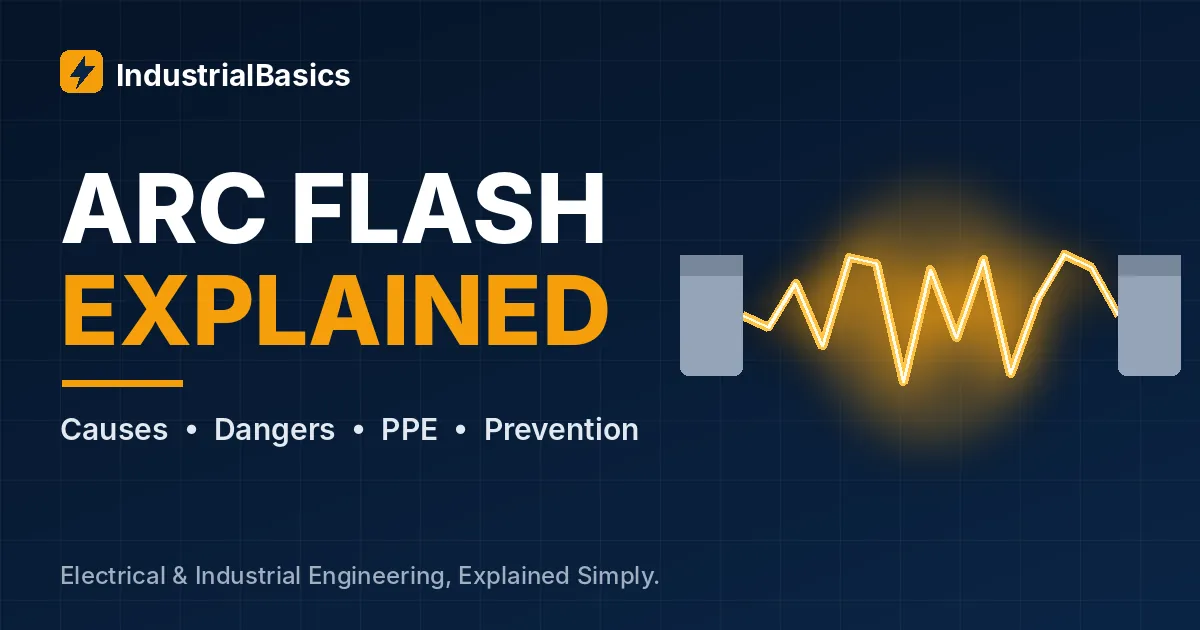
An arc flash is a sudden burst of intense heat and light. It happens when electricity jumps through the air between live conductors, or from a live conductor to earth. It can cause severe burns, eye and hearing damage and flying molten metal, usually in well under a second. It is a hazard for anyone who works on or near live electrical equipment.
The short answer
- What causes it: a fault that lets current flow through air, such as a dropped tool, failing equipment, loose connections, dirt, moisture or damaged insulation.
- Where it happens: switchgear, motor control centres, distribution boards, busbars, cable terminations, and DC systems such as solar and batteries.
- Voltage: it is not only a high-voltage problem. A 415 V board with high fault current can sustain a dangerous arc.
- Best protection: de-energise, prove dead and lock off. Arc-rated PPE is the last line of defence, not the first.
- Arc flash boundary: the distance at which heat energy falls to 1.2 cal/cm², the level at which bare skin may suffer a second-degree burn.
This guide explains what an arc flash is, what causes it, how serious the injuries can be, how boundaries, incident energy, labels and PPE work, how to prevent it, and which standards apply in the UK, USA and India. It is written in plain English for apprentices, electricians, engineers, safety managers and students.
Last verified: 8 November 2026. Standards and statistics are dated where they appear.
What Happens During an Arc Flash?
Air is normally a good insulator. When something weakens it, such as a tool bridging a gap, dust and moisture on insulation, or a failing component, current can start to flow through the air. The air heats, ionises and turns into plasma, which conducts electricity. That conducting channel is the arc.
The arc turns electrical energy into several forms at once: intense heat, bright visible and ultraviolet light, a pressure wave, loud noise, and molten and vaporised metal from the conductors.
The role of current and voltage
Voltage helps start and sustain the arc across a gap. The fault current, meaning how much current the supply can push through the fault, largely decides how much energy the arc releases. Energy also grows with arcing time, so a fault cleared in a fraction of a cycle releases far less than one that burns for a second.
What happens to the equipment
Inside an enclosure, sudden heating raises the pressure sharply. Doors and covers can be blown off, copper and aluminium can vaporise, insulation and cables can burn, and fires can start. Even when nobody is hurt, the equipment is often destroyed and the plant can be out of action for a long time.
How hot can an arc flash get?
OSHA guidance (2024) says arc temperatures can exceed 35,000 °F (19,400 °C), several times hotter than the surface of the sun. That figure applies to the arc itself, close to the arc terminals. A worker receives far less heat, and only for a very short time. That is why engineers measure the heat energy a person would receive (incident energy) instead of quoting the arc temperature.
What affects arc flash severity?
- Available fault current: more current means more energy.
- Arcing time: how long the protective device takes to clear the fault.
- System voltage: it affects whether an arc can be sustained.
- Gap between conductors: a wider gap changes arc behaviour.
- Electrode arrangement and enclosure: an arc in a box behaves differently from one in open air.
- Working distance: the closer the person, the more heat they receive.
Arc Flash vs Arc Blast vs Electric Shock vs Short Circuit
These terms are often mixed up. They describe different things and need different precautions.
| Hazard | Meaning | Main harm |
|---|---|---|
| Arc flash | Intense heat and light released by an electrical arc | Burns, eye damage, ignited clothing |
| Arc blast | Pressure wave, noise and mechanical force from the same event | Being thrown, hearing damage, flying debris |
| Electric shock | Electric current passing through the human body | Heart disturbance, internal and surface burns |
| Arc fault | An unintended electrical discharge through air or across insulation | Can start an arc flash, a fire or both |
| Short circuit | An unintended low-resistance connection between conductors | Very high current, equipment damage, fire |
Is an arc flash the same as an arc blast? No, but they usually happen together. The flash is the heat and light. The blast is the pressure wave, noise and flying debris.
Can an arc fault cause an arc flash? Yes. An arc fault is the unintended arc. If it occurs in equipment that can supply enough fault current, it releases dangerous energy, and that event is the arc flash.
Why do the differences matter? Shock is controlled by insulation, distance and isolation. A short circuit is dealt with by protective devices such as fuses and circuit breakers. An arc flash needs those controls plus energy reduction and, finally, PPE. Treating one hazard as another leads to wrong precautions, such as believing insulated gloves alone make live work safe.
What Causes an Arc Flash?
Arc flashes are triggered in the ways below. We found no reliable public source that ranks these causes by percentage, so the order is not a ranking.
Equipment failure
Components wear out. Failing breakers, contactors, bushings and cable joints can short internally and start an arc without anyone touching them. This is why an arc flash can occur even with the panel door closed.
Loose electrical connections
A loose bolted joint heats up, oxidises and can eventually arc across the gap. Thermal imaging and torque checks find these early.
Dust, dirt and moisture
Conductive dust, condensation and vermin can create a path across insulation. Current then tracks along the surface and can flash over.
Damaged insulation
Cracked, aged, overheated or crushed insulation can break down under normal voltage. Insulation resistance testing shows deterioration before it fails.
Dropped tools and foreign objects
A dropped screwdriver, a stray bolt or a tool striking a live buried cable can bridge conductors instantly. This is a common trigger during live work and excavation.
Corrosion and poor maintenance
Corroded joints and neglected equipment fail more often. Protection that has not been tested may also clear a fault slowly, which raises the energy released. Regular relay testing confirms that protection operates as set.
Incorrect electrical work practices
Examples include live work that could have been done dead, the wrong test equipment, bypassed interlocks, and failing to prove the circuit dead before work starts.
Circuit breaker switching and racking
Operating circuit breakers, switches and isolators, or racking a breaker in and out of a cubicle, puts the operator right beside equipment that may fail as it operates. The risk is highest on old or poorly maintained gear.
Human error
Many incidents include a human element: working on the wrong cubicle, misreading a drawing, rushing or skipping a step. Clear procedures and supervision reduce it.
Conditions that raise the risk
- Older or poorly maintained switchgear
- Equipment fed by large transformers, which can deliver high fault current
- Slow protection, meaning a long clearing time
- Working with covers off, or testing and fault-finding on live equipment
- Dusty, damp, corroded or vermin-prone rooms
- Non-routine tasks, such as one-off repairs and commissioning
Arc Flash Dangers, Injuries and Health Effects
How badly someone is hurt depends on the heat energy they receive, how far away they are, how long the exposure lasts, what they are wearing and how quickly they get treatment. The main injuries are below.
Severe thermal burns
Burns come from direct heat, molten metal and clothing that catches fire. Burning clothing often causes the worst burns, which is why fabric choice matters. HSE guidance describes arcing burns as deep-seated and slow to heal, even after a very short exposure.
Eye injuries and vision problems
The flash is extremely bright and includes ultraviolet light. Both can damage the eyes, and molten particles can strike the face.
Hearing damage
The blast produces very loud noise. It can cause immediate hearing loss, including burst eardrums.
Blast injuries and pressure trauma
The pressure wave can knock a person over or throw them, and can cause internal injuries.
Breathing problems and smoke exposure
Hot gases, smoke and vaporised metal can be inhaled and harm the airway and lungs.
Secondary injuries from falls and flying objects
Workers on ladders or platforms can fall when startled or thrown. Doors, covers and shrapnel from the equipment can strike people nearby.
Can an arc flash cause death?
Yes. Deaths can result from burns, blast injuries or secondary injuries. In US OSHA data, arc flash accounts for about 2% of recorded electrical fatalities, because most electrical deaths come from power-line contact and other shock events (see the statistics section). That does not make arc flash minor. Survivors can face long treatment and lasting disability.
Understanding Arc Flash Boundaries
Three different boundaries are set around exposed live equipment. Two are about electric shock and one is about arc flash. Mixing them up is a common mistake.
What is an arc flash boundary?
The arc flash boundary is the distance from an exposed live part at which the incident energy equals 1.2 cal/cm² (5.02 J/cm²). OSHA explains that a worker without proper protection at this distance could suffer a second-degree burn. Inside the boundary, arc-rated PPE is needed. An unqualified person may cross only wearing appropriate protection and under close supervision by a qualified person. Older documents call this the “flash protection boundary”. The current term is arc flash boundary.
What is a limited approach boundary?
The limited approach boundary protects against electric shock. Inside it, shock is possible. An unqualified person who must enter has to be accompanied by a qualified person throughout.
What is a restricted approach boundary?
The restricted approach boundary sits closer to the live part and carries the highest shock risk. It differs from the limited boundary in how strict the rules are. An unqualified person must never cross it. A qualified person may enter only with suitable PPE and insulated tools.
Arc flash boundary vs shock approach boundaries
| Arc flash boundary | Limited approach boundary | Restricted approach boundary | |
|---|---|---|---|
| Protects against | Thermal burns from an arc | Electric shock | Electric shock (highest risk) |
| Based on | Incident energy of 1.2 cal/cm² | Voltage and equipment type | Voltage and equipment type |
| Who may cross | Anyone wearing suitable arc-rated PPE. Unqualified people only with close qualified supervision | Qualified people. Unqualified people only with a qualified escort | Qualified people only, with suitable PPE and insulated tools |
| Fixed distance? | No. Calculated for each piece of equipment | Set by the standard for the voltage | Set by the standard for the voltage |
What determines boundary distances?
The arc flash boundary depends on voltage, equipment configuration, available fault current, protective-device clearing time and the calculation method used. Change any one of these and the boundary moves.
Why this article gives no distance table
A generic table of boundary distances is unsafe. Real distances need an assessment under the current standard for your equipment, voltage and protection settings. Use the distances on the equipment label or in your site’s study.
What Is Incident Energy in Arc Flash?
Incident energy is the heat energy that reaches a surface, such as a worker’s chest or face, at a given distance from an arc. It is the number that drives PPE choice and boundary distances.
How is it measured, and what does cal/cm² mean?
It is expressed in calories per square centimetre (cal/cm²) or joules per square centimetre (J/cm²). You cannot read it off a meter on site. Engineers calculate it from the electrical system’s data, using models built from laboratory arc tests. The conversion is simple arithmetic.
| cal/cm² | J/cm² | Where the value appears |
|---|---|---|
| 1.2 | 5.02 | Arc flash boundary threshold (second-degree burn onset on bare skin) |
| 8 | 33.5 | Example arc rating marked on some garments |
| 25 | 104.6 | Example arc rating marked on some garments |
| 40 | 167.4 | Example arc rating marked on some garments |
Incident energy and arc rating
Arc-rated PPE carries a rating in the same unit. The rating of the PPE must be at least equal to the incident energy at the working distance. The calculation guide, IEEE 1584-2018, produces the incident energy but does not recommend PPE.
Why working distance matters
Working distance is how far the worker’s face and chest are from the possible arc. Heat energy falls as that distance grows, so remote operation and longer tools directly reduce exposure.
How is incident energy assessed?
Qualified engineers use the IEEE 1584-2018 models, which cover three-phase AC systems from 208 V to 15 kV and exclude DC and single-phase systems. They need short-circuit data, protective-device settings and equipment details. The factors that change the result are the same ones listed earlier in this guide.
What Is an Arc Flash Risk Assessment?
An arc flash risk assessment, often called an arc flash study, is a structured review of where an arc flash could happen, how severe it could be and how to control it. Its results inform safe work practices, boundaries and PPE.
Why electrical workplaces need one
Employers have a legal duty to assess electrical risk. In Great Britain that sits under the Management of Health and Safety at Work Regulations 1999 and the Electricity at Work Regulations 1989. In the USA it is covered by OSHA’s electrical rules and NFPA 70E.
What information is considered?
- Single-line diagrams and the equipment list
- Short-circuit (fault current) study results
- Protective-device settings and clearing times, which link to protection coordination
- Equipment condition and maintenance records
- The tasks people actually do, and their working distances
Incident-energy analysis and the PPE-category method
| Method | How it works | Main limitation |
|---|---|---|
| Incident-energy analysis | Calculates incident energy and boundary for each location, usually with IEEE 1584 models | Needs accurate system data and skilled engineers |
| PPE-category method | Looks up a PPE category from tables for listed tasks and equipment types | Valid only within the table’s stated limits on fault current and clearing time |
Who should carry out the assessment?
A competent, qualified person, usually an electrical engineer experienced in power-system studies. The employer stays responsible for acting on the findings.
When should it be reviewed?
NFPA 70E has set a maximum review interval of five years, plus a review after major changes. Check the current edition. In practice, also review after new equipment, changed protection settings or network changes.
What Is an Arc Flash Label?
An arc flash label is a warning fixed to electrical equipment. It tells a worker, before they open or work on it, that an arc flash hazard exists and what the assessment found.
What information does a label contain?
- Nominal system voltage
- Arc flash boundary
- Incident energy and the working distance it applies to
- Arc rating or PPE information, where applicable
- Equipment identification and the date of the assessment
Why are labels important?
They put the study results in front of the person at the equipment. Without a label, the study is just a document in an office.
When should labels be updated?
Whenever the assessment changes: after a periodic review, new equipment, changed protection settings or a change in the supply. An out-of-date label can be worse than none, because it gives false confidence. UK law has no single equivalent of NFPA 70E’s label rules, so many UK and Indian sites follow similar labelling through client specifications or company policy.
How to read an arc flash label
Check the voltage matches the equipment. Note the arc flash boundary. Compare the incident energy and working distance with your task. Confirm that your PPE’s arc rating meets or exceeds that energy. Finally, check the study date. If anything does not match, stop and ask.
Arc Flash PPE: Clothing and Protective Equipment
PPE reduces the severity of injury if an arc flash happens. It does not prevent the event. Each item below has a specific job.
What is arc-rated PPE?
Arc-rated PPE has been tested against an electric arc and carries a rating in cal/cm². Ordinary work clothing has no such rating.
Arc-rated clothing
Shirts, trousers, jackets and coveralls made from arc-rated fabric. Layers add protection, and what counts is the rating of the whole layered system. Fabrics that melt, such as nylon and polyester, can make burns worse and should not be worn in the layers that provide protection unless the garment is itself arc rated.
Arc flash suits
An arc flash suit is arc-rated clothing combined with a hood, designed for tasks with higher incident energy. Choose by the rating on the label and the assessment, not by the name “suit”.
Arc flash face shields and hoods
Face shields, balaclavas and hoods protect the face, eyes and neck from heat, light and molten particles. They must have an arc rating suitable for the task and fit with the rest of the headgear.
Electrical safety gloves
Insulating rubber gloves protect against shock and are tested to IEC 60903. Leather protectors worn over them add mechanical and some thermal protection. Rubber gloves alone are not arc protection.
Hearing protection
Ear plugs or canal caps reduce the blast noise.
Safety footwear and eye protection
Safety boots protect the feet. Safety glasses worn under the face shield protect the eyes if the shield is displaced.
What is an arc rating?
| Term | Meaning |
|---|---|
| Arc rating | The tested level of protection of a fabric or garment, in cal/cm² |
| ATPV (arc thermal performance value) | Incident energy at which there is a 50% chance that enough heat gets through to cause a second-degree burn |
| EBT50 (energy at breakopen threshold) | Incident energy at which the fabric has a 50% chance of breaking open. Used when it breaks open before the burn threshold is reached |
| ELIM (incident energy limit) | A rating reported where performance is limited by fabric breakopen, not by skin-burn prediction |
| cal/cm² | The unit for all of the above |
Arc-rated vs flame-resistant clothing
| Flame-resistant (FR) | Arc-rated (AR) | |
|---|---|---|
| What it describes | A fabric property: resists ignition and self-extinguishes | A tested result under arc exposure |
| Labelled with a rating? | Not necessarily | Yes, in cal/cm² (or arc class) |
| Suitable for arc flash work? | Only if it is also arc rated | Yes, if the rating meets the incident energy |
Does arc flash PPE prevent all injuries?
No.
PPE lowers the risk and severity of burns. It does not stop the arc, the pressure wave or the noise, and it does not protect you from shock. Wearing an arc-rated suit does not make live work safe.
How to Prevent an Arc Flash Accident
Prevention follows the hierarchy of controls. Start at the top. Only fall back to the next level when the one above cannot be done. Substitution means choosing a safer design at the specification stage, such as arc-resistant equipment.
Elimination: de-energise the equipment
Switch it off. An arc flash can only happen on live equipment. In Great Britain, Regulation 14 of the Electricity at Work Regulations 1989 allows live work only if three conditions are all met: it is unreasonable for the equipment to be dead, it is reasonable for the person to work on it live, and suitable precautions are taken.
Verify an electrically safe work condition
Never assume. Use a proving unit and approved test equipment to check the circuit is dead, then re-check the tester. The 2027 edition of NFPA 70E also notes that a voltage test alone may not show equipment is de-energised, for example on current-driven circuits such as current transformer secondaries.
Use lockout/tagout (LOTO)
Lock the isolation point off with your own personal lock and attach a tag. This stops someone re-energising the circuit while you work. Keep the key with you.
Engineering controls
- Arc-resistant switchgear: built and tested to direct arc energy away from people, for example to the IEC 62271-200 internal arc classification. See types of switchgear panels.
- Arc flash detection systems: light-sensing protection relays that trip in milliseconds.
- Current-limiting devices: fuses and breakers that cut both the fault current and the time it flows.
- Faster protection settings: a shorter clearing time cuts incident energy, but settings must stay selective. Overcurrent functions such as ANSI 50 and 51 are explained in the list of ANSI device numbers.
- Remote operation and racking: move the worker out of the arc flash boundary.
Administrative controls
- Training: electrical safety training matched to each worker’s role.
- Risk assessments: as described above.
- Safe working procedures: written, followed and supervised.
- Warning labels: accurate and up to date.
- Permit systems: a permit to work for isolations and an energised work permit where live work is justified.
Use appropriate arc-rated PPE
PPE is the last line of defence. It is what protects the worker when every control above has failed or could not be applied. It should never be the first answer.
Arc Flash Standards and Regulations Around the World
Some documents are law and others are voluntary consensus standards. A standard becomes enforceable only when a law or contract requires it. NFPA, for example, is a standards body, not a regulator.
| Standard or regulation | Region | Legal status | Main purpose |
|---|---|---|---|
| NFPA 70E (2027 edition) | USA | Voluntary consensus standard | Workplace electrical safety practices |
| IEEE 1584-2018 | International practice | Voluntary guide | Arc flash incident-energy and boundary calculations |
| OSHA 29 CFR 1910 (Subpart S) | USA | Law | Workplace electrical safety requirements |
| NEC (NFPA 70) | USA | Law where adopted locally | Electrical installation requirements |
| Electricity at Work Regulations 1989 | UK | Law | Duties to prevent danger from electricity at work |
| IEC 61482 series | International | Voluntary standard | Testing of arc-rated protective clothing |
| Electricity Act 2003 | India | Law | Legal framework for the electricity sector |
| CEA Safety Regulations 2023 | India | Law | Electrical safety requirements for installations |
Arc flash regulations in the USA
OSHA’s electrical rules sit in 29 CFR 1910 Subpart S for general industry and 1926 Subpart K for construction. NFPA 70E was originally developed at OSHA’s request and helps employers comply, but OSHA describes it as a consensus standard, not a regulation. The 2027 edition is the current one and replaced the 2024 edition. OSHA’s arc flash guidance, publication 4472 (2024), states that it creates no new legal obligations.
Arc flash regulations in the UK
There is no UK arc flash standard that works like NFPA 70E. Duties come from the Health and Safety at Work etc. Act 1974 and the Electricity at Work Regulations 1989. Regulation 4 requires systems to be constructed and maintained to prevent danger, Regulation 14 restricts live work and Regulation 16 requires competence. HSE publishes practical guidance in HSG85, Electricity at work: safe working practices (third edition, 2013). Employers must also assess risk and provide suitable PPE, with arc-rated clothing tested to the BS EN IEC 61482 series.
Arc flash safety requirements in India
India’s legal framework is the Electricity Act 2003. The CEA (Measures relating to Safety and Electric Supply) Regulations, 2023 were notified on 8 June 2023 and replaced the 2010 regulations. They cover safety in the construction, installation, protection, operation and maintenance of electric lines and apparatus, and require suppliers to appoint an Electrical Safety Officer. From the published summaries we checked, they set general safety duties rather than a step-by-step arc flash calculation method. Many Indian facilities therefore use NFPA 70E and IEEE 1584 voluntarily, or because a client or insurer asks for it. We could not confirm a mandatory Indian-specific certification mark for arc-rated clothing, so specifications usually refer to IEC 61482 or ASTM test reports. Confirm current requirements with your Electrical Inspector.
International arc flash standards
IEEE 1584-2018 is the most widely used calculation guide. A revision project was approved in 2025, so check for a newer edition. IEC 61482 covers the testing of arc-rated clothing. IEC 62271-200 covers metal-enclosed medium-voltage switchgear, including internal arc classification.
Arc Flash in DC Systems, Solar Panels and Battery Storage
What is a DC arc flash?
It is an arc in a direct-current circuit. DC has no natural zero crossing as AC does every half cycle, so a DC arc does not extinguish itself as easily once it starts.
Arc flash risks in solar PV systems
Solar modules produce voltage whenever light falls on them, so the cables stay live even when the inverter is off. A damaged cable or loose connector in a string can arc.
Arc flash in battery energy storage systems (BESS)
Batteries store energy and can deliver very high fault current. The 2027 edition of NFPA 70E expands its battery content, and adds new articles on DC hazards and photovoltaic systems.
Arc flash risks in EV charging infrastructure
High-power DC chargers carry large currents inside the cabinet. Maintenance work on them should follow the manufacturer’s instructions and a documented risk assessment.
How DC and AC arc flash hazards differ
| AC arc flash | DC arc flash | |
|---|---|---|
| Arc behaviour | Current falls to zero every half cycle | No zero crossing, so the arc can persist |
| Calculation model | IEEE 1584-2018 (three-phase AC, 208 V–15 kV) | Outside the scope of IEEE 1584-2018 |
| Typical sources | Switchgear, panels, motor control centres | PV strings, batteries, DC chargers |
| Isolation | Open the supply and lock off | Sources can remain live (sun, stored energy) |
Arc Flash vs Welding Arc Flash: What Is the Difference?
People searching for “arc flash welding” usually mean an eye injury. It is a different hazard from an electrical arc flash and needs different protection.
| Electrical arc flash | Welding arc flash (arc eye) | |
|---|---|---|
| What it is | Fault arc in electrical equipment | UV light from a welding arc |
| Main injury | Burns, blast, hearing and eye damage | Painful corneal burn (photokeratitis) |
| Onset | Immediate | Often 3–10 hours after exposure |
| Recovery | Can be long and life-changing | Usually 24–48 hours |
| Protection | Arc-rated clothing, hood, gloves, hearing protection | Welding helmet with the correct filter shade, screens, eye protection for bystanders |
Arc eye is also called welder’s flash or photokeratitis. It feels like sand in the eyes and affects bystanders as well as the welder. UV light from an electrical arc can damage eyes too, but an electrical arc flash adds heat, blast and molten metal.
Arc Flash Statistics and Real-World Incidents
No single official source counts arc flash incidents worldwide. The figures below come from official US and UK sources, with the definitions stated.
The ESFI compilation of OSHA investigation data puts arc flash at 2% of electrical fatalities. Overhead power-line contact alone accounts for 49%. Arc flash is rarer as a cause of death but often leaves survivors with severe burns.
The US Bureau of Labor Statistics recorded 142 deaths from exposure to electricity in 2023 and 130 in 2024. ESFI counts 2,070 across 2011–2024. BLS also records 5,180 non-fatal electrical injuries that caused days away from work in 2023 and 2024.
What about the UK?
HSE research report RR771 found contact with electricity was the biggest source of fatal accidents in its electricity-related dataset. HSE’s 2007 edition of HSG85 stated that several hundred serious burn accidents arising from unsafe working practices occur each year in Britain. That figure is dated, so treat it as indicative.
Why sources report different figures
- Some count all electrical injuries, others only arc flash.
- Fatal and lost-time injuries are counted differently.
- Reporting rules differ between countries, and arc flash is often coded as burns, fire or explosion.
- Reported cases are not the same as estimated cases.
Figures to treat with care
Claims such as “5–10 arc flash incidents per day” are widely repeated, but we could not trace a primary source, so we do not use them. The 35,000 °F figure is real but applies to the arc itself, as explained earlier.
What workplaces can learn from investigations
A 2015 prosecution in Scotland shows the pattern. Two workers suffered serious burns while working on a live electricity distribution board in December 2011. Their employer was fined £24,000 and the company controlling the site £20,000 for breaching Regulation 14. The lesson is the same as in most cases: the work could have been done dead, and live work was not properly justified.
First Aid and Emergency Response After an Arc Flash
Do not approach exposed electrical equipment, and do not touch anyone who may still be in contact with a live source.
Your safety comes first. A second casualty does not help.
Ensure the scene is safe
Isolate the supply if you can do so safely, for example at a remote emergency stop. Keep others away. Watch for fire and further arcing.
Contact emergency services
Call 999 or 112 in the UK, 112 in India or 911 in the USA. Say that it is an electrical burn injury.
Get medical attention immediately
Everyone exposed should be assessed by a medical professional, even if they seem fine. Burns can be deeper than they look and electrical injuries can affect the heart and other organs.
Follow official guidance for electrical burns
Once it is safe, the NHS advises holding the burn under cool running water for 20 minutes, starting as soon as possible. Remove clothing or jewellery near the burn, but leave anything stuck to the skin alone. Once it has cooled, loosely cover it with cling film. The NHS says burns caused by electricity need a 999 call or a visit to A&E.
Report and investigate the incident
Report it as the law requires, such as to HSE under RIDDOR in Great Britain or to the Electrical Inspector in India. Then investigate to find the root cause, and update the risk assessment and labels.
Arc Flash Safety Checklist for Electrical Workplaces
- Identify the electrical hazards at the task.
- Check the equipment’s arc flash label.
- Review the latest hazard assessment.
- De-energise the equipment wherever feasible.
- Follow the lockout/tagout procedure.
- Verify the electrically safe work condition.
- Confirm every worker is qualified for the task.
- Check the PPE requirements and inspect the PPE.
- Provide electrical safety training suited to each role.
- Review safety procedures regularly.
Keeping the approach to equipment clear is part of arc flash safety. Our guide to electrical panel clearance explains the NEC 110.26 working space, including depth, width, height and exit rules.
Frequently Asked Questions About Arc Flash
1. What is an arc flash in simple terms?
An arc flash is a sudden burst of heat and light caused by electricity jumping through the air between live conductors, or from a conductor to earth. It can cause severe burns and damage to eyes and hearing.
2. What causes an electrical arc flash?
Common triggers are equipment failure, loose connections, dust and moisture, damaged insulation, dropped tools, poor maintenance, switching or racking breakers, and human error.
3. How hot can an arc flash get?
OSHA guidance says arc temperatures can exceed 35,000 °F (19,400 °C) at the arc itself. A worker receives far less, which is why incident energy at working distance is the measure that matters.
4. Can an arc flash happen at low voltage?
Yes, if the supply can deliver enough fault current to sustain the arc. Arcs are harder to sustain at low voltage, but the risk is real. IEEE 1584-2018 covers systems from 208 V upwards.
5. Can 415V cause an arc flash?
Yes. A 415 V board close to a large transformer can deliver very high fault current. Severity depends on fault current, gap and clearing time, so assess it rather than assume it is safe.
6. What is the difference between an arc flash and an electric shock?
Shock is current passing through the body. Arc flash is heat, light and pressure from an arc nearby, and you do not have to touch anything to be injured.
7. What is the difference between arc flash and arc blast?
They come from the same event. The flash is the heat and light. The blast is the pressure wave, noise and flying debris.
8. What is an arc flash boundary?
It is the distance from a live part at which incident energy is 1.2 cal/cm². Inside it, unprotected skin could suffer a second-degree burn, so arc-rated PPE is needed.
9. How is arc flash incident energy measured?
It is calculated by engineers, not measured on site, usually with IEEE 1584-2018 models. The result is given in cal/cm² at a stated working distance.
10. What PPE is required for arc flash protection?
That depends on the assessment. It typically includes arc-rated clothing, an arc-rated hood or face shield, insulating gloves with protectors, hearing protection and safety footwear. The arc rating must meet the incident energy.
11. Does an arc flash suit protect against all injuries?
No. It reduces burn severity. It does not stop the blast, noise or shock.
12. Can an arc flash cause death?
Yes, through burns, blast injuries or secondary injuries. Many people survive with serious injuries.
13. How can an arc flash be prevented?
De-energise, prove dead and lock off. Then use engineering controls, procedures, training and maintenance. PPE is the last line of defence.
14. What is an arc flash study?
It is an engineering analysis, also called an arc flash risk assessment. It calculates incident energy and boundaries at each location and produces labels and recommendations.
15. What is the difference between arc-rated and flame-resistant clothing?
Flame-resistant fabric resists burning. Arc-rated clothing is tested in an arc and carries a rating in cal/cm². All arc-rated clothing is flame resistant, but not all FR clothing is arc rated.
16. Which standards cover arc flash safety?
NFPA 70E, IEEE 1584, OSHA 1910 and the NEC in the USA. The Electricity at Work Regulations 1989 and HSG85 in the UK. The CEA Regulations 2023 in India. IEC 61482 for clothing.
17. Is arc flash possible in solar and battery systems?
Yes. DC arcs can persist because there is no zero crossing, and PV strings and batteries can stay live. IEEE 1584-2018 does not cover DC.
18. Is welding arc flash the same as electrical arc flash?
No. Welding arc flash usually means arc eye, a UV injury to the cornea. Electrical arc flash involves heat, blast and molten metal.
Conclusion: Why Arc Flash Safety Matters
An arc flash is a sudden release of heat, light and pressure caused by an arc through air. It can burn, blind, deafen and kill, and it can happen at low voltage as well as high.
The most effective protection is to avoid live work. De-energise, prove dead and lock off first. Use a risk assessment, accurate labels, engineering controls and trained people next. Arc-rated PPE is the final layer, and it reduces injury without removing the hazard. Make the hierarchy of controls the habit on every job.
Sources
- OSHA 4472-11 (2024): Protecting Employees from Electric-Arc Flash Hazards
- OSHA 4474: Establishing Boundaries Around Arc Flash Hazards
- OSHA: Electrical flash hazards and NFPA 70E
- IEEE 1584-2018: Guide for Performing Arc-Flash Hazard Calculations
- The Electricity at Work Regulations 1989 (legislation.gov.uk)
- HSE: HSG85, Electricity at work: safe working practices
- HSE: RR771, Identifying the incidence of electricity-related accidents in Great Britain
- Central Electricity Authority: Measures relating to Safety and Electric Supply Regulations, 2023
- US Bureau of Labor Statistics: Census of Fatal Occupational Injuries, Table 2 (2023–24)
- ESFI: Workplace electrical injury and fatality statistics, 2011–2024
- Specsavers: What is arc eye?
- NHS: Burns and scalds
- HSE, HSG85 second edition (2007), on serious burn accidents. Superseded by the third edition (2013).
Disclaimer
This article gives general educational information. It does not replace a professional arc flash risk assessment, your workplace safety procedures or the regulations that apply to you. Only qualified people should work on or near live electrical equipment.