
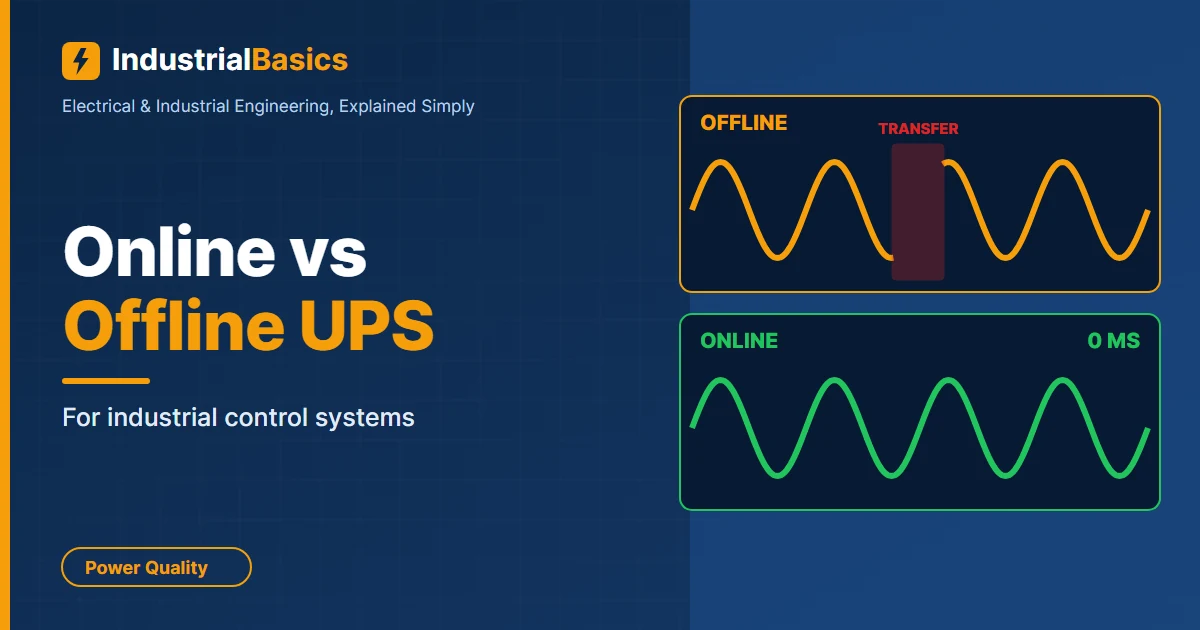
An offline UPS switches to battery only after the mains fails, while an online UPS feeds the load through its inverter all the time. For most industrial control systems, choose an online double-conversion UPS because there is no transfer gap in normal operation. An offline UPS is only suitable for a control panel if its power supply can ride through the transfer time with a real margin.
| Factor | Offline (standby) | Line-interactive | Online (double conversion) |
|---|---|---|---|
| IEC 62040-3 class | VFD | VI | VFI |
| Normal power path | Mains passes through | Mains with voltage regulation | Rectifier and inverter |
| Published transfer time | About 2–20 ms | About 2–10 ms | 0 ms in double conversion |
| Frequency correction | No | No | Yes |
| Efficiency | Highest | High | Lower |
| Cost | Low | Medium | High |
| Control system fit | Non-critical only, after testing | Light duty | Best fit |
How Offline and Online UPS Systems Work
An offline UPS keeps its inverter on standby. In normal operation, the load receives ordinary mains power, including most of its disturbances. When the mains goes out of tolerance, a transfer switch connects the inverter.
An online UPS converts incoming AC to DC and back to AC continuously. Because the load is always on the inverter, a mains failure causes no switch from mains to battery. The output voltage and frequency are also isolated from most supply disturbances. Our main guide to types of UPS covers all topologies in more depth.
Why Transfer Time Matters for Control Systems
A PLC or control system does not lose power the moment the AC disappears. Its power supply can hold up briefly, which is called ride-through or hold-up. The question is whether that time is longer than the UPS transfer.
Rockwell’s Compact I/O selection guide shows why this needs checking. Its 1769 power supplies list a minimum line-loss ride-through of 5 ms or 10 ms, depending on the model. Published offline UPS transfer times range from about 2 to 20 ms. A slower UPS could therefore outlast the guaranteed ride-through and reset the controller.
| UPS transfer (example) | Supply minimum ride-through | Result |
|---|---|---|
| 4 ms | 10 ms | Margin, confirm by test |
| 8 ms | 10 ms | Small margin |
| 8 ms | 5 ms | Reset risk |
| 20 ms | 10 ms | Reset risk |
| 0 ms (double conversion) | Any | No transfer gap |
Which UPS for Which Control Load?
| Load | Recommended approach |
|---|---|
| PLC, HMI and network in a production panel | Online UPS or a dedicated DC UPS |
| Process control with costly restart | Online UPS |
| Remote or noisy supply, generator backup | Online UPS |
| Non-critical monitoring PC | Offline or line-interactive may be enough |
| 24 V DC controls only | Consider a DIN-rail DC UPS |
| Large motors or drives | Do not simply add to a small control UPS |
For a 24 V control panel, a DIN-rail DC UPS can be a neat option because it protects the DC bus directly. Check what will happen to outputs and field devices during an outage: keeping the PLC alive does not help if its sensors or actuators lose power. Supply disturbances are covered further in our guide to power quality problems.
Worked Sizing Example
A control panel draws 600 W at a power factor of 0.9. Allow a 25% margin for growth and aging.
With 25% margin = 667 × 1.25 = 833 VA
Choose a UPS rated above about 833 VA, and confirm that its watt rating also covers 600 W plus the margin. Then size the runtime for what must happen during an outage, such as a controlled shutdown or the time until a generator starts. Include inrush from power supplies and coils in the check.
Commissioning Checklist
- Confirm the UPS class and operating mode.
- Compare transfer time with the control power supply’s ride-through.
- Check VA, watts and inrush.
- Decide which field devices must stay powered.
- Simulate a mains failure under real load.
- Confirm the PLC, HMI and network stay up.
- Wire a UPS alarm to the control system.
- Plan battery testing and replacement.
Frequently Asked Questions
What is an offline UPS?
An offline, or standby, UPS normally passes mains power to the load. When the mains fails, it switches the load to a battery-powered inverter.
What is the difference between online and offline UPS?
An online UPS always feeds the load through its inverter, so there is no mains-to-battery transfer gap. An offline UPS must switch over after the mains fails.
What is the transfer time of an offline UPS?
Published figures range from about 2 to 20 ms, depending on the product and source. Use the value in the datasheet for the exact model.
Is an offline UPS suitable for a PLC?
Only if the PLC power supply can ride through the transfer with margin at the real load. For critical control, an online UPS is the safer choice.
What do VFD, VI and VFI mean on a UPS?
They are IEC 62040-3 classes: VFD is voltage and frequency dependent, VI is voltage independent and VFI is voltage and frequency independent. Offline is VFD, line-interactive is VI and online is VFI.
Does an online UPS always have zero transfer time?
In normal double-conversion mode, yes. In ECO or bypass modes, a transfer can occur, so check how the UPS is configured.
Should motors or contactors run from a small UPS?
Check inrush first. Motor and coil loads can overload a small UPS, so size for them or keep them on a separate supply where the design allows.
Is an online UPS worth the extra cost?
For control systems where a reset causes downtime, scrap or a safety demand, it usually is. For non-critical loads, a simpler UPS may be enough.
Sources and Further Reading
- Industry Electronics: UPS Topologies: topology operation, classes and transfer time.
- SourceBySpec: Industrial UPS Guide: industrial duty, sizing and DC UPS options.
- Network-Switch: Offline vs Line-Interactive vs Online UPS: protection and transfer comparison.
- Paradyne: Online vs Line-Interactive vs Offline UPS: selection and sizing.
- Rockwell Automation: Compact I/O Selection Guide: power supply line-loss ride-through.



