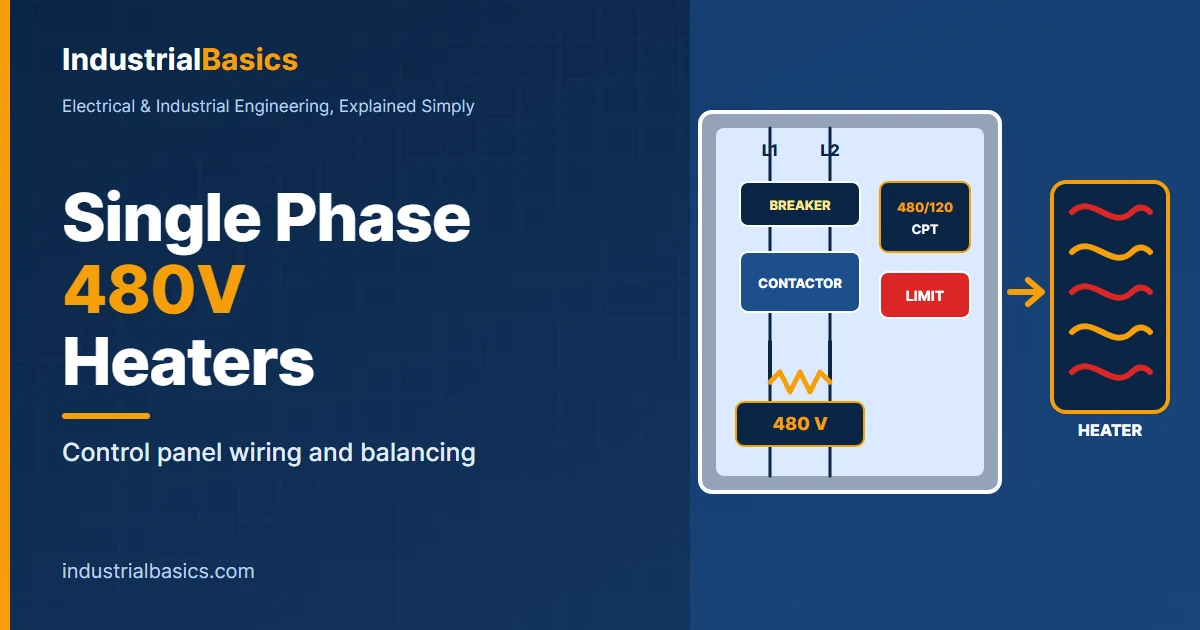
A 480 V single-phase heater is wired across two lines of a 480 V three-phase supply, for example L1 and L2. Both wires are live, so it needs a 2-pole disconnect, fuses or a breaker on both legs, and a contactor that opens both legs, usually driven from a 120 V control transformer. Current is simply watts ÷ 480: a 6 kW element draws 12.5 A. For larger loads, spread equal elements across A-B, B-C and C-A to balance the three lines.
| Heater watts | 480 V single phase | 480 V three phase, balanced |
|---|---|---|
| 1,000 W | 2.1 A | 1.2 A |
| 2,000 W | 4.2 A | 2.4 A |
| 5,000 W | 10.4 A | 6.0 A |
| 6,000 W | 12.5 A | 7.2 A |
| 10,000 W | 20.8 A | 12.0 A |
What “Single Phase 480” Means
A 480 V three-phase system has three lines. Any two of them give 480 V, so a single-phase heater rated 480 V connects between them. On a 480Y/277 V wye system there is also a neutral, but a heater from a line to neutral sees only 277 V. Tutco puts it plainly: on a wye system labelled V, a heater on one leg is subjected to V ÷ 1.732, while a heater across a leg of a 480 V delta sees the full 480 V.
So check the element rating before you choose the connection. A 277 V element goes line to neutral on a wye system; a 480 V element goes line to line. For the voltage relationships in more depth, see 3 phase calculations and wye-wye transformers.
Wiring the Heater in a Control Panel
- Disconnect: a 2-pole or 3-pole switch or breaker that opens both legs feeding the heater.
- Short-circuit protection: a fuse or breaker pole in each leg. Size it to the heater current and conductor, following your adopted code.
- Contactor: switches the heater. Tempco’s wiring diagrams show a contactor for single-phase circuits when line current exceeds the thermostat rating. A 3-pole contactor with two poles used is common.
- Control transformer: steps 480 V down to 120 V for the controller, limit device and contactor coil.
- Temperature controller: cycles the contactor, or drives a solid-state relay for faster switching.
- High-limit control: an independent, approved limit device that drops the contactor if the process overheats.
For the switching hardware itself, see contactor vs relay. For protecting the 480 to 120 V control transformer, read our transformer fuse guide.
Balancing Single-Phase Heaters on Three Phases
One single-phase heater loads only two lines. Tutco recommends heaters in multiples of three, connected in equal groups, so each pair of lines carries the same load. Three equal heaters across A-B, B-C and C-A form a balanced delta, and Tempco’s formula gives the line current: I = W ÷ (1.73 × E). Three 6 kW elements at 480 V draw 21.7 A per line instead of 12.5 A per heater.
Unequal connections leave one line carrying more than the others. With 6 kW on A-B and 6 kW on B-C and nothing on C-A, line B carries about 21.7 A while lines A and C carry 12.5 A. EC&M notes that unbalanced single-phase loads are a common cause of voltage imbalance in a facility, and that most equipment needs voltage imbalance below 2% for reliable long-term operation.
Line Current Calculator
The calculator adds the heater currents as phasors, so it gives the real current in each line for any mix of loads. Enter equal watts on all three pairs to see the balanced case.
Worked Example: 18 kW Tank Heater Bank
| Option | Connection | Line currents |
|---|---|---|
| One 18 kW, 480 V single-phase element | A-B only | A 37.5 A, B 37.5 A, C 0 A |
| Three 6 kW, 480 V elements | A-B, B-C, C-A | 21.7 A on each line |
| Three 6 kW, 277 V elements (wye) | A-N, B-N, C-N | 21.7 A on each line, neutral near zero if balanced |
The three-element version cuts the largest line current from 37.5 A to about 21.7 A and keeps the supply balanced. Tempco also notes that elements designed for delta drop to one third of their wattage if rewired in wye, so never change the connection without checking the element voltage.
Commissioning and Troubleshooting
- Lock out first. Follow your lockout/tagout procedure and prove both legs dead.
- Measure element resistance. Compare with R = V² ÷ W. A 6 kW, 480 V element works out to about 38 Ω. A reading far from the calculated value, or an open circuit, points to a failed element.
- Check a delta bank. Tutco gives R ÷ 1.5 between any two lines for three equal heaters, and R ÷ (1.5 × P) with P heaters in parallel per leg.
- Check insulation. A megger test to ground finds wet or damaged elements. See insulation resistance testing.
- Measure line currents with a clamp meter and compare with the calculator.
Frequently Asked Questions
What is single phase 480 V?
It is a load connected across two lines of a 480 V three-phase system. There is no 480 V single-phase utility service in most US buildings; the voltage comes from any two of the three phases.
How many amps does a 480 V single-phase heater draw?
Amps = watts ÷ volts. Tempco’s table gives 2.1 A for a 1,000 W heater and 10.4 A for 5,000 W at 480 V single phase.
Do I need a 2-pole breaker for a 480 V single-phase heater?
Yes. Both conductors are ungrounded, each 277 V to ground on a 480Y/277 V system, so the disconnect and protective device must open both legs.
Can I connect a 480 V heater between a phase and neutral?
No. On a 480Y/277 V system that gives only 277 V. Tutco notes that a heater on a wye leg sees V ÷ 1.732, so a 480 V element would make about a third of its rated power.
How do I balance single-phase heaters on a three-phase supply?
Use heaters in multiples of three and connect equal loads across A-B, B-C and C-A. The line current then equals total watts ÷ (1.73 × volts).
Can the heater thermostat switch 480 V directly?
Only if it is rated for it. Tempco shows contactor circuits for when the line current exceeds the thermostat rating, which is the normal panel arrangement.
Is the temperature controller enough to make the heater safe?
No. Tempco warns an integral thermostat is a temperature control only and not a fail-safe device. Use an approved temperature or pressure limit control.
How do I check heater wiring with a meter?
With power off and locked out, measure resistance. Tutco gives R ÷ 1.5 between any two lines for three equal heaters in delta, where R is one heater’s resistance.
Sources and Further Reading
- Tempco: Engineering Data, Wiring Information and Wiring Diagrams (pages 16-10 and 16-11): current table, formulas, wiring hints.
- Tutco: 3 Phase Power Systems and How to Know You Have Wired Them Correctly: delta and wye heater connections, resistance checks.
- EC&M: The Basics of Voltage Imbalance: imbalance limits and causes.