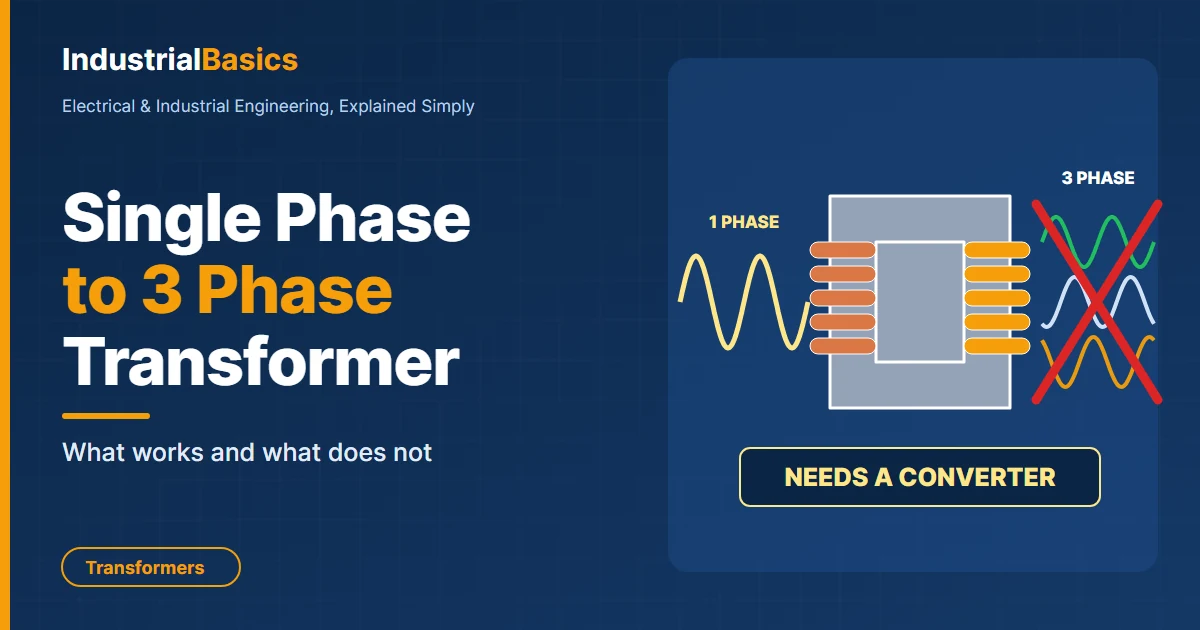
A transformer cannot convert a true single-phase supply into three-phase power. It can change voltage and current, but one input phase creates one alternating flux, so every output winding stays in phase. To get three-phase from single-phase, use a phase converter or a suitable VFD. Open delta and Scott-T transformer connections are often mentioned, but both need more than one input phase.
| Method | Input needed | Output | Creates 3-phase from 1-phase? |
|---|---|---|---|
| Ordinary transformer | Single-phase | Single-phase | No |
| Open delta (V-V) | Three-phase | Three-phase at reduced capacity | No |
| Scott-T | Three-phase or two-phase | Two-phase or three-phase | No |
| Rotary phase converter | Single-phase | Three-phase | Yes |
| VFD with single-phase input | Single-phase | Three-phase motor output | Yes, for a motor |
Why a Transformer Cannot Create a Phase
A transformer works by mutual induction. The input winding produces an alternating magnetic flux, and that flux induces a voltage in the output winding. With a single-phase input, there is only one flux waveform. Add more windings and you get more voltages, but they are all in phase with that one flux or exactly opposite to it.
A three-phase system needs three voltages 120° apart. Something must create that time shift, and a passive transformer on a single input cannot. Our guide to types of transformers explains the basic operation, and the transformer vector group guide shows how three-phase windings produce phase shifts when three phases are already present.
Open Delta: Two Transformers, Three Phases
An open delta, or V-V, connection uses two single-phase transformers to serve a three-phase load. It often leads people to think that a transformer can create the missing phase. It cannot: the bank is connected to a three-phase source.
| Bank | Calculation | Three-phase capacity |
|---|---|---|
| Two 300 kVA units | √3 × 300 | 520 kVA |
| Share of combined rating | 520 ÷ 600 | 86.6% |
| Versus three 300 kVA units | 520 ÷ 900 | 57.7% |
To size an open delta bank, the combined transformer rating must be about 115% of the load. A 100 kVA three-phase load needs 100 ÷ 0.866 = 115.5 kVA total, or at least 57.7 kVA per transformer.
Scott-T Transformers
A Scott-T connection uses a center-tapped main transformer and a teaser transformer with a ratio of √3/2, or about 86.6%. It converts between three-phase and two-phase, with the two-phase outputs 90° apart.
Two-phase is not the same as ordinary single-phase. A Scott-T needs two separate voltages already 90° apart to produce three-phase, so it does not solve the problem on a normal single-phase service.
What Actually Works
| Solution | Best for | Limit |
|---|---|---|
| Rotary phase converter | Several motors or a workshop | Idler motor runs and adds losses |
| VFD | One motor needing speed control | Check the drive’s single-phase rating |
| Static phase converter | One light, fixed-speed motor | Reduced motor output |
| Utility three-phase service | Large or permanent loads | Installation cost and availability |
Our comparison of the static phase converter, rotary converter and VFD covers these options in detail. If the load needs a different voltage, a transformer can then be added after a true three-phase source.
Worked example: 5 HP motor at home
You have a 240 V single-phase supply and a 5 HP, 230 V three-phase motor. A 240:480 V transformer will not help, because its output is still single-phase. Instead, a suitable VFD or rotary converter creates the three-phase supply for the motor. Check the converter or drive rating against the motor’s full load amps and the load.
Common Misconceptions
| Claim | Reality |
|---|---|
| “A three-phase transformer can make three phases from one.” | Its core does not create the missing phases |
| “Open delta runs on single phase.” | It is fed from a three-phase source |
| “A Scott-T converts ordinary single phase.” | It works between three-phase and two-phase |
| “Two hot legs are two phases.” | A 120/240 V split-phase service is still single-phase |
| “A center tap creates three-phase.” | It only gives voltages in phase or 180° apart |
If your supply is 208 V from two legs of a wye, see our guide to 208 single phase. For line and phase calculations, use our electrical 3 phase calculations guide.
Frequently Asked Questions
Can a transformer convert single phase to 3 phase?
No. A transformer alone cannot create three-phase power from a true single-phase supply. It can only change voltage and current. You need a phase converter or a suitable VFD.
What converts single phase to three phase?
Common options are a rotary phase converter, a digital phase converter, a static converter for light motor starting duty, or a VFD for a single motor.
Does an open delta transformer work on single phase?
No. An open delta uses two transformers, but it is fed from a three-phase source.
Can a Scott-T transformer make three phase from single phase?
The Scott-T connection converts between three-phase and two-phase, with outputs 90° apart. It does not create three-phase from one ordinary single-phase supply.
What is the capacity of an open delta bank?
It is about 86.6% of the two transformers’ combined rating, or 57.7% of an equivalent three-transformer delta bank. Two 300 kVA units supply about 520 kVA.
Can I connect a three-phase transformer to single phase?
That will not produce a true three-phase output. If a three-phase transformer is used on a single-phase circuit, its usable capacity is reduced, so ask the manufacturer.
What is the 57.7% rule?
It compares an open delta bank with the same bank closed in delta. With one of three transformers removed, the remaining two can carry about 57.7% of the original capacity.
Can a transformer step up the voltage from a phase converter?
Yes. Once a true three-phase supply exists, a three-phase transformer or bank can change its voltage.
Sources and Further Reading
- HD Transformer: Three-Phase to Single-Phase Transformer Guide: limits of transformers and converter alternatives.
- Voltage Disturbance: Open Delta Transformer: source, capacity and worked example.
- Wikipedia: Scott-T Transformer: connection, ratio and two-phase output.