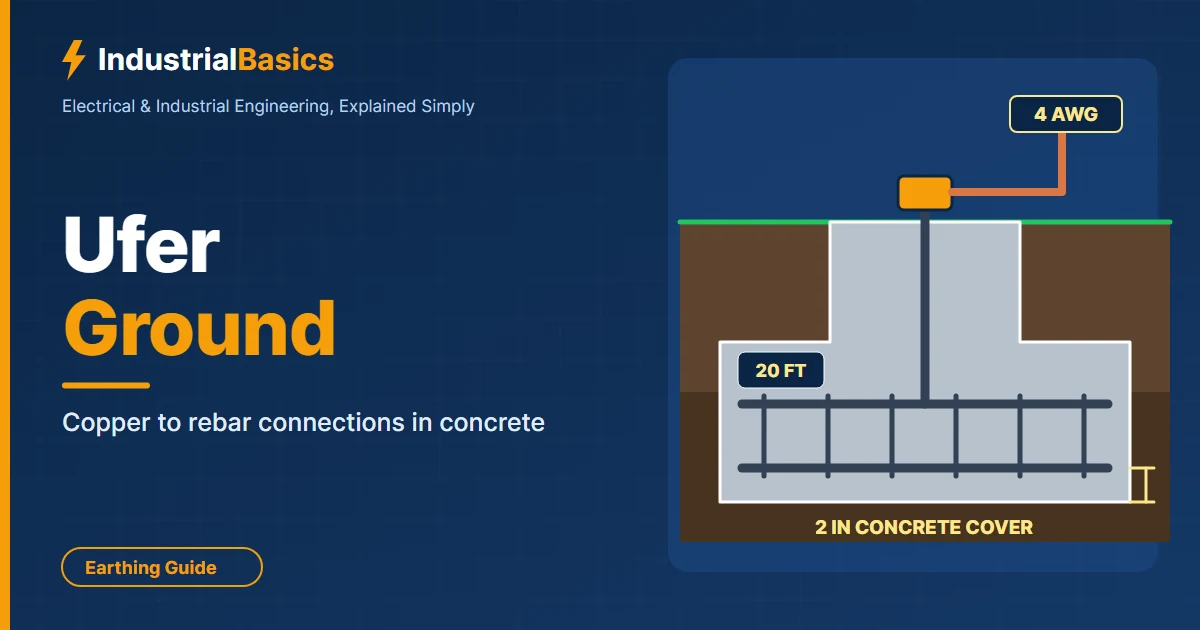
A Ufer ground is a concrete-encased grounding electrode: at least 20 ft of ½ in. rebar or 4 AWG bare copper, inside at least 2 in. of concrete that is in direct contact with the earth. It is covered by NEC 250.52(A)(3). Connect copper to the rebar with a listed clamp or exothermic weld. The part of the grounding electrode conductor serving only the Ufer does not need to be larger than 4 AWG copper.
| Requirement | Rebar electrode | Copper electrode |
|---|---|---|
| Minimum length | 20 ft | 20 ft |
| Minimum size | ½ in. (#4) | 4 AWG bare copper |
| Surface | Bare, zinc-galvanized or conductive coating | Bare |
| Concrete cover | At least 2 in. | At least 2 in. |
| Location | Footing or foundation in direct earth contact | Footing or foundation in direct earth contact |
How a Ufer Ground Works
Concrete in contact with soil provides a large contact area with the earth. Embedding the electrode in that concrete turns the building’s foundation into part of the earthing system. The name comes from Herbert G. Ufer, who is associated with its development during World War II work at military sites in Arizona.
If you are new to the terminology, our guide to earthing vs grounding explains how these terms are used.
What Qualifies as a Ufer Ground
| Situation | Qualifies? | Why |
|---|---|---|
| 20 ft of bare ½ in. rebar in a footing | Yes | Meets length, size and encasement |
| Several tied bars totaling 20 ft | Yes | Bars may be joined by tie wire, welding or another effective means |
| 20 ft of 4 AWG bare copper in a footing | Yes | Copper option |
| Zinc-galvanized rebar | Yes | Conductive coating |
| Ordinary epoxy-coated rebar | No | Coating is insulating |
| Footing isolated by a continuous barrier | No | No direct earth contact |
| Rebar with less than 2 in. of cover | No | Does not meet encasement |
Where a qualifying concrete-encased electrode is present, it forms part of the grounding electrode system under NEC 250.50. If a building has several, only one needs to be connected. In an existing building, rebar that cannot be reached without disturbing the concrete is generally treated differently, so ask the local authority.
Copper to Rebar Connections
| Method | Use | Check |
|---|---|---|
| Listed rebar clamp | Common for stub-ups | Listed for the rebar and conductor size |
| Direct-burial or encasement-rated clamp | Connections in concrete or earth | Marked for that location |
| Exothermic weld | Permanent connection | Correct mold and procedure |
| Irreversible compression | Permanent connection | Listed connector and correct tool |
| Hose clamp or unlisted part | Do not use | Fails inspection |
- Identify the rebar that forms the 20 ft electrode.
- Confirm the bars are continuous through ties or another effective means.
- Bring out a stub-up, or plan a connection point before the pour.
- Select a connector listed for both the rebar and conductor size.
- Keep any accessible clamp protected and available for inspection.
- Route the copper conductor to the service and protect it from damage.
Sizing the Grounding Electrode Conductor
Start with NEC Table 250.66. Section 250.66(B) then sets a cap: the part of the conductor that goes only to the concrete-encased electrode is not required to be larger than 4 AWG copper. The cap does not make a smaller table size larger.
| Service conductor (copper) | Table 250.66 GEC | To Ufer only |
|---|---|---|
| 2 AWG | 8 AWG Cu | 8 AWG Cu |
| 1/0 AWG | 6 AWG Cu | 6 AWG Cu |
| 3/0 AWG | 4 AWG Cu | 4 AWG Cu |
| 350 kcmil | 2 AWG Cu | 4 AWG Cu |
| 500 kcmil | 1/0 AWG Cu | 4 AWG Cu |
| Over 1100 kcmil | 3/0 AWG Cu | 4 AWG Cu |
Example: a service with 500 kcmil copper conductors has a Table 250.66 GEC of 1/0 AWG copper. A conductor running only to the Ufer can be 4 AWG copper. If that same conductor continues on to a water pipe electrode, the 4 AWG limit no longer applies to the section feeding it.
Ufer Ground vs Ground Rod
| Factor | Ufer ground | Ground rod |
|---|---|---|
| Installed | Before the concrete pour | Can be added later |
| Length in contact | At least 20 ft | Rod length |
| Supplemental electrode | Not required for a single compliant electrode | A single rod may need one |
| GEC limit | 4 AWG copper | 6 AWG copper |
| Main risk | Missed before the pour | Poor soil contact |
The rules for conductors connected to other electrodes are explained in our ground wire size chart and Table 250.66 guides.
Frequently Asked Questions
What is a Ufer ground?
It is a concrete-encased grounding electrode. Rebar or bare copper inside a footing or foundation uses the concrete’s contact with the earth to form a grounding electrode.
What are the NEC requirements for a Ufer ground?
NEC 250.52(A)(3) calls for at least 20 ft of ½ in. or larger rebar, or 4 AWG or larger bare copper, encased in at least 2 in. of concrete that is in direct contact with the earth.
What size wire goes to a Ufer ground?
Start with Table 250.66. The part of the conductor that serves only the concrete-encased electrode is not required to be larger than 4 AWG copper, and smaller table sizes still apply.
How do you connect copper to rebar?
Use a connector listed for the purpose, such as a listed rebar clamp, or an exothermic weld. If it will be buried in concrete, it must be suitable for encasement.
Can epoxy-coated rebar be used for a Ufer ground?
No. The rebar must be bare, zinc-galvanized or have another electrically conductive coating. Ordinary epoxy coating does not qualify.
Does a vapor barrier stop a Ufer ground from working?
A continuous barrier that isolates the concrete from the earth can disqualify it. A perimeter footing in contact with soil may still qualify, so evaluate the actual construction.
Does a Ufer ground need a ground rod too?
A single compliant concrete-encased electrode does not need a supplemental rod under the NEC guidance reviewed here. Local rules can add requirements.
Why is it called a Ufer ground?
It is named after Herbert G. Ufer, the engineer associated with its development during World War II work at military sites in Arizona.
Sources and Further Reading
- ExpertCE: Concrete-Encased Electrode Rules in NEC 250.52: requirements, conductor cap and history.
- Anvilfield: Ufer Ground Field Guide: field checks, GEC sizing and clamps.
- Conversions Tech: Ufer Ground Requirements: rebar types, stub-ups and connections.
- NFPA fact sheet, Grounding and Bonding: Using the Tables in Article 250 of the NEC: Table 250.66 and electrode limits.